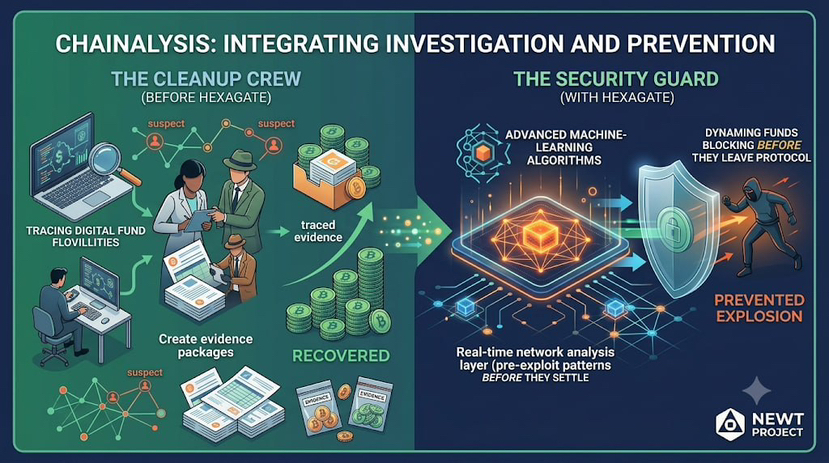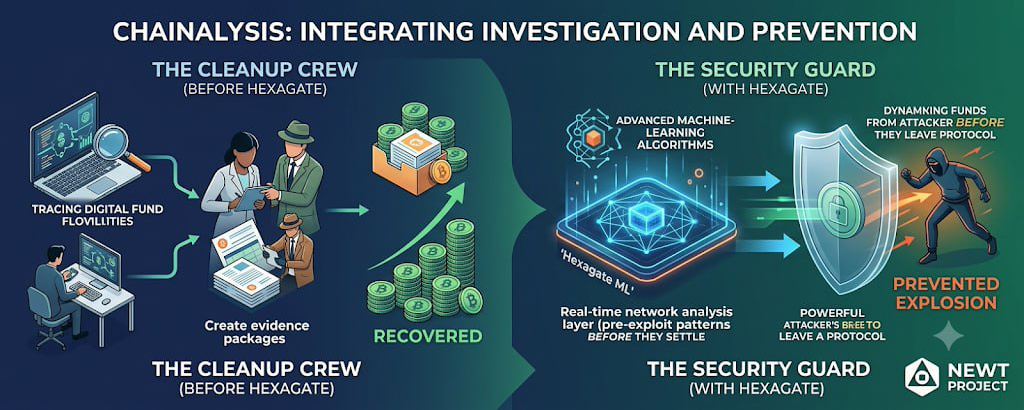
Chainalysis built the most credible investigative capability in crypto over roughly a decade of consistent, unglamorous work. When a protocol got exploited, a bridge got drained, a ransomware operator cashed out, Chainalysis was usually somewhere in the chain of events that followed. Its analysts helped trace funds across hundreds of wallets, identified choke points where stolen crypto passed through exchanges that could freeze it, and produced evidence packages that law enforcement in more than seventy countries have used to successfully prosecute cases. The result is a public claim that Chainalysis's work contributed to recovering more than ten billion dollars in stolen or illicitly moved crypto, which is a real number, not a marketing approximation.
But ten billion dollars recovered means ten billion dollars that was already stolen. Every single recovery story in that number began with a successful attack, a drained wallet, a shocked team posting a post-mortem while the attacker's funds were already moving through mixers and bridges. Chainalysis's forensics are applied after the fact by design. That's not a criticism of how the company was built, it's an accurate description of what the investigation model is capable of. You can't trace funds that haven't moved yet, and until Hexagate, there wasn't a mature enough real-time detection layer to credibly promise stopping the movement before it happened.
The Hexagate acquisition changed that, and I think the acquisition itself is the clearest signal Chainalysis could have sent about how the industry's security posture needs to evolve. Hexagate's machine-learning models are trained on the kind of behavioral patterns that precede an exploit, not just the patterns that follow one. They look for conditions that historically appear in the block or two before a flash loan manipulation, a price oracle attack, or a governance exploit, and they act before settlement rather than after it. Catching more than 98 percent of known hacks before they happen, across a customer list that includes Coinbase, Aave's core contributor BGD Labs, Uniswap, Polygon, and EigenLayer, is a track record built in production, not in a lab.
Newton's decision to route its security domain through Hexagate rather than building its own threat detection from scratch reflects a clear-eyed reading of how hard the detection problem actually is. Training a machine learning model that can distinguish a legitimate flash loan from the opening move of an exploit requires years of adversarial data, constant iteration as attacker tactics evolve, and the kind of institutional knowledge that accumulates slowly and can't be approximated by hiring smart engineers and starting fresh. Hexagate has that knowledge base. An AVS built in eighteen months doesn't. The acquisition by Chainalysis extends Hexagate's data advantage, because now the investigation records from Chainalysis's decade of forensics, the after-the-fact paper trails of every attack that was eventually traced and documented, can feed back into Hexagate's detection models in ways that improve what the real-time blocking catches next time.
What this partnership signals for Newton's institutional users is something beyond a feature checklist. Every compliance or risk committee evaluating whether to trust Newton's security domain will eventually ask who is responsible for keeping the threat detection current, what happens when a new attack vector emerges that the model hasn't seen before, and whether there's an organization with the resources and the operational depth to respond quickly enough for a block to happen before funds move rather than after. Hexagate inside Chainalysis is a more credible answer to those questions than any novel in-house detection system Newton could have shipped in time for mainnet beta.
The remaining open question is whether the detection lead Hexagate has built remains durable as it operates inside a larger organization. Acquisition by a company that built its reputation on investigation creates an obvious cultural and organizational tension with a product whose value proposition is prevention. Investigation and prevention reward different instincts, move at different speeds, and optimize for different outcomes. How well Hexagate's detection model evolves inside Chainalysis, whether it continues improving at the pace it did as an independent team, is something that will only become clear over the next several years of production. For Newton, it's the kind of risk that a signed partnership agreement doesn't resolve and that a due diligence review can't fully surface. It lives in organizational culture, and culture is the thing outside documents never fully capture, which is why the early production record under Chainalysis ownership matters more than any announcement about the acquisition's strategic rationale.