
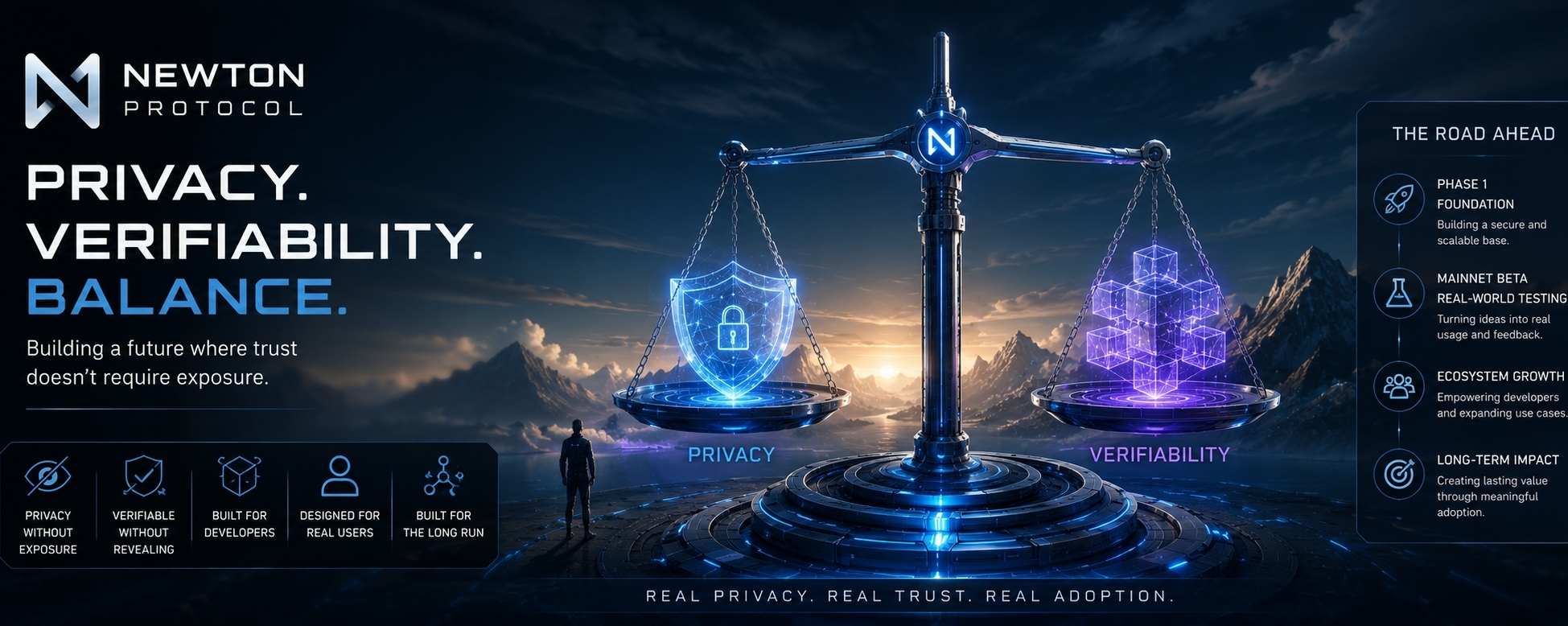

After spending years following the crypto industry, I've learned that first impressions rarely tell the whole story. Every market cycle brings projects with fresh ideas and ambitious goals. Some gradually prove their value, while others quietly fade from the conversation. Because of that, I've stopped judging projects by their launch announcements and started paying more attention to what happens after they begin operating in real-world conditions. That's the mindset I'm bringing to Newton Protocol as it approaches Phase 1 and the Newton Mainnet Beta.
What caught my attention isn't a promise of changing everything. It's the question the project appears to be exploring. Most public blockchains were designed around transparency. Wallet activity, transactions, and on-chain interactions are generally visible to anyone willing to look. That openness has helped build trust across decentralized networks, but I've often wondered whether the same approach remains practical as blockchain technology reaches more users and different types of applications.
For developers, businesses, and everyday users, complete transparency isn't always ideal. There are situations where people may want to prove something is valid without revealing every detail behind it. That's where Newton Protocol's use of zero-knowledge proofs becomes interesting to me. The idea is to verify information while limiting unnecessary exposure, aiming to balance privacy with the ability to validate activity on the network. From a technical perspective, it's a thoughtful direction that tries to address a genuine challenge rather than simply adding another feature.
That said, I've also seen enough projects to know that a good concept doesn't automatically become a widely used product. Crypto history is full of examples where promising technology struggled once it reached real users. Sometimes the experience was too complicated. Sometimes developers found it difficult to build with. In other cases, the problem being solved wasn't important enough for people to change their existing habits. Even well-designed systems can face obstacles that aren't obvious during the planning stage.
To me, that's what makes the Newton Mainnet Beta particularly interesting. This is where ideas begin meeting practical reality. It's an opportunity to see how the network performs, how developers interact with it, and whether privacy-focused features fit naturally into real applications. Those observations will likely be more meaningful than early expectations or initial excitement.
I also think it's worth asking a broader question. Privacy is discussed frequently across the blockchain industry, but it's still unclear how much it influences everyday user decisions. People often value convenience, and if privacy tools introduce additional complexity or friction, adoption may not be as straightforward as many expect. Whether that balance can be achieved is something only real usage can demonstrate.
At this stage, I see Newton Protocol as a project exploring an important question rather than offering a guaranteed answer. That's enough to keep it on my watchlist, but not enough to draw firm conclusions. As Phase 1 begins and the Newton Mainnet Beta develops, I'll be more interested in practical results than bold narratives. In the end, the real measure of success won't be early attention—it will be whether Newton Protocol can remain useful and relevant once the curiosity surrounding its launch has passed.