
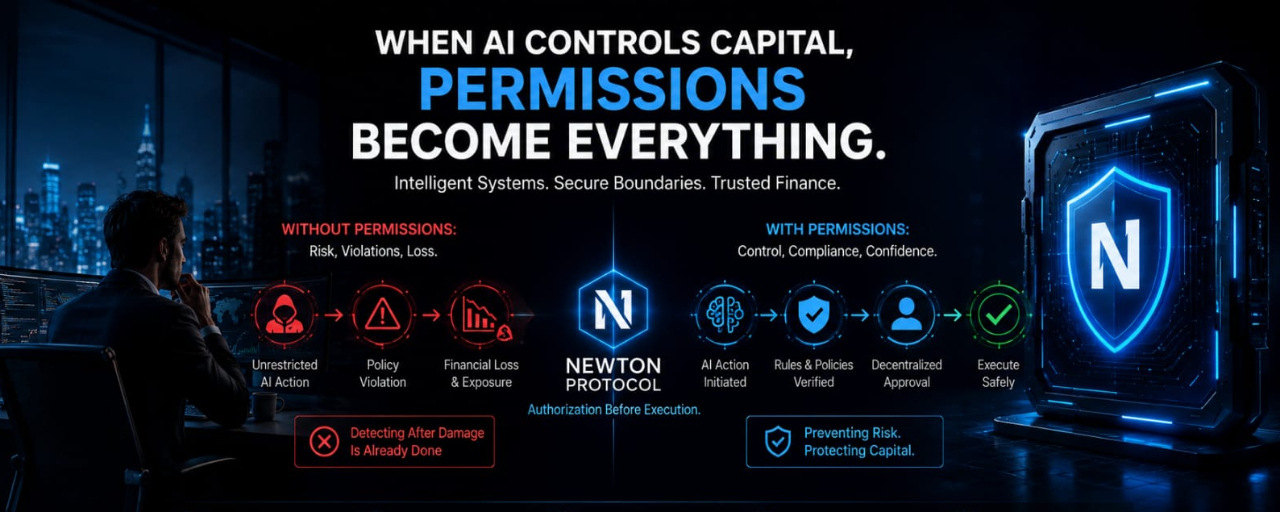
Everyone talks about AI in finance like intelligence is the main thing that matters.
Smarter models. Faster execution. Better decision-making.
I think that framing misses something important.
The second AI gets direct access to capital, the conversation changes.
At that point, raw intelligence stops being the most interesting part.
Control becomes the real issue.
And that’s where things start getting serious.
We’re moving toward a system where AI agents can manage wallets, move funds, execute trades, allocate treasury capital, and interact with markets in real time. No delay. No hesitation. Just execution happening at machine speed.
From the outside, it sounds like progress.
More efficiency. Sharper decisions. Faster markets.
But speed without boundaries creates its own problems.
That’s the part people still don’t talk about enough.
I don’t think the biggest risk is some evil AI suddenly turning hostile.
That’s the dramatic version people like to imagine.
The more realistic threat is much simpler.
An AI system making decisions with too much freedom and too little restraint.
That alone is enough to create serious damage.
An AI doesn’t need malicious intent to become dangerous.
Sometimes all it takes is authority without limits.
One flawed decision. One bad execution path. That’s enough.
A wallet interacts with the wrong protocol.
Capital moves into a restricted jurisdiction.
A transaction crosses limits it shouldn’t.
Compliance rules get violated.
And because everything happens so fast, humans usually realize the problem after the damage is already done.
That’s the uncomfortable reality of machine-speed finance.
Traditional finance has friction built into it.
People often complain about that friction because it slows things down.
But friction was never just inefficiency. In many cases, it was protection.
It created checkpoints. Time to review. Time to intervene.
AI-driven systems remove much of that friction.
That improves execution.
It also removes layers of protection people barely notice until they’re gone.
This is why permissions matter so much.
More than most people realize.
The real question isn’t just whether an AI can execute.
It’s whether it should be allowed to execute under certain conditions.
What can it access?
What rules does it operate under?
Where do the boundaries exist?
That’s what trust in autonomous finance will be built on.
Not just intelligence.
Reliable behavior.
Controlled execution.
Clear limits.
That’s exactly why @NewtonProtocol stands out to me.
What Newton is building feels important because it focuses on something AI finance desperately needs: authorization before execution.
Simple idea.
Big implications.
Before capital moves, transactions should pass through programmable rules and risk checks.
Not after execution.
Before it.
That difference matters a lot.
Most systems today focus on monitoring. They observe activity, detect problems, and trigger alerts once something goes wrong.
But alerts after execution don’t really protect capital.
They tell you what happened.
They don’t stop it.
And in onchain markets, reacting late can be costly.
Newton introduces an authorization layer between transaction intent and execution.
Every action gets evaluated against predefined rules—compliance requirements, risk thresholds, jurisdiction restrictions, spending limits, internal policies.
If the action satisfies those rules, execution moves forward.
If not, it stops immediately.
No funds moving. No panic. No damage control.
That changes the model entirely.
Because the future of AI in finance shouldn’t be about removing human control altogether.
It should be about embedding human judgment directly into execution systems.
Humans define the boundaries.
AI operates inside them.
That feels far more sustainable.
Not unlimited autonomy.
Not blind automation.
Just intelligent systems operating inside trusted guardrails.
And I think that’s where this market is heading.
As AI becomes deeply integrated into finance, intelligence alone won’t be enough to stand out.
Eventually, everyone will have access to strong models.
That won’t be the differentiator.
What will matter more is trust.
Reputation will matter.
Control will matter.
Security will matter.
The systems that win may not be the ones moving the fastest.
They may be the ones people trust most with capital.
Because once AI controls capital, freedom without boundaries stops looking like innovation.
It starts looking like risk.
#Newt $NEWT @NewtonProtocol @Binance BiBi
