
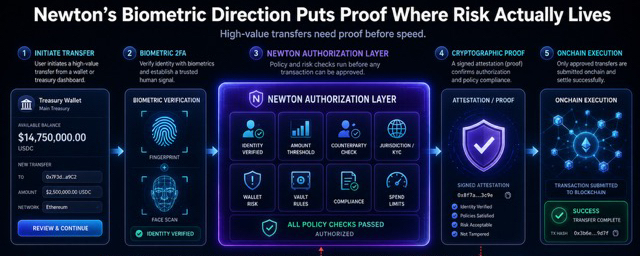

I used to think biometric 2FA was mostly about keeping the wrong person out of an app.
A face scan. A fingerprint. A small pause before access is granted. It feels familiar now, almost automatic. Most of us barely think about it anymore. The phone asks, we look at the screen, and we move on.
But the longer I watch how value moves through crypto systems, the less convinced I am that login security is where the real battle happens.
The dangerous moment is not always when someone opens a wallet. The dangerous moment is when a transaction is allowed to pass.
That difference matters.
When a small amount is moving, speed feels natural. Nobody wants to fight through five checks to send a routine payment. But high-value transfers are different. A vault reallocation, a treasury withdrawal, a large onchain movement, or a regulated asset transfer should not be treated like a casual wallet action. At that level, the system needs to ask a harder question: is this specific action allowed under the rules right now?
That is the part of Newton’s design I keep coming back to.
Newton is not interesting to me because it adds another layer of friction. Friction is easy. Anyone can slow users down. What matters is whether the extra step actually proves something useful before funds move. Newton’s model sits closer to the transaction path, where a policy can check the action before execution. Not after. Not in a dashboard later. Before.
I find that important because a lot of crypto security still feels like watching the replay after the damage is done. We analyze wallets. We study flows. We write threads about what should have happened. By then, the money is already gone.
Prevention is less dramatic, but it is more honest.
This is where biometric verification starts to look different. I do not see it as a shiny login trick. I see it as one possible proof inside a larger decision. For a high-value transfer, maybe the system should confirm that the person behind the action matches a verified identity. Maybe it should check whether that identity is still valid. Maybe it should look at the jurisdiction, the counterparty, the amount, and the policy limits before anything reaches final execution.
That does not mean every transfer needs a face scan.
Actually, I think that would be a mistake.
Security controls lose power when they are used carelessly. If users are forced to approve everything with the same level of friction, they stop thinking. They click through. They treat the warning like background noise. A better system should know when proof matters most. Small actions can stay light. Large or unusual actions should carry more evidence.
That is the balance I like in this idea: proof where the risk deserves it.
Newton’s identity work with Veriff points toward that direction. The useful part is not exposing personal data onchain. That would be reckless. A public blockchain is not the place for someone’s private identity details, and it is definitely not where biometric information should leak. The better approach is narrower: keep sensitive information offchain, then provide the result needed for the transaction decision.
In plain language, the contract does not need to know your face. It needs to know whether the required identity check passed.
That is a very different privacy posture.
I have seen people talk about onchain identity as if more visibility automatically means more trust. I do not buy that. More visibility can also mean more permanent exposure. The goal should not be to drag private information into public view. The goal should be to prove only what the transaction needs to know, and nothing more.
That is why Newton’s privacy model matters here. If biometric verification becomes part of high-value authorization, the system has to separate the proof from the person’s raw data. Otherwise, the cure creates a new wound.
The recent VaultKit work makes the whole concept easier to picture. A curator managing a vault should not be able to change sensitive settings or move funds simply because they are generally trusted. Trust is too broad. Permission needs to be tied to the exact action.
This instruction.
This vault.
This amount.
This moment.
That level of specificity is where many systems fall apart. They rely on reputation, broad approvals, or manual oversight. I understand why. It is simpler. It feels practical. But when the money is real and the movement is fast, vague permission becomes a quiet liability.
I prefer systems that make permission narrow.
A biometric check can fit into that, but only if it is attached to the action itself. Not just the app session. Not just the device. The transfer.
That is the part I think people should pay attention to. A face scan before opening an interface is useful, but it does not automatically prove that a $5 million transaction should go through. A biometric check tied to a policy decision is more meaningful because it becomes part of the approval logic.
For institutions, this matters even more. A fund or treasury team cannot simply say, “We use 2FA,” and expect that to answer every serious risk question. Who approved the transaction? Was the identity valid? Did the action fit the mandate? Was the destination allowed? Did the amount cross a threshold? Was the policy checked before execution?
Those are the questions that matter when something goes wrong.
And something always goes wrong eventually.
The broader Newton ecosystem shows that identity is only one part of the stack. Risk checks, sanctions screening, wallet reputation, vault health, price data, collateral intelligence, and proof-of-humanity signals can all matter depending on the transaction. I like that because it keeps biometric verification in its proper place. It is not magic. It is not a complete security model by itself. It is a signal.
A strong signal, maybe.
But still only one signal.
That distinction keeps the conversation grounded. I do not think biometric 2FA should be sold as a cure for DeFi risk. It cannot fix weak policies. It cannot make stale identity data accurate. It cannot protect a system if the rules are badly written. Newton can make authorization more verifiable, but someone still has to design the rules with care.
That is the part many people skip.
Infrastructure can enforce a policy. It cannot make a lazy policy wise.
So when I look at Newton’s biometric direction, I see both promise and caution. The promise is clear: high-value transactions can require stronger proof before they move. The caution is just as clear: if teams treat biometrics like a branding layer instead of a serious authorization input, they will miss the point.
The best version of this is quiet. It does not need to shout. It simply asks the right questions before execution.
Is this the right person?
Is this the right action?
Is this the right amount?
Is this the right destination?
Is this allowed under the policy right now?
For small transfers, maybe the answer comes quickly. For high-value transfers, I want the system to slow down just enough to prove the action belongs.
That is not inefficiency.
That is discipline.
And in crypto, discipline before execution is worth far more than a perfect explanation after the loss.