
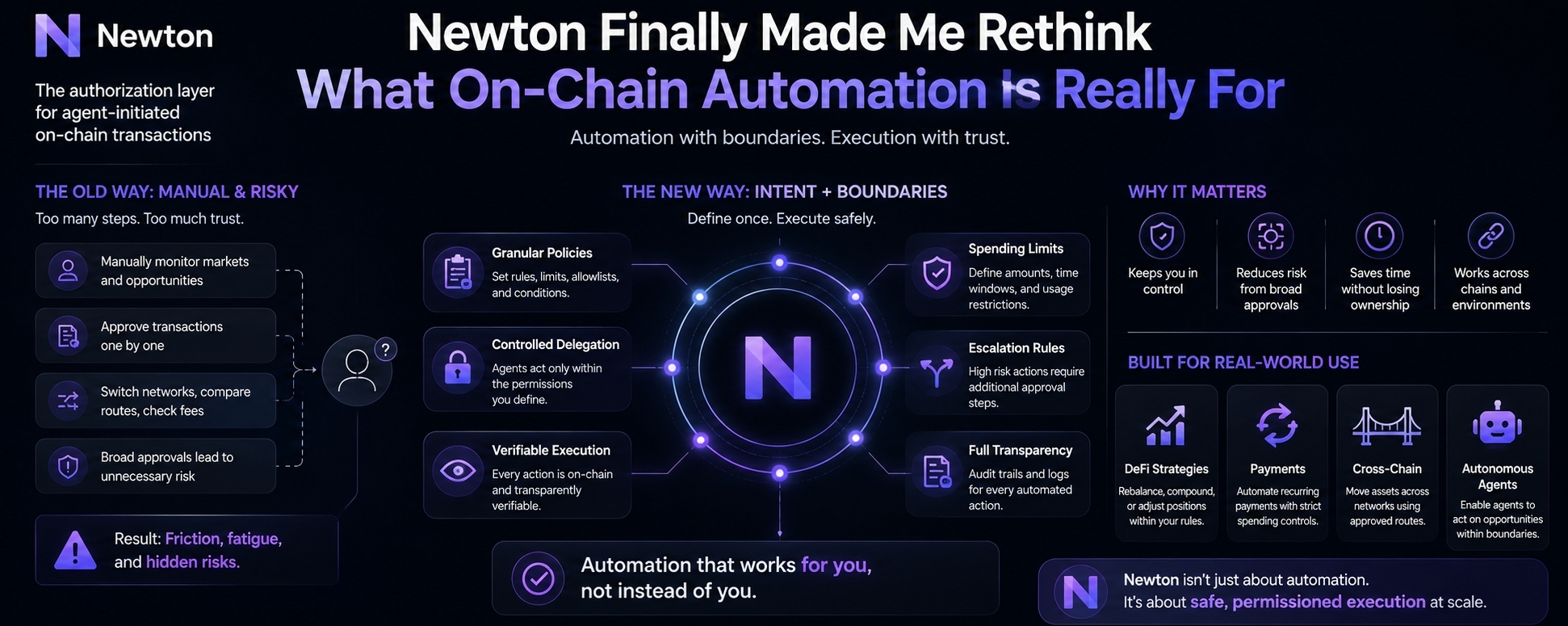
I’ve been thinking about Newton because it made me look again at something I usually took for granted in blockchain infrastructure: the idea that automation is just a convenience layer. At first, it is easy to place Newton in that category because it deals with agents, permissions, and actions that can happen without a user manually signing every single step. But the more I sit with it, the more I see the project as part of a deeper infrastructure question: how can a blockchain system let someone delegate activity without turning that delegation into blind trust?
That question feels very real to me because most on-chain experiences still ask users to behave like operators. Move assets here. Approve this contract. Check this route. Watch this transaction. Switch this network. Confirm this action. Revoke that permission later if you remember. None of these steps is strange on its own, but together they create a kind of mental load that never really disappears. Blockchain ownership can become exhausting when every small action requires direct supervision.
Newton is interesting because it seems to start from a different assumption. Instead of expecting users to manually manage every interaction, it asks what kind of infrastructure is needed for delegated action to be safe, limited, and verifiable. That is a subtle shift, but I think it matters. The project is not just about letting automated agents do things on-chain. The more important part is creating a structure around what those agents are allowed to do.
I find that distinction important because automation without boundaries can quickly become uncomfortable. If a system can act for me, I need to know where its authority begins and where it ends. I may be fine with an agent moving funds under a specific condition, but not with giving it open-ended control. I may want it to execute a transaction when fees are reasonable, but not if the route changes into something riskier. I may want it to manage a recurring action, but only inside a policy I understand.
That is where Newton’s focus on authorization becomes meaningful. Authorization sounds like a dry technical word, but in practice it is the heart of the problem. It is the difference between saying “do whatever is needed” and saying “you may do this specific thing, under these specific conditions, and the result should be checkable.” In blockchain systems, that difference is not cosmetic. It is the line between convenience and control.
I keep comparing it to giving someone a spare key versus giving them a one-time access code. Both allow another party to act, but the risk is completely different. A spare key is broad authority. A one-time access code is limited authority. A good automation system should feel closer to the second example. It should help users delegate narrow permissions instead of forcing them to choose between doing everything manually or trusting a black box.
This is why Newton feels like a project built around coordination more than simple automation. Blockchains are already good at recording what happened. The harder part is connecting intent to execution in a way that remains understandable. A user does not always want to think in transactions. They often think in outcomes. They want a position adjusted, a transfer completed, a task handled, or an action triggered when the right conditions appear. Newton’s role becomes interesting because it tries to give that kind of intent a safer path into on-chain execution.
That also connects to the larger issue of fragmentation. Blockchain activity is not one smooth environment. It is many networks, wallets, applications, liquidity sources, and execution paths stitched together. From the outside, people may talk about “using crypto” as if it is one activity, but in practice the user is often jumping between disconnected systems. Every jump creates friction. Every approval creates risk. Every manual decision becomes another place where something can go wrong.
Newton’s project direction matters here because agent-based execution and permissioned automation could reduce some of that coordination burden. Not by pretending the complexity disappears, but by handling more of it through rules the user has already approved. That is a healthier kind of abstraction. It does not need to hide everything. It needs to make the important boundaries clear enough that users can step back without losing control.
For developers, this kind of infrastructure could also change how applications are designed. Right now, many teams have to build around the limits of manual signing and fragmented execution. They either make users approve every action, which creates friction, or they move more logic into centralized services, which creates trust assumptions. Newton points toward a third path where developers can design workflows around delegated permissions that are more structured and easier to verify.
That does not make the design problem easy. In some ways, it makes it more serious. Once automation becomes part of the core experience, small details matter a lot. How broad is the permission? How long does it last? Can the user cancel it easily? What happens if conditions change? What happens if an execution path fails halfway through? What proof exists that the agent followed the original instruction? These are not secondary questions. They are the questions that decide whether people can rely on the system.
I like looking at Newton through that lens because it avoids the usual shallow conversation around agents. A lot of people hear “agents” and immediately think about speed, convenience, or futuristic interfaces. But the more grounded question is about responsibility. An agent that can act on-chain needs limits. It needs a framework. It needs verification. Otherwise, it is just another powerful tool asking users to trust it.
Newton’s value as a project is easier to understand when seen as infrastructure for controlled delegation. It is not simply trying to remove clicks from the user journey. It is trying to make delegated execution more precise. That matters because the future of blockchain activity probably cannot depend on users signing every small action forever. At the same time, it also cannot depend on users handing full authority to invisible systems. The useful middle ground is permissioned automation that can be inspected and constrained.
This is also where decentralization becomes more practical than philosophical. Decentralization is not only about where validators are located or how many nodes exist. It is also about whether users keep meaningful authority as systems become easier to use. If better user experience comes at the cost of hidden control, then something important has been lost. Newton is interesting because it works directly inside that tension.
The project makes me think that the next stage of blockchain infrastructure may be less about raw execution and more about safe coordination. The industry has spent years improving throughput, reducing fees, and building faster networks. Those things matter, but they do not solve everything. A fast system can still feel difficult if the user has to coordinate every step alone. A cheap transaction can still be risky if the permission behind it is too broad. A smooth interface can still be dangerous if it hides too much authority.
Newton focuses attention on the parts that are easier to overlook: permissions, policies, execution boundaries, and verification. These are not the loudest parts of infrastructure, but they are often the parts that decide whether a system can grow responsibly. When more activity becomes automated, the quality of authorization becomes just as important as the quality of execution.
I think that is why Newton made me rethink my original assumption. Automation is not something that simply gets added after the serious infrastructure is finished. In a multi-network, agent-driven environment, automation becomes part of the serious infrastructure itself. It shapes how users express intent, how developers build workflows, and how networks prove that actions happened within the right limits.
What stays with me is that Newton is not interesting because it makes blockchain systems sound more advanced. It is interesting because it deals with a very ordinary but difficult problem: how to let systems help us without letting them quietly take over too much. That problem exists in many areas of technology, but it becomes sharper on-chain because permissions can move real value.
The more I think about it, the more I believe reliable infrastructure will be judged less by how much it promises and more by how calmly it handles complexity. Newton brings attention to that quieter side of blockchain design. Speed, scale, and automation will always get attention, but the systems that matter over time are usually the ones that define authority clearly, execute within limits, and keep working correctly even when users are no longer watching every step.