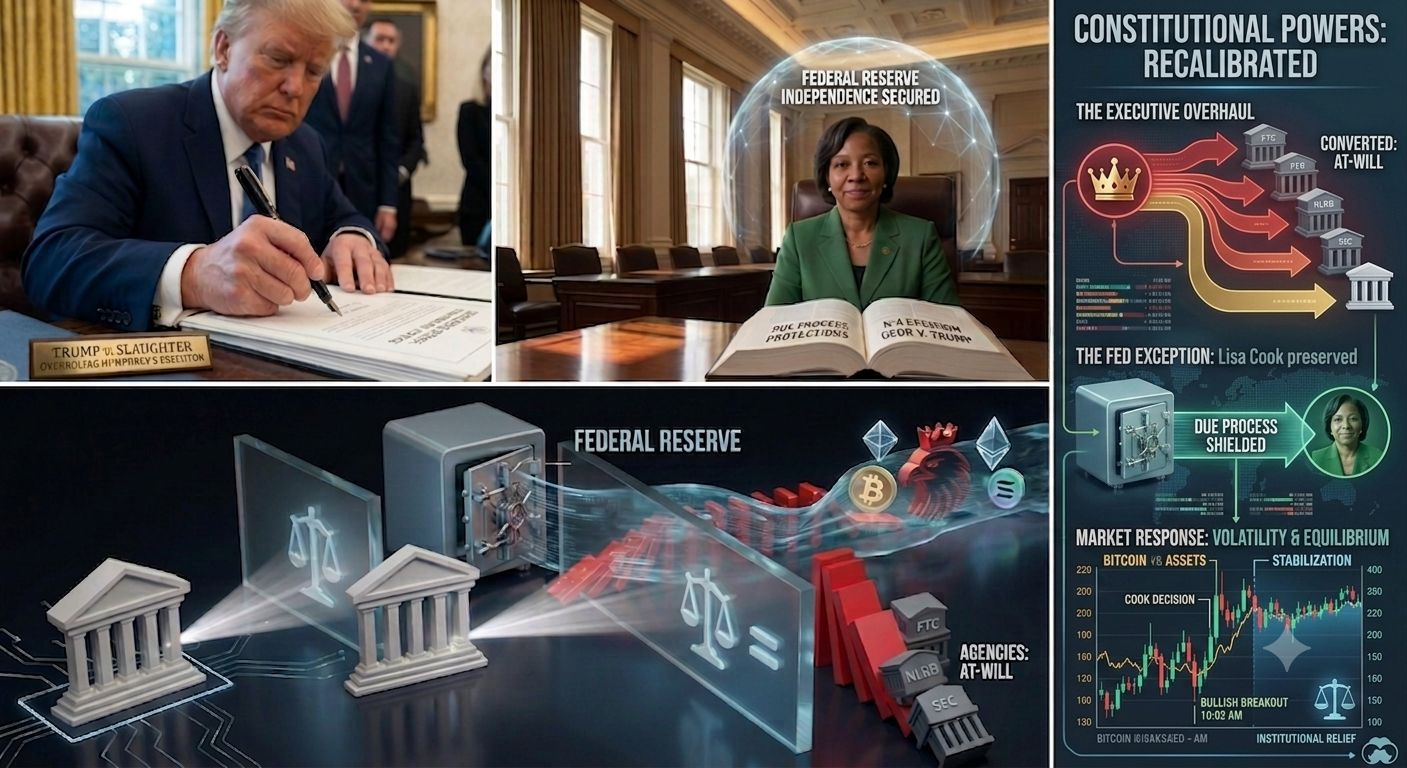
In a pair of landmark constitutional rulings, the U.S. Supreme Court has fundamentally reshaped the architecture of American governance. The high court significantly expanded presidential authority over the federal bureaucracy while drawing a strict, critical line to preserve the political independence of the nation’s central bank.
⚡ 1. The Executive Overhaul: Reversing Century-Old Precedent
In a 6–3 decision split precisely along ideological lines, the conservative majority handed a historic victory to the executive branch by dismantling nearly a century of legal doctrine.
🏛️ The Core Ruling: The Court explicitly overturned the 91-year-old bedrock precedent Humphrey’s Executor (1935).
💼 The Impact: The ruling strips away historical "for-cause" job protections for the heads of independent regulatory agencies (such as the FTC, NLRB, and SEC).
📉 The Reality: Thousands of top federal regulators and independent civil servants have essentially been converted into "at-will" employees. The President now possesses the unilateral constitutional authority to fire them at any time, for any reason.
Chief Justice John Roberts, writing for the majority, noted that independent agencies exercising executive authorities violate the structural separation of powers if their leaders cannot be held directly accountable by the Chief Executive.
🏦 2. The Federal Reserve Exception: The Defense of Lisa Cook
While the broader administrative state was opened to swift executive removals, the Federal Reserve successfully weathered the storm in a separate, razor-thin 5–4 decision.
🛡️ The Core Ruling: Chief Justice John Roberts and Justice Brett Kavanaugh broke ranks with fellow conservatives, joining the three liberal justices to legally block the immediate firing of Federal Reserve Governor Lisa Cook.
📱 The Dispute: The administration had sought to abruptly dismiss Cook—the first Black woman to serve on the Fed's board—via a social media decree based on unproven personal allegations. Cook maintained the move was a manufactured pretext to punish her for refusing to bow to political pressure regarding interest rates.
⏳ The Impact: The Court ruled that the administration completely failed to afford Cook the statutory procedural due process she was legally owed to contest the charges. This decision reinforces that Fed governors—who serve staggered 14-year terms—cannot be unceremoniously removed at the whim of the White House.
⚖️ Economic & Legal Takeaways.
⬇️
🏦 Federal Regulatory Agencies
Immediate Legal Outcome: 🔴 Lost "for-cause" job protection. These agencies are now vulnerable to immediate restructuring.
Future Outlook: Sweeping policy shifts are likely as agency leadership is expected to align tightly with the White House.
🏛️ The Federal Reserve System
Immediate Legal Outcome: 🟢 Immediate independence has been preserved. Fed Governor Lisa Cook remains in office.
Future Outlook: Long-term vulnerability remains. The ruling provides a clear legal roadmap for removals if proper, rigorous procedural due process is utilized in the future.
📈 Financial Markets
Immediate Legal Outcome: 🟡 The markets experienced brief volatility followed by quick stabilization.
Future Outlook: Wall Street breathed a sigh of relief. Monetary policy remains insulated from direct, immediate political mandates.
⚠️ The Legal Caveat: Legal scholars warn that because the Federal Reserve's shield was upheld largely on procedural rather than absolute constitutional grounds, the long-term boundaries of central bank independence will remain a highly contested legal battleground.
#OilPriceFalls #TRUMP #Binance #cryptouniverseofficial #BTC走势分析