@NewtonProtocol I've been paying pretty close attention to AI in crypto lately, and honestly, one thing keeps bothering me.
Every few days there's another project showing off an AI agent that can supposedly trade better, hunt for yield, rebalance portfolios, or automate some complicated DeFi strategy. The demos usually look slick. The promises sound huge.
But here's the thing...
Almost nobody spends enough time talking about what happens after the AI makes a decision.
Who actually secures the execution?
People don't talk about that enough.
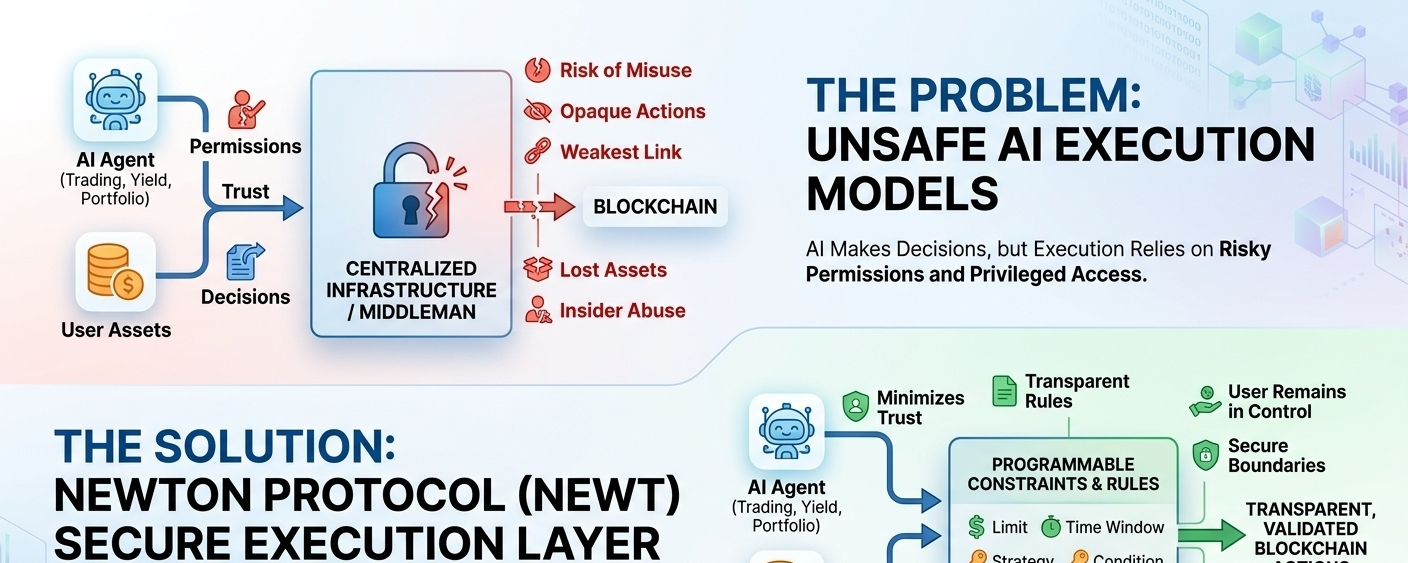
Because let's be real. An AI can make the smartest trading decision in the world, but if the way it executes that decision depends on risky permissions, hidden backend systems, centralized infrastructure, or trust that nobody can verify, you've still got a problem. Maybe an even bigger one.
At this point, I don't think intelligence is the hardest challenge anymore.
Safe execution is.
That's exactly why Newton Protocol caught my attention.
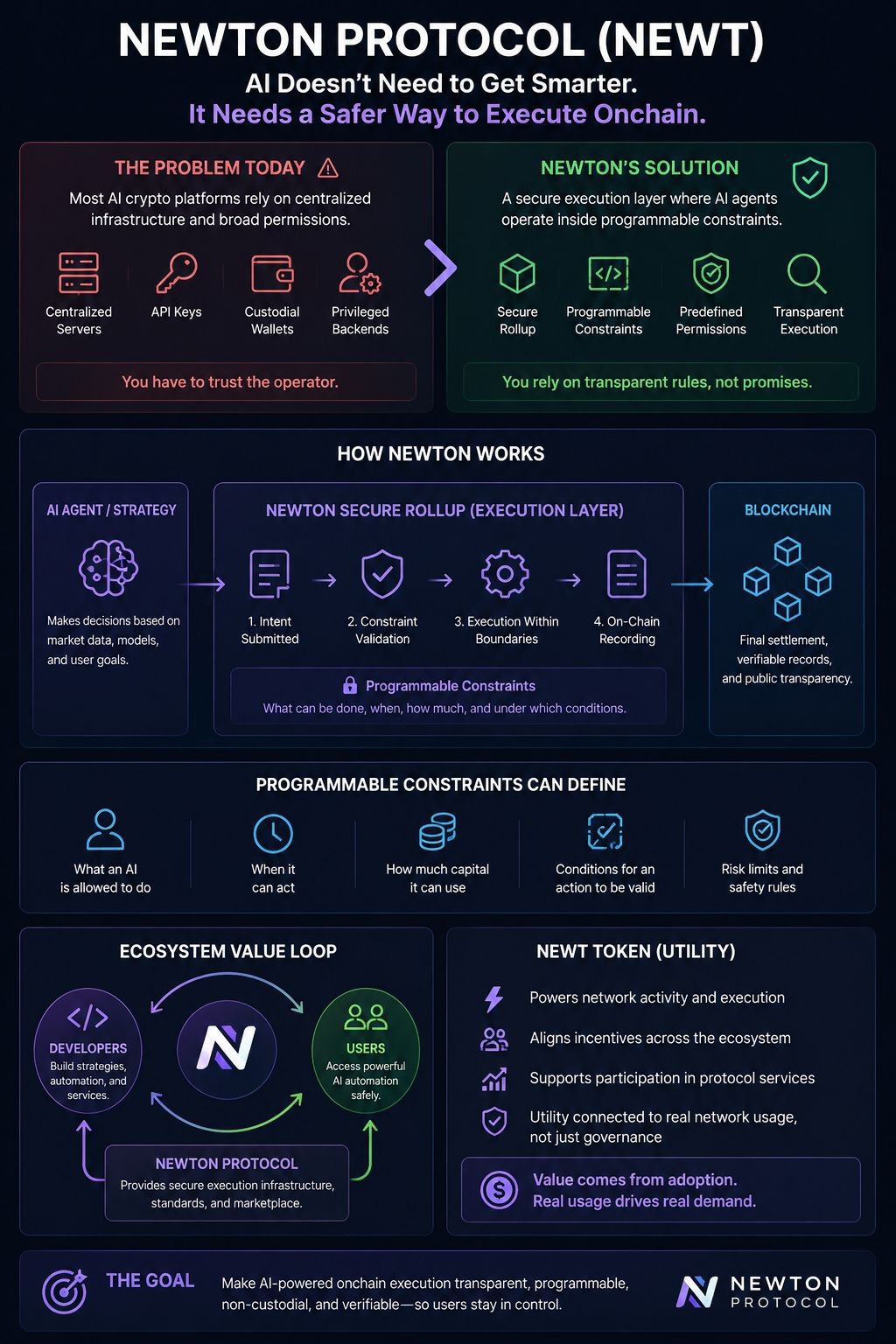
Instead of trying to build yet another AI assistant or compete in the race for bigger language models, Newton focuses on something I think matters a lot more right now. It's building a secure execution layer where AI-driven strategies can interact with blockchains inside programmable security boundaries.
That might sound like a small distinction.
I don't think it is.
Most projects keep asking one question:
"How do we make AI smarter?"
Newton asks a completely different one.
"How do we let AI execute financial actions safely while users stay in control?"
To me, that's the more interesting problem.
Look around at today's AI-powered crypto tools. A surprising number of them still depend on centralized servers, API keys, custodial wallets, or backend systems with privileged access. In other words, they ask you to trust whoever runs the platform. You trust they won't abuse permissions. You trust their infrastructure won't get compromised. You trust their automation won't suddenly do something you never intended.
I've seen this story before.
And crypto has, too.
The industry has already learned some painful lessons about trusting intermediaries. Exchange collapses. Bridge hacks. Stolen private keys. Insider abuse. Opaque execution. Over the past several years, users have lost billions of dollars because someone sitting between them and the blockchain became the weakest link.
The blockchain often wasn't the problem.
The middleman was.
That's where Newton takes a different approach.
The protocol builds around a secure rollup that acts as an execution environment for AI agents and automated strategies. Instead of handing an AI unlimited authority over your assets and hoping everything works out, Newton keeps execution inside predefined programmable constraints.
That changes everything.
Those constraints can specify exactly what an AI can do, when it can act, how much capital it can use, and which conditions have to exist before any action becomes valid.
Now you're not relying on someone's promises.
You're relying on transparent rules that blockchain infrastructure enforces.
That's a very different security model.
Sure, it sounds technical. But the real-world impact is pretty easy to understand.
Imagine an AI agent managing your portfolio.
Most traditional systems ask you for exchange API keys, wallet permissions, or credentials that stay active until you revoke them. If someone steals those credentials—or if the platform misuses them—the damage can happen fast.
Newton starts from a different idea.
Don't give AI unlimited authority in the first place.
Simple.
Permissions become programmable.
Execution stays constrained.
Security becomes part of the protocol instead of something developers bolt on later.
I think that's a meaningful shift in how AI automation should work inside decentralized finance. One thing I also like about Newton is that it isn't only thinking about the technology. It's thinking about the people who actually use it.
And honestly, that's where a lot of crypto projects stumble.
Some build great tools for developers, but nobody shows up to use them. Others chase users with flashy products but never give developers a real reason to stick around. You end up with one side waiting for the other, and nothing really takes off.
Newton seems to be trying to avoid that trap.
The idea is to create a loop where both sides benefit.
Developers can build AI strategies, automated execution logic, or specialized services that run inside Newton's secure infrastructure. Instead of worrying about building payment systems, earning trust from scratch, or figuring out how to distribute everything themselves, they can spend their time building automation that people actually want to use.
That matters.
Because good developers usually want to solve technical problems, not rebuild an entire business around every product they create.
Users benefit too.
They get access to increasingly sophisticated AI automation without needing to understand every line of code behind it. They don't have to write smart contracts or sit in front of charts all day looking for opportunities. They can simply use AI-powered strategies that already operate within predefined execution rules.
That's a healthier setup.
Developers have a way to monetize useful work.
Users get better tools.
The protocol becomes the layer connecting everyone instead of competing with them.
Healthy networks usually grow like that. Everyone has a reason to participate.
Another piece that stands out to me is transparency.
People criticize AI all the time for being a black box, and honestly, I get it. You ask a model to do something, it gives you an answer, and half the time you can't really see why it made that decision.
Blockchain can't magically explain every thought process inside an AI more.