

Newton Protocol has been sitting in my tabs for a while now, the kind of tab you don’t close because you feel like you should understand it properly before moving on. I’ve been through enough cycles at this point—DeFi summer, NFT mania, GameFi experiments that never quite became games, modular chain everything, and now AI agents suddenly becoming the new narrative gravity. So when something like this shows up claiming to sit at the intersection of AI execution and crypto infrastructure, my first instinct is not excitement. It’s more like quiet suspicion mixed with curiosity I can’t fully shut off.
The core claim is actually simple, even if the framing is dense. Newton Protocol is trying to make AI-driven automation safe enough to use in financial systems by embedding rules directly into execution. Not as an afterthought, not as monitoring, but as part of the action itself. That idea is not new in spirit. Every cycle has had its version of “we bring trust on-chain.” But the way they’re structuring it is slightly different, or at least they say it is.
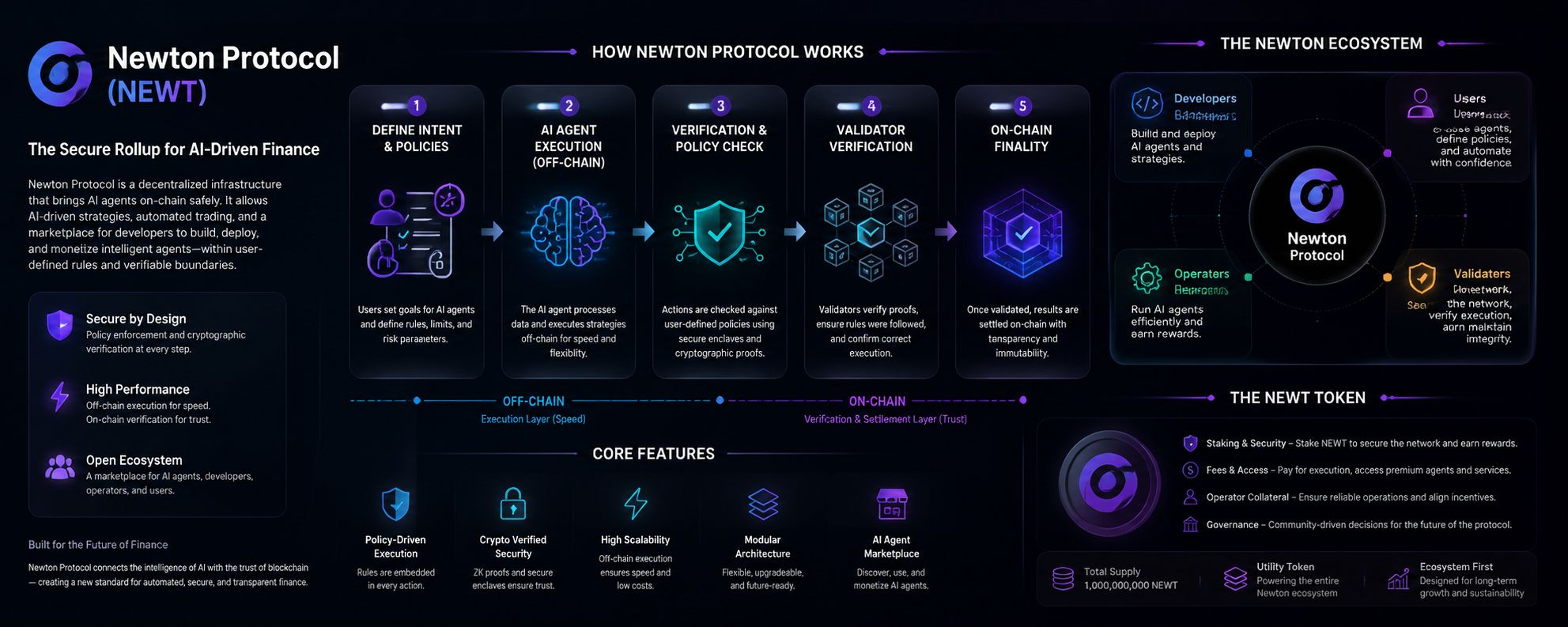
The mental model they’re pushing is this: users define intent, not transactions. So instead of manually executing trades or interacting with protocols step by step, you define what you want an AI agent to do within constraints. Risk limits, behavioral boundaries, allowed environments. Then an agent executes off-chain because obviously it has to—no blockchain today is running real AI workloads at scale. But the key part is that execution is not trusted blindly. It is checked, verified, and only finalized if it matches the original policy.
On paper, this is the familiar split we’ve seen before: off-chain speed, on-chain settlement. I’ve seen this pattern in rollups, in MEV systems, in all kinds of “modular” narratives. So I find myself asking: what is actually new here, and what is just re-labeled architecture?
The answer, if I’m being honest late at night after reading too many docs, is that the novelty is less in the components and more in the framing of “policy as a first-class primitive.” Instead of smart contracts directly defining behavior, they’re trying to elevate rules into something that travels with AI agents across execution environments. It’s like saying: don’t just deploy logic, deploy guardrails that survive movement.
But then the skeptic in me immediately reacts. Because we’ve seen “agent frameworks” before. We’ve seen automated trading layers. We’ve seen intent-based systems. Each time, the gap between theoretical safety and real adversarial environments has been where things quietly break.
The architecture they describe leans heavily on a familiar hybrid structure. AI agents run off-chain where computation is cheap and flexible. Verification happens through cryptographic methods and controlled execution environments before anything is finalized on-chain. This is the part where I pause, because this is also where many systems quietly rely on assumptions that are hard to stress test early. Secure enclaves, proof systems, validator honesty—these are all fine until scale introduces weird edge cases that no whitepaper paragraph really captures.
Still, I can see why they chose this path. If you try to force AI execution fully on-chain, you hit a wall immediately. Cost, latency, compute constraints—it just doesn’t work. So off-chain execution is not optional, it’s mandatory. The real question is whether the verification layer is strong enough to meaningfully constrain behavior without becoming a bottleneck or a centralized checkpoint disguised as decentralization.
Then there’s the marketplace angle. Developers build agents, operators run them, users select them, validators secure them. It’s a structure that feels almost modular in itself, like roles in a distributed machine. I’ve seen similar “multi-role ecosystems” before, and they often look elegant in diagrams and slightly messier in reality once incentives start interacting.
The NEWT token sits inside this system as the coordination layer. Staking, access, incentives, governance—standard list. Nothing surprising there. At this point in crypto history, tokens are almost always described as alignment mechanisms, and sometimes they actually are. Other times they’re just the gravity well around which activity gets described after the fact.
What I keep coming back to, though, is not the token or even the architecture in isolation. It’s the assumption that AI agents will become persistent financial actors inside crypto systems. That assumption feels both obvious and still under-validated at the same time. Yes, agents will exist. Yes, they will trade, optimize, and execute. But whether users will trust them with meaningful capital under strict automated policies is still not something we’ve seen proven at scale.
If I try to strip away the narrative layers, what remains is a system trying to answer a very specific question: how do you let machines act in financial environments without turning control into either chaos or centralization?
And the uncomfortable part is that there is no clean answer yet. Every design choice is a compromise. Off-chain execution introduces trust assumptions. On-chain enforcement introduces cost and rigidity. Policy frameworks introduce complexity that users may not fully understand. Even the idea of “verifiable behavior” becomes blurry once strategies become adaptive and AI-driven.
Metrics matter here, but not the usual ones people tweet about. Not price action, not hype cycles. The real signals, if this ever matures, will be much quieter. Whether agents actually get reused instead of replaced. Whether failures decrease over time instead of accumulating unnoticed edge cases. Whether users keep delegating control after experiencing real market volatility. Whether the system still behaves predictably when incentives are under stress rather than in ideal conditions.
Those are not easy things to measure early, and I suspect most of the current “traction metrics” in this space will look meaningful right up until they don’t.
I don’t think Newton Protocol is pretending to have solved all of this. At least not from what I can see. But I also don’t fully trust any system that feels like it’s trying to sit at the intersection of AI autonomy and financial enforcement without eventually hitting contradictions. That tension is still unresolved across the entire industry, not just here.
So where does that leave it?
Somewhere between interesting and unfinished, which is honestly where most serious infrastructure ideas live for a long time before they either fade or harden into something real. I’ve seen enough cycles to know that most things that matter don’t feel complete early. But I’ve also seen enough cycles to know that most things that sound like they should matter never actually survive contact with real usage.
Newton Protocol is still in that ambiguous space where both outcomes are possible. And maybe that’s the most honest way to leave it for now—without forcing certainty where there isn’t any yet.