

I keep noticing that decentralization is often discussed in terms of validators, consensus, or token distribution. Yet one of the easiest places for centralization to quietly emerge is much simpler: the component responsible for routing requests. If every interaction depends on a single gateway, that gateway can become a bottleneck—or worse, a censorship point.
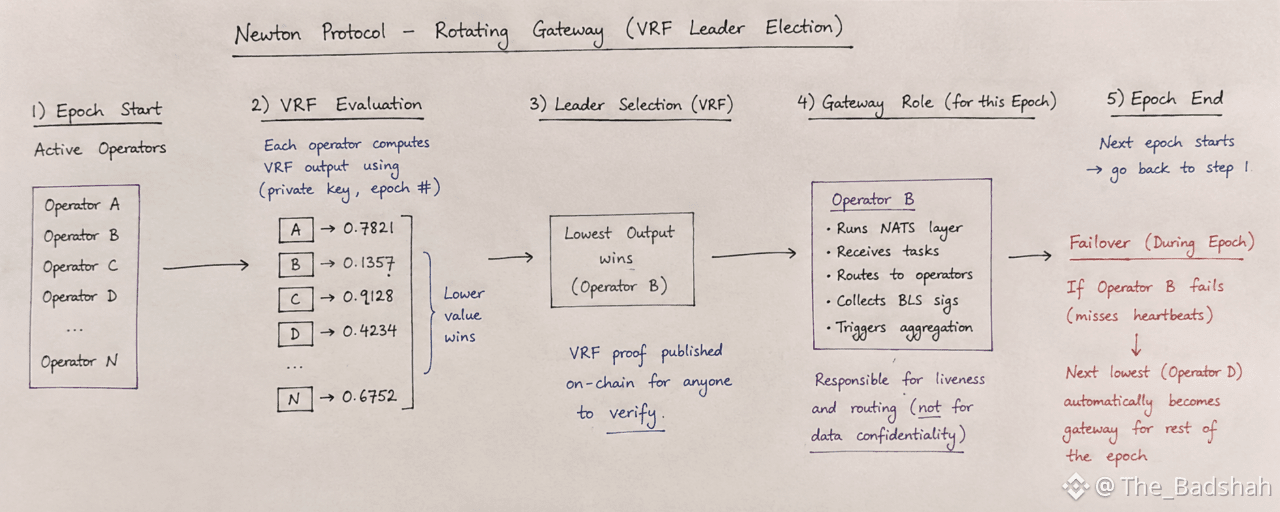
That is why Newton Protocol's rotating Gateway model caught my attention. Instead of assigning one operator to permanently receive and coordinate requests, the role changes every epoch through a Verifiable Random Function (VRF). Every operator generates a VRF output using its private key and the current epoch number, and the operator with the lowest verifiable output becomes the Gateway for that period. More importantly, the proof is published on-chain, allowing anyone to verify that the selection happened fairly rather than trusting a central coordinator.
I think of it like hosting a community meeting. If the same person always controls the microphone, they can decide who gets to speak. But if the moderator is selected randomly before every meeting—and everyone can independently verify the selection—it becomes much harder for any individual to consistently influence the conversation. The power to coordinate still exists, but it never stays in one place long enough to become permanent.
This design delivers three properties that work together. First is unpredictability. Because no one knows who will become the next Gateway before the epoch changes, planning targeted denial-of-service attacks becomes significantly more difficult. Second is unbiasability. Operators cannot manipulate the selection process without sacrificing their own opportunity to be chosen, making the election economically and cryptographically fair. Third is verifiability. Since every VRF proof is publicly checkable, the network doesn't have to rely on assumptions about honest behavior—it can confirm the result mathematically.
What I find equally important is what happens when things go wrong. If a selected Gateway stops publishing heartbeats, Newton doesn't wait for governance proposals or manual intervention. Every operator already knows the ranking of valid VRF outputs, so the operator with the next-lowest result automatically assumes the role for the remainder of the epoch. That kind of deterministic failover improves resilience without introducing additional coordination overhead.
The censorship-resistance story becomes much stronger because of this architecture. A permanent Gateway could become the perfect pressure point for regulators, attackers, or any entity seeking to block specific requests. In Newton's model, however, routing authority is temporary by design. Even if one Gateway behaves maliciously or comes under external pressure, its influence lasts only until the next rotation. Combined with the protocol's broader push toward decentralized validation, the system reduces the risk of any single participant becoming a lasting point of control.
For me, that's the bigger takeaway. Newton Protocol isn't treating censorship resistance as a slogan—it is designing operational roles so that control is always moving, always verifiable, and never concentrated for long. As decentralized infrastructure evolves, will resilience depend more on stronger cryptography, or on designing systems where no single participant stays in control long enough to become indispensable?
@NewtonProtocol #Newt $NEWT $RIF $VELVET