
I've spent enough time around crypto to become suspicious whenever a project leads with the letters "AI." Maybe that's unfair, but after watching cycle after cycle of teams attaching artificial intelligence to almost anything they could tokenize, I learned to separate the narrative from the actual problem being solved. Most of the time, once the excitement fades, there isn't much left underneath.
That's partly why Newton Protocol caught my attention. Not because of the AI angle, but because I found myself thinking about a problem that doesn't get discussed nearly as often as people think it should.
Everyone seems excited about the idea of autonomous systems managing money. AI agents trading markets, reallocating portfolios, chasing yield, managing treasury assets. The assumption is usually that if the software is smart enough, the rest takes care of itself. I don't see it that way. Every time I hear someone talk about AI handling larger pools of capital, my first thought isn't what the system can do. It's what happens when it gets something wrong.
I've seen enough mistakes in this industry to know they don't have to come from bad intentions. Sometimes a strategy fails because conditions change. Sometimes a model reaches the wrong conclusion. Sometimes a perfectly rational decision ends with a terrible outcome. Money doesn't care whether the mistake came from a human or a machine.
That's where Newton started making more sense to me.
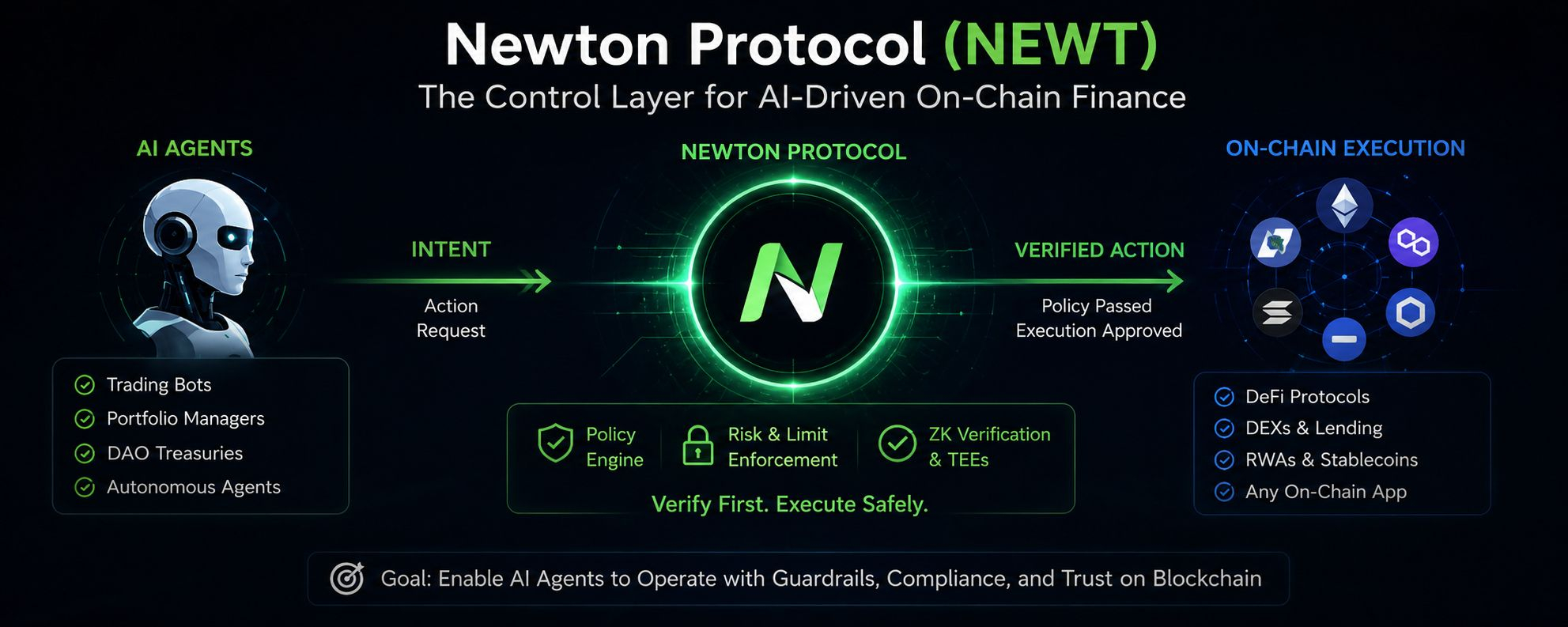
The way I understand it, the protocol isn't really trying to build a smarter AI. It's trying to create boundaries around what automated systems are allowed to do in the first place. When I thought about it from that angle, the idea felt a lot more practical. If software is going to manage assets, there should probably be rules. Maybe it shouldn't be allowed to exceed a certain position size. Maybe it shouldn't touch specific protocols. Maybe leverage should have hard limits. Those sound like boring details compared to flashy AI narratives, but I've found that boring details are often where real risk management lives.
And risk management is usually ignored right up until the moment everyone wishes they had more of it.
What makes Newton interesting isn't that the idea is complicated. It's that the problem feels real. As more decisions get handed over to software, somebody eventually has to decide where the guardrails are placed. I keep coming back to that thought whenever I look at the project.
The market, however, seems far less convinced.
The token is still trading dramatically below the levels people were willing to pay during the peak excitement around it. A lot of investors see a chart like that and immediately move on. I understand why. Crypto is full of assets that fell 90% and never recovered. In many cases, the market got it right.
But I've also been around long enough to know that price alone doesn't tell the whole story.
Sometimes a project collapses because the thesis was wrong. Sometimes it collapses because expectations ran years ahead of reality. Those situations can look identical on a chart even though they're completely different underneath.
That's what I've been trying to figure out with Newton.
The more I looked into it, the less I worried about whether the technology could function and the more I worried about whether enough people would actually need it. That might sound obvious, but I've watched plenty of technically impressive projects disappear because demand never materialized. Building something useful and building something people actively use are two different challenges.
I think that's the biggest risk here.
Not competitors.
Not market volatility.
Not even the technology itself.
Adoption.
If automated financial systems become a larger part of crypto over the next few years, I can easily see why a protocol focused on permissions and policy enforcement could matter. The bigger the capital pools become, the harder it is to justify giving software unlimited freedom. That feels like common sense to me.
The problem is that common sense doesn't always translate into immediate demand.
I've seen entire sectors built around assumptions that eventually proved correct, but far later than investors expected. Timing matters. Being early and being wrong can produce the same result for a trader staring at a portfolio.
That's why I find myself watching usage more than announcements. I don't pay much attention to partnership graphics anymore. I've seen too many of them. What I care about is whether people are actually building around the system, whether activity is increasing, and whether the protocol becomes part of real workflows rather than remaining a concept people talk about on conference stages.
That's the evidence I'm waiting for.
Because at the end of the day, I don't view Newton as an AI bet.
I view it as a bet that automation keeps growing and that eventually someone has to decide what automated systems are allowed to do before they touch real money. The longer I've been in crypto, the more that question feels inevitable.
Maybe the market is underestimating that possibility.
Maybe it's pricing the risk correctly.
I'm not completely sure yet.
What I do know is that Newton is one of the few projects in this category that made me spend more time thinking about the problem than the token itself. In my experience, that's usually a better starting point than getting excited about a narrative. Narratives come and go. The problems that keep showing up tend to be the ones worth paying attention to.