

I still remember watching a DeFi position go bad because I trusted the interface more than the rules underneath it. The trade was simple. A lending position, some collateral, a little leverage. What bothered me afterward was not the loss. Traders lose. What bothered me was how much risk lived outside the smart contract I thought I understood. The contract did what it was told. The problem was that what it was told should never have passed.
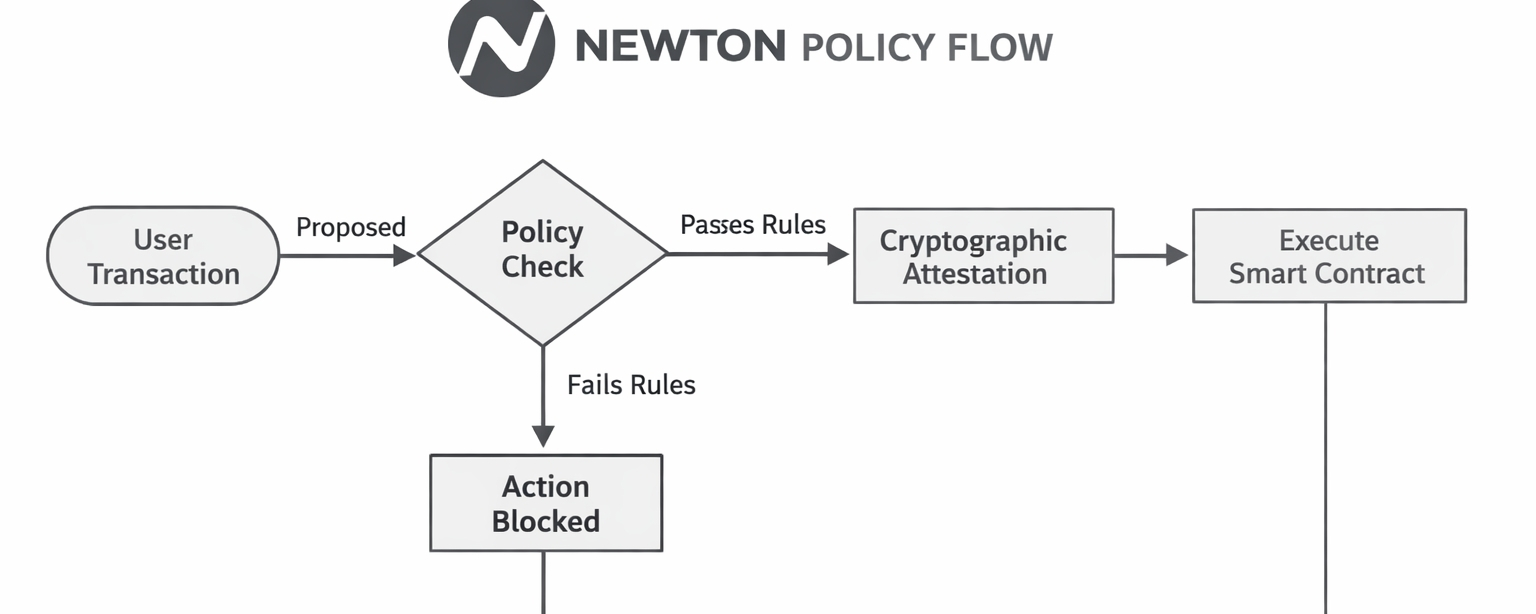
That is why Newton’s verifiable automation caught my attention. Not because automation sounds exciting. Honestly, automation in crypto usually makes me nervous. A bot that can click faster than me is useful until it clicks the wrong thing with my money attached. Newton is trying to reduce that specific risk by putting a permission layer before execution. In plain English, a transaction gets checked against rules before it settles. If it passes, the contract can verify a cryptographic attestation. If it fails, the action should not go through.
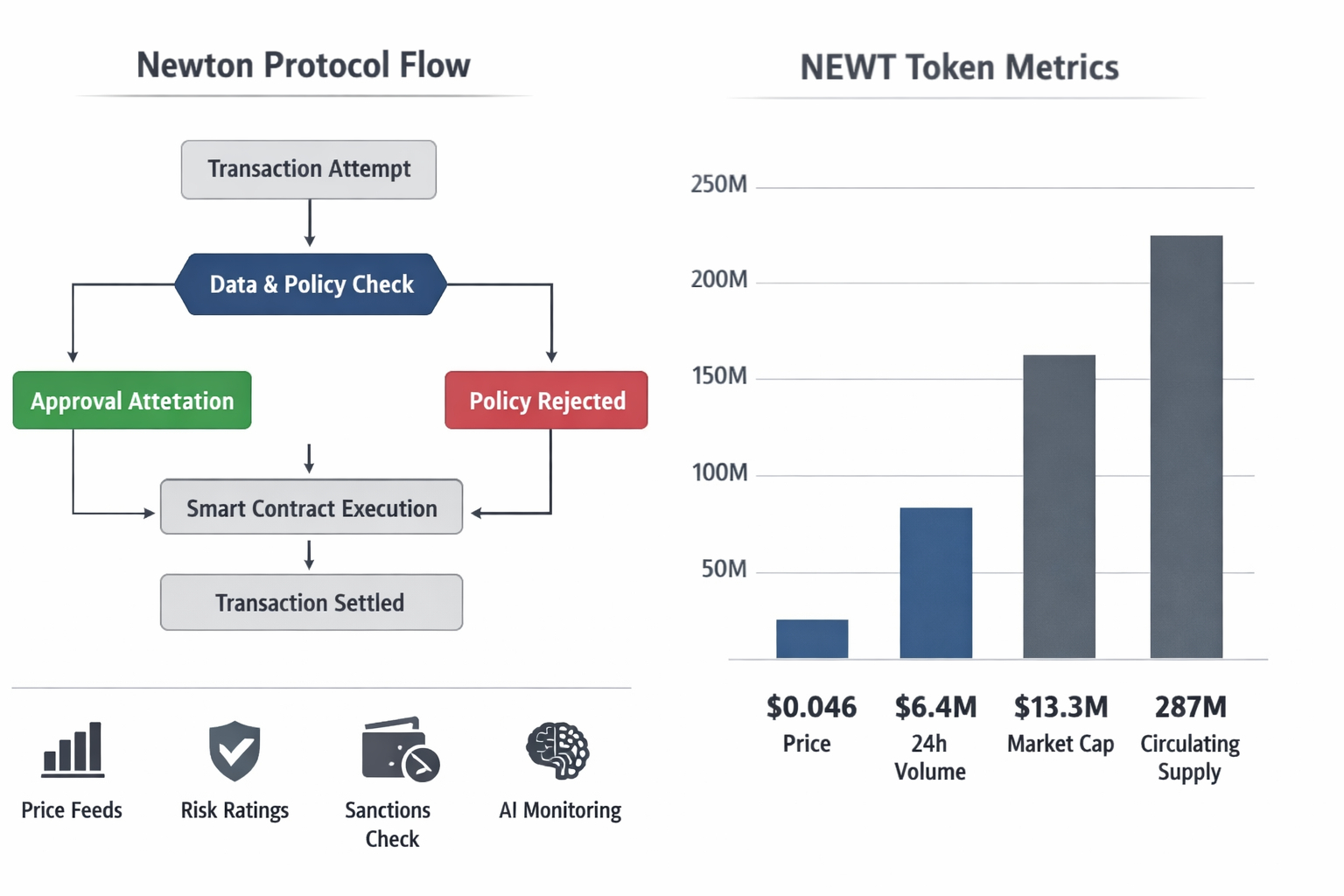
That matters because smart contracts are good at following internal logic, but weak at understanding context. They do not naturally know whether a wallet is sanctioned, whether an AI agent has gone off task, whether a vault position crossed a risk threshold, or whether a trader’s automated strategy is about to spend more than intended. Newton lets policies read approved data inputs, evaluate the action, and create a verifiable yes or no. Think of it like card authorization before payment settlement, except built for onchain transactions.
The fresh numbers make the setup interesting but keep me grounded. As I’m writing this on July 1, 2026, NEWT is trading around $0.046, with about $6.4 million in 24 hour volume, a live market cap near $13.3 million, 287 million tokens circulating, and a maximum supply of 1 billion. That is not a giant asset. It is a small market trying to prove that infrastructure need can become real usage. The bull case is not “price goes up because AI.” That is lazy. The bull case is that if Newton becomes a default authorization layer for vaults, agents, stablecoins, or regulated onchain products, the current valuation leaves room for the market to reprice usefulness.
But usefulness has to show up in behavior, not just integrations. Newton’s materials point to large pools of activity around stablecoins, RWAs, and compliance, and RedStone says Newton’s mainnet beta is live with RedStone and Credora as launch data partners. That matters because a policy is only as good as the data it checks. If a vault rule depends on collateral price or risk rating, bad data turns clean automation into confident failure. RedStone supplies price and market data, while Credora contributes risk ratings.
Now here’s the thing traders should watch: retention. Crypto is full of protocols that attract wallets once and lose them forever. Airdrops bring activity. Campaigns bring screenshots. Real products bring repeat behavior. The Retention Problem for Newton is simple. Will developers, vault curators, and agent builders keep using policy enforced automation after the launch noise fades? Will traders feel safer letting agents execute within limits? Will institutions pay for authorization instead of building private controls? If yes, retention becomes the hidden signal. If not, Newton becomes another clever layer people admire and ignore.
My honest frustration is that this infrastructure is hard to trade cleanly. The narrative is easy to understand, but adoption is slow to verify. Mainnet beta is still beta. Integrating policy checks into contracts takes developer effort. There may be latency, gas cost, oracle dependency, operator risk, and ugly edge cases when markets move fast. If I am liquidating collateral during a violent wick, I do not want my safety layer becoming the bottleneck. Security that blocks bad actions is valuable. Security that blocks urgent good actions becomes expensive.
The bear case is not that Newton has no purpose. It clearly has one. The bear case is that the market may not reward it soon, the token may face dilution as more supply enters circulation, and users may prefer simpler wallet based limits or centralized policy servers because they are easier, cheaper, or already inside their workflow. There is also a deeper risk: smart contract risk is not one thing. Some failures come from code bugs, bad governance, compromised keys, oracle manipulation, and humans under pressure. Newton can reduce a slice of that risk. It cannot erase the whole stack.
Still, I like the direction because it attacks the moment where damage actually happens. Before execution. Before settlement. Before the agent or bot or vault gets to say, “too late.” For traders, that is the right mental model. Do not ask only whether Newton has partners. Ask whether its policies are being used repeatedly in live transactions, whether attestations are easy to verify, whether builders keep shipping with it, and whether the token captures any of that demand.
Watch the retention, not the slogans. Track the live usage, not the launch thread. If Newton keeps turning risky automation into controlled execution, pay attention before the market makes the obvious feel obvious.