
I’m watching the conversation around AI change in a subtle but important way. A year ago, most discussions focused on how intelligent AI models were becoming. Today, the bigger question is whether those models can be trusted to act on our behalf. That shift is what led me to spend more time studying Newton Protocol. The project is less concerned with making AI smarter and more concerned with making autonomous execution safer and more predictable.
To understand Newton, it helps to begin with the problem rather than the protocol itself.
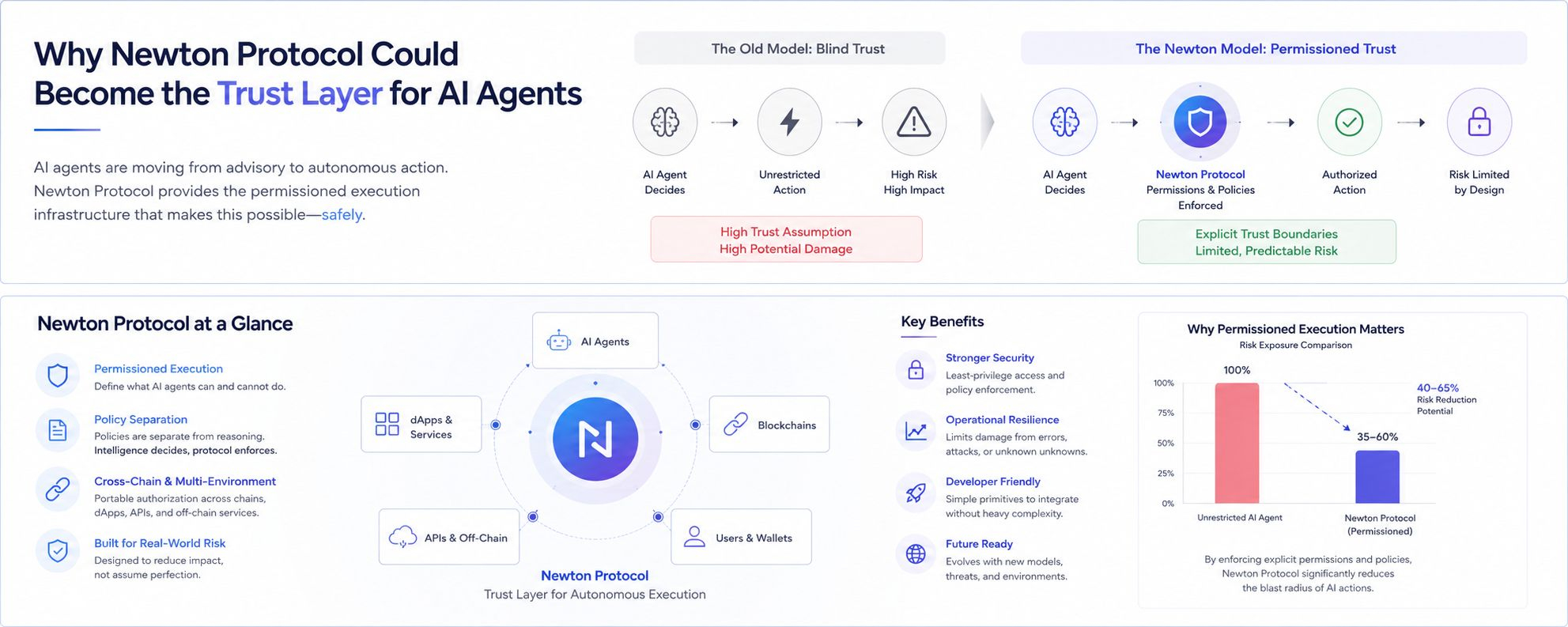
Large language models can already write code, analyze data, and interact with software. The next stage is AI agents that don't simply generate responses but perform actions—moving assets, executing transactions, managing workflows, and coordinating across applications. As soon as AI begins acting instead of advising, trust becomes an infrastructure problem rather than a model problem.
Newton Protocol is designed around this idea.
Instead of assuming an AI should have unrestricted authority, Newton introduces an execution framework where permissions, policies, and authorization are separated from the AI's reasoning process. The intelligence decides what should happen, while the protocol defines what is actually allowed to happen. This distinction may appear small, but it changes the security model significantly.
Traditional blockchain infrastructure already minimizes trust between users through deterministic smart contracts. Newton attempts to extend that philosophy to autonomous software by reducing the amount of blind trust placed in AI agents themselves. Rather than expecting perfect decisions, it focuses on limiting the consequences of imperfect ones.
From an architectural perspective, this is a practical direction. AI models will continue to improve, but mistakes, prompt manipulation, unexpected behaviors, and changing environments are unlikely to disappear completely. Infrastructure that assumes occasional failure is generally more resilient than infrastructure that assumes perfection.
That said, Newton should not be viewed as a complete solution to AI safety.
Permission systems can restrict what an agent is allowed to do, but they cannot guarantee that an AI always makes the correct decision. Poorly designed policies, incorrect user configurations, or vulnerabilities in surrounding applications can still introduce risk. In other words, Newton reduces certain categories of risk rather than eliminating them.
Developer experience will also play an important role in determining the protocol's adoption. Security frameworks only become valuable when developers can integrate them without excessive complexity. If defining permissions and execution policies becomes difficult or expensive, adoption may slow regardless of the protocol's technical strengths.
Interoperability presents another long-term consideration. AI agents are unlikely to remain confined to a single blockchain ecosystem. They will increasingly operate across multiple chains, decentralized applications, APIs, and off-chain services. A trust layer becomes significantly more useful if its authorization model remains portable across these environments rather than tied to one network.
Governance introduces additional trade-offs. Security policies must evolve alongside increasingly capable AI systems and new attack vectors. At the same time, excessive governance flexibility can reduce predictability. Finding the balance between adaptability and stability will likely remain an ongoing challenge rather than a one-time engineering decision.
Perhaps the most interesting aspect of Newton is not the technology itself but the assumption behind it. The protocol assumes that future AI systems will require infrastructure governing execution, not just better models. History suggests that foundational infrastructure often receives less attention than applications, yet it frequently determines whether entire ecosystems scale securely.
For anyone evaluating Newton, the important questions are not whether AI agents are exciting or whether autonomous systems represent the future. The more useful questions are whether permissioned execution genuinely improves security, whether developers find the architecture practical, whether independent audits and real-world deployments validate the design, and whether the protocol continues evolving as AI capabilities advance.
Viewed through that lens, Newton Protocol represents an interesting attempt to solve one of the least discussed challenges in autonomous computing. Whether it ultimately becomes a foundational trust layer will depend less on ambitious vision and more on sustained technical execution, developer adoption, transparent security practices, and the ability to prove its value in real-world environments.
