
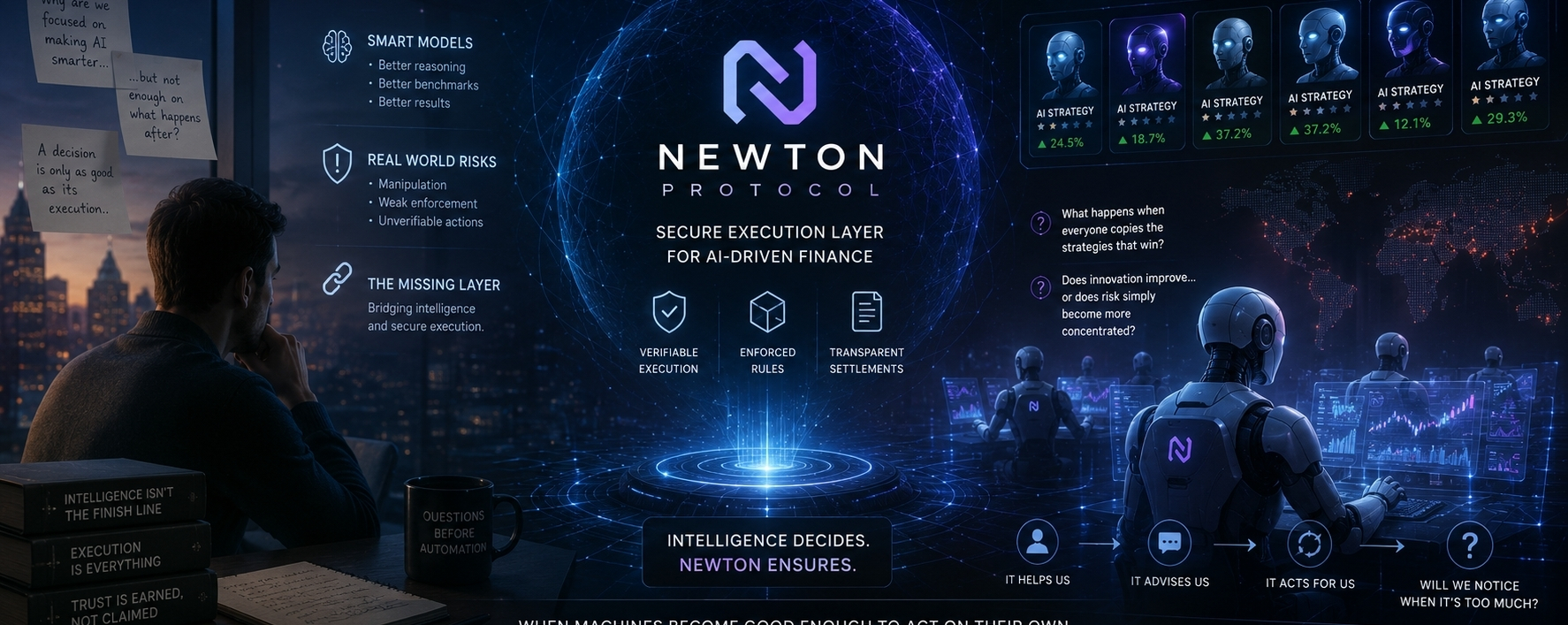
It's funny how some ideas disappear the moment you close your laptop, while others just... stay.
Newton Protocol turned out to be one of those ideas for me.
At first, I didn't think much of it. I read that it was building a secure rollup for AI-driven strategies, automated trading, and a marketplace for AI developers, and my immediate reaction was, "Okay... another protocol." Crypto has a way of making almost everything sound revolutionary, so I've become careful about getting excited too quickly.
But a few days later I caught myself thinking about it again. Not because I suddenly believed it was going to change everything, but because it pushed me toward a question I hadn't really spent enough time on.
What happens after AI makes a decision?
We spend so much time talking about how intelligent AI is becoming. Every new model is faster, smarter, better at reasoning. That's the conversation everyone seems to enjoy. And yeah, it's fascinating. I read those updates too.
But the thing is... intelligence is only one part of the story.
Imagine an AI decides to execute a trade, manage a treasury, or coordinate a strategy across multiple protocols. The difficult part isn't always reaching the decision. Sometimes it's everything that comes next. Can that action actually be trusted? Can it be verified? Can someone prove what happened if things go wrong?
I don't think we ask those questions often enough.
That's where Newton Protocol started making more sense in my head. Not as another blockchain project trying to stand out, but as something focused on the layer between decision and execution.
Maybe that's the missing piece.
Or maybe I'm completely overthinking it.
Honestly, that's happened before.
I keep going back and forth because part of me loves the idea of AI becoming more useful, while another part wonders if we're getting a little too comfortable letting software make choices on our behalf. Those two thoughts don't really cancel each other out. They just sit there together.
The marketplace idea is interesting too.
On paper, giving developers a place to build and share AI strategies sounds like a natural step forward. More people can experiment. Better ideas have a chance to spread. Innovation becomes less dependent on a handful of large teams.
But then another thought sneaks in.
What kind of strategies end up winning?
The most responsible ones?
Or simply the most profitable ones?
Those aren't always the same thing.
That's something technology alone can't solve. Every system reflects the incentives inside it. If the rewards point in one direction, people usually follow them. AI agents won't exist outside those incentives either.
And I think that's easy to forget.
Sometimes we talk about AI as if it's some perfectly rational actor floating above human behavior. It isn't. It operates inside environments that we build. If those environments encourage short-term thinking, AI can end up scaling that behavior instead of fixing it.
I guess that's why secure infrastructure matters.
Not because security magically creates trust, but because without it, trust never really has a chance to exist in the first place.
Still, even secure systems aren't perfect. They can fail. Assumptions can break. Governance can change. That's true for every ambitious project. Newton Protocol isn't an exception to that reality, and I actually think admitting that makes the conversation more interesting, not less.
Maybe what keeps bringing me back isn't the technology itself.
It's what the technology quietly says about where we're heading.
For years, we've been asking whether AI can think.
Now it feels like we're asking whether AI can participate.
Participate in markets. Participate in financial systems. Participate in decisions that have real consequences.
That's a much bigger shift than I realized when I first read about Newton Protocol.
And honestly... I'm still not sure I know exactly how I feel about it.
Maybe that's okay.
Some ideas aren't supposed to give you immediate answers.
Sometimes they're valuable simply because they leave you with better questions than the ones you started with.
