
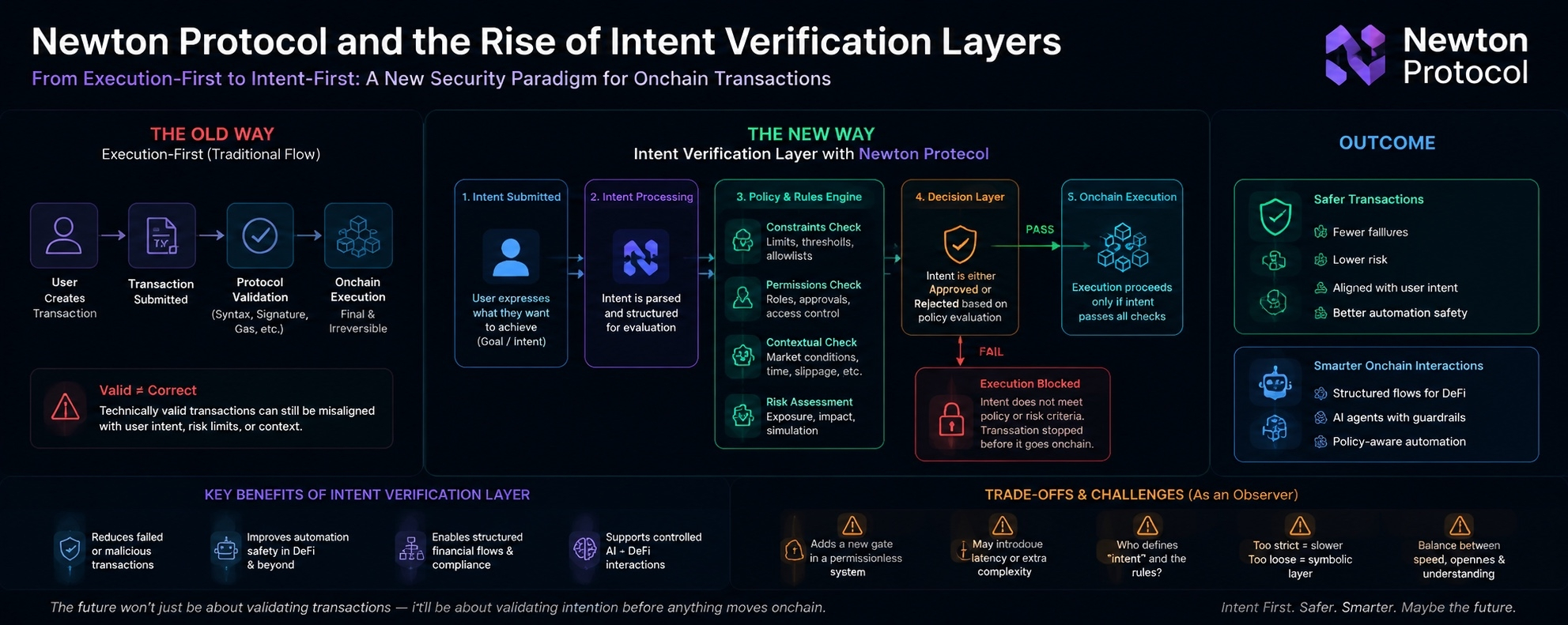

I am keep thinking about how blockchain systems feel incredibly precise on the surface, but a bit “blind” when you zoom into real human usage. Like everything is technically correct, signatures match, rules pass, gas is fine & still something can go wrong. Not because the system failed, but because it never really understood what the user was trying to do in the first place.
That gap between execution and intention is where things start to get interesting.
Most execution-first blockchain designs basically treat transactions like instructions carved in stone. If it’s valid, it runs. No questions asked. But in real environments, especially DeFi or automated flows, validity is not the whole story. A transaction can be valid and still completely misaligned with risk limits, context, or even basic user expectation. I think that mismatch is the quiet friction people don’t always talk about, but they definitely feel.
This is where the idea of an intent verification layer comes in. Instead of jumping straight from transaction ->execution, the system first asks a softer but more important question: what is the user actually trying to achieve here? And does this action make sense within that intent, given all the constraints sitting around it?
So it’s less “can we execute this?” and more “should we execute this at all?”
In systems like Newton Protocol, this shows up as a pre-execution checkpoint. There’s a flow where intent gets submitted, then runs through a kind of policy reasoning layer. That layer checks conditions, constraints, permissions, maybe even contextual rules depending on how it’s configured. Only after that does execution actually happen onchain. If something doesn’t align, it just stops there, before anything becomes irreversible.
I’m watching that conceptually it sounds clean. But when you sit with it a bit longer, you start seeing the trade-offs.
Because now you’re introducing a new gate in a system that was originally designed to be permissionless and fast. That gate could reduce risk, sure. It might also introduce complexity, latency, or even disagreement about what “intent” really means. I think honestly that part is still a bit fuzzy—like, who defines the rules of interpretation, and how flexible should they be before the system starts feeling heavy?
From a UX angle though, i can see why this direction is being explored. Fewer failed transactions, fewer accidental losses, more structured flows. Especially when you imagine AI agents interacting with wallets, where intent is not always expressed perfectly. That’s where a blockchain intent system starts making sense, at least in theory. $NFP
But there’s always a flip side. If you tighten pre-execution validation too much, you might end up slowing down the very openness that made these systems useful in the first place. And if you keep it too loose, then the intent layer becomes more symbolic than functional.
So I guess the real tension here is speed versus understanding. Execution versus interpretation. Trust in code versus trust in a reasoning layer sitting before the code even runs. $VOOI
I’m wondering if this becomes a standard design pattern in the long run or just a specialized layer for high-risk environments. Maybe it spreads quietly, embedded into wallets and protocols without users even noticing. Or maybe it stays optional, used only when the stakes are high enough to justify that extra “intent check” before things go live Onchain.