
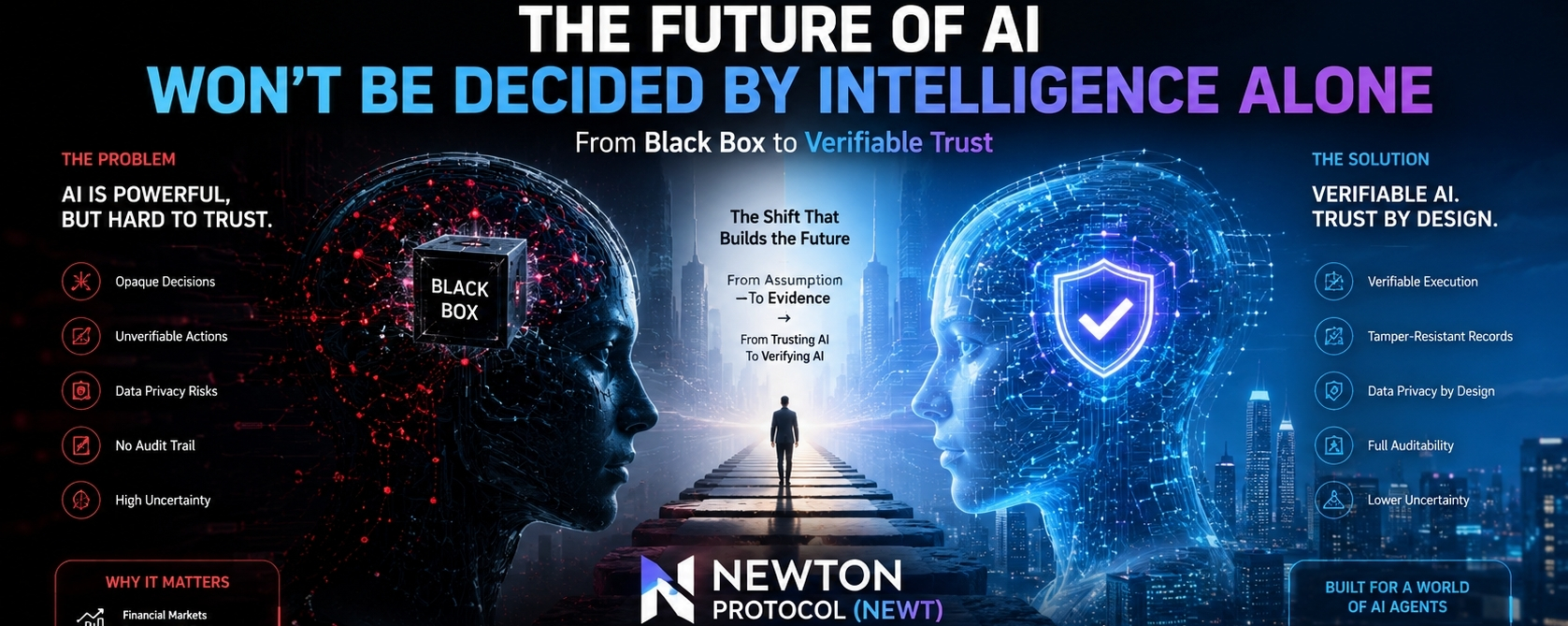
For the longest time, I thought AI was simply a race toward bigger models and better reasoning.
Every few months, another breakthrough would arrive. Models became faster, more capable, and more creative. It felt as though intelligence itself was the finish line.
But the more I watched the industry evolve, the more I realized something was missing.
The real challenge isn't making AI smarter.
It's making AI trustworthy.
Think about the technologies we rely on every day. We trust airplanes not because pilots promise they'll fly safely, but because every part of the system is built around standards, testing, and accountability. We trust banks because transactions are recorded, audited, and regulated. Scientists earn credibility because their work can be verified by others.
Trust has never been built on promises alone.
It's built on proof.
AI is now reaching the point where that lesson matters more than ever.
Writing an email or generating an image is one thing. But what happens when AI starts managing investments, negotiating contracts, running supply chains, or helping doctors make clinical decisions?
At that point, getting the right answer isn't enough.
People will want to know how the decision was made, whether the AI followed the rules, whether sensitive data stayed protected, and whether anyone can verify what actually happened if something goes wrong.
These aren't technical details.
They're the foundation of trust.
One of the biggest challenges with modern AI is that even the people who build these systems can't always explain every step behind a specific decision. That's why many people describe AI as a "black box."
Maybe we're asking the wrong question.
Instead of trying to understand every calculation happening inside the model, perhaps we should focus on whether its actions can be verified afterward.
After all, we don't inspect every component inside an airplane before boarding it. We trust the systems that inspect, monitor, and certify it.
AI may need the same kind of infrastructure.
This is where the conversation becomes interesting.
Blockchain has often been viewed through the lens of cryptocurrencies, but its most valuable contribution may have little to do with speculation. Its real strength is creating records that are difficult to alter and easy to verify.
That idea becomes powerful when combined with AI.
Rather than simply trusting that an AI agent behaved correctly, we can build systems that make its execution transparent and auditable.
That's the direction projects like Newton Protocol (NEWT) are exploring.
Instead of building another AI model, Newton Protocol focuses on infrastructure secure rollups for AI-driven strategies, automated execution, and a marketplace where developers can build and share AI agents.
What stands out isn't the combination of AI and blockchain.
It's the problem they're trying to solve.
Not "Can AI do this?"
But "Can anyone prove it did it correctly?"
That may sound like a small difference, but history suggests it's the difference that changes everything.
The internet didn't become essential because computers could communicate.
It became essential because people learned to trust digital communication.
Online shopping didn't explode because websites existed.
It exploded because payment systems became secure enough for ordinary people to rely on them.
Every major technological leap eventually reaches a point where trust becomes more important than raw capability.
AI is arriving at that moment now.
The companies that shape the next decade may not be the ones building the smartest models.
They may be the ones building the strongest foundations around those models foundations based on transparency, accountability, and verifiable execution.
Intelligence will always matter.
But in the long run, the systems that earn the world's trust are usually the ones that leave the biggest mark on history.
Maybe that's where the next chapter of AI begins.
Not with smarter machines.
But with AI that can finally be trusted.