
I wasn't planning to spend my night testing hooks.
I was scrolling through a developer discussion when someone asked a simple question about @NewtonProtocol: "How long does hook integration actually take?" The replies were completely different. One developer said it was done in a few hours. Another claimed permission validation kept the team busy for days.
That made me curious enough to stop reading opinions and open the testnet myself.
After spending a few hours with the integration, my conclusion was surprisingly simple: both sides were partly right.
The hook itself isn't particularly difficult to integrate. What takes time is everything that comes after.
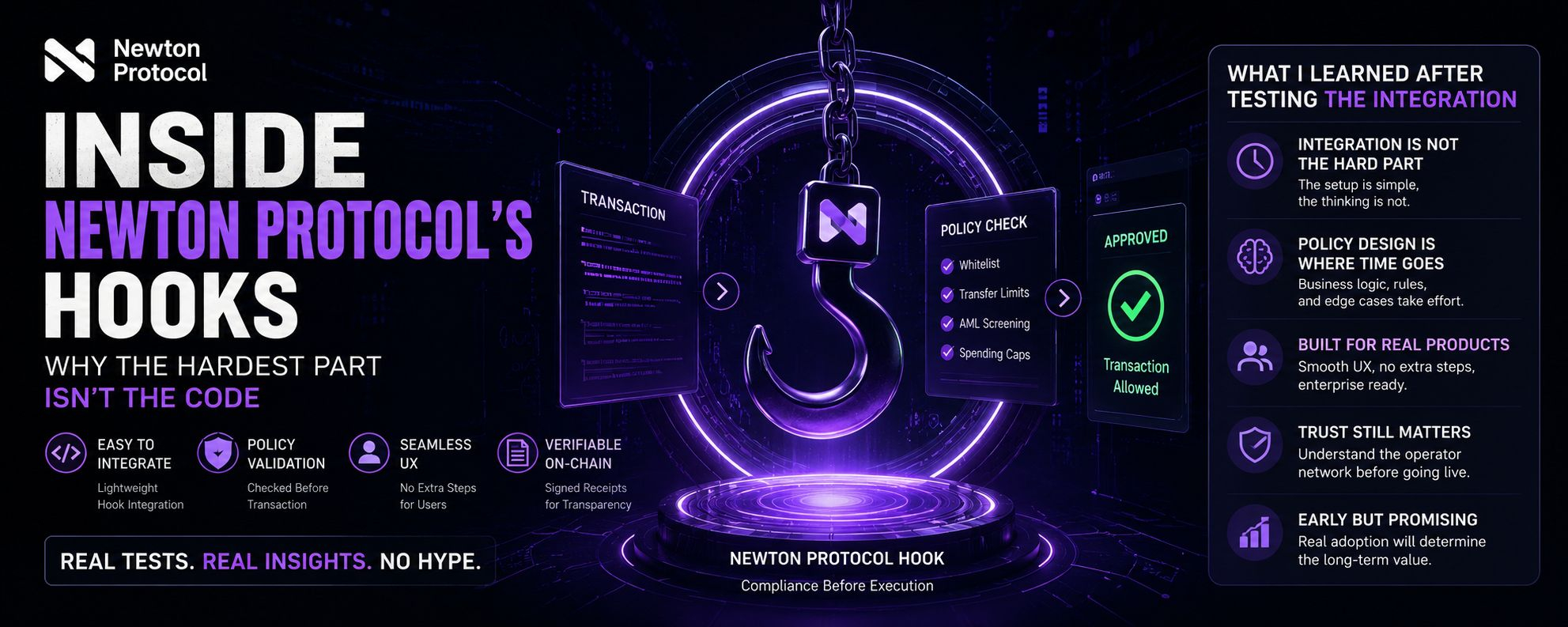
One thing I appreciated almost immediately was the way Newton approaches the problem. Instead of asking developers to redesign their existing smart contracts, the protocol adds a lightweight hook into the transaction flow. Before a transaction is finalized, it's evaluated against a predefined policy. If the rules are satisfied, execution continues. If not, the transaction stops before settlement. It's a straightforward idea, but it changes where compliance happens in the workflow.
That approach makes sense to me.
Most projects still handle compliance through backend scripts or manual review after a transaction has already happened. Newton tries to move those decisions closer to execution itself. Rather than checking what went wrong afterward, it focuses on deciding what should happen before anything reaches the chain. That's a cleaner way to think about risk management.
Setting up the basic integration wasn't what slowed me down.
The documentation was easy to follow, and getting a simple test deployment running felt fairly smooth. Developers who already have experience deploying smart contracts probably won't struggle much with the initial setup.
The real challenge starts when you begin writing policies.
That's where things become much more interesting.
The code is usually the easy part.
The difficult part is deciding exactly what your application should allow, what should be rejected, which conditions matter, and how different business rules interact with each other. Once you begin translating investor requirements, transfer restrictions, spending limits, or redemption rules into machine-readable policies, you quickly realize that the complexity comes from the business itself—not from the hook. Newton's policy engine is designed to evaluate those rules before transactions settle, but developers still have to define those rules clearly in the first place.
Because of that, I don't think it's fair to blame the protocol every time someone says integration took several days.
In many situations, the hook simply exposes complexity that already existed inside the project's own workflow. If your business logic is complicated, no SDK is going to magically simplify those decisions.
Another detail that stood out during testing was the user experience.
The policy evaluation happens quietly before settlement, so users aren't asked to complete extra signatures or follow additional approval steps. If infrastructure like this is ever going to support stablecoins, tokenized real-world assets, or institutional applications, keeping the experience simple is almost as important as the compliance layer itself. Newton is designed so policy checks happen behind the scenes while preserving the application's normal flow.
Still, I don't think every important question has been answered yet.
Whenever a protocol depends on an operator network to validate decisions, developers should understand who those operators are, how decentralized the network really is, and how verification behaves under real production conditions. Good documentation explains the architecture, but documentation alone shouldn't replace independent research.
If I were integrating this into a production application, I'd spend just as much time studying the network assumptions as I would studying the SDK.
After testing the hook flow, my opinion stayed fairly balanced.
I think Newton is trying to solve a real problem.
Moving compliance closer to execution feels more practical than relying on manual reviews after transactions have already settled. At the same time, I don't think developers should expect the hook to remove every layer of complexity.
It won't.
The hard part has never been writing a few extra lines of code.
The hard part is designing policies that genuinely reflect how a business operates.
If Newton continues attracting real production integrations over time, we'll have a much better way to judge the architecture than simply reading documentation or watching technical demos. Infrastructure earns credibility through adoption, reliability, and consistent execution—not marketing.
For now, that's how I see it.
Interesting technology.
A practical design.
And a project that's worth testing carefully before drawing big conclusions.
