
@NewtonProtocol I’ve been sitting with an uncomfortable thought lately, the kind that starts as a faint pressure behind the ribs and doesn’t leave. It isn’t about a chart or a funding round. It’s about how rarely we, as an industry, price in the cost of becoming real. We talk about mass adoption, but we rarely ask what that adoption will demand from us legally, structurally, quietly. And I keep circling back to one name, not because it’s loud, but because it seems to be preparing for a question most people haven’t asked yet.
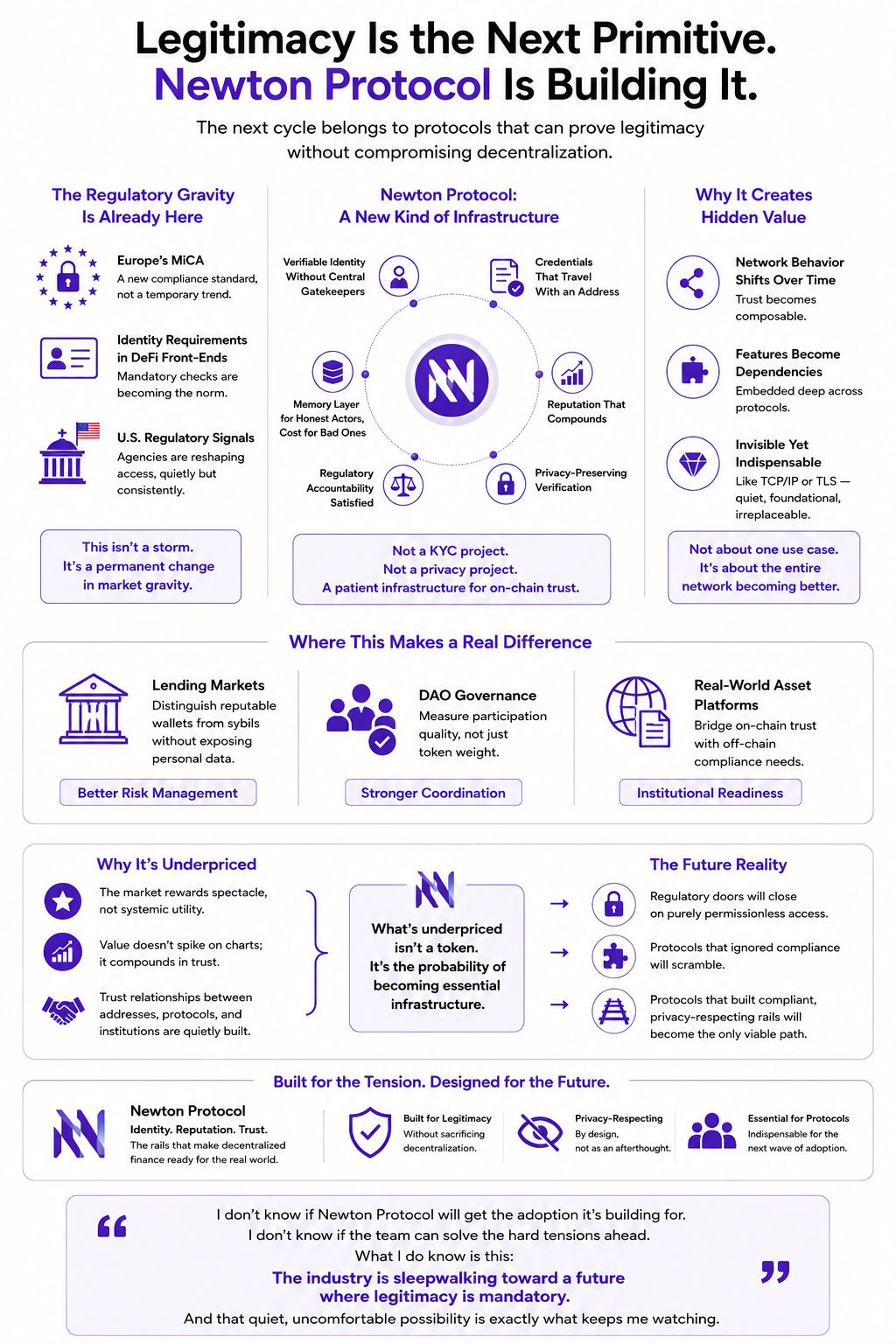
The regulatory pressure I’m watching isn’t the headline risk. It’s the slow, bureaucratic kind that rewires market access without anyone noticing. Europe’s MiCA framework, the creeping identity requirements in DeFi front-ends, the persistent signals from U.S. agencies—this isn’t a storm to weather. It’s a permanent change in the gravity of the space. Most investors are still pricing crypto as if the regulatory perimeter will stay negotiable, as if compliance can remain an optional wrapper. I think they’re wrong. The next cycle won’t belong to the fastest or the most permissionless. It will belong to the protocols that can prove legitimacy without losing the point of decentralization.
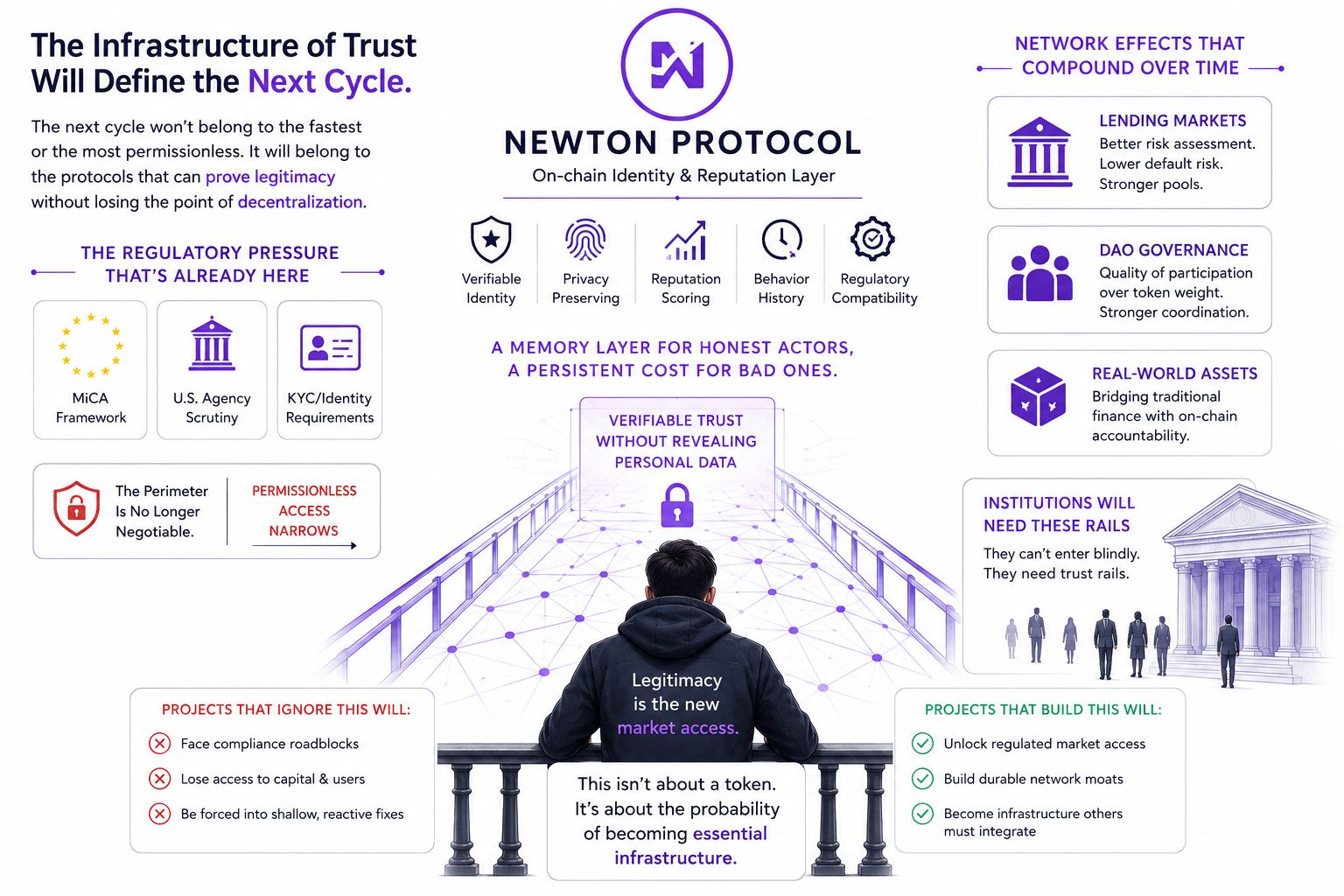
This is where @NewtonProtocol keeps appearing in my notes, not as a solution, but as a sketch of a different kind of infrastructure. What I see, looking past the surface, is an attempt to build a verifiable identity and reputation layer that doesn’t rely on centralized gatekeepers. The protocol seems less interested in speculative users and more in the unglamorous work of on-chain trust: credentials that travel with an address, behavior that compounds into reputation, verification that preserves privacy while satisfying a regulator’s need for accountability. It’s not a privacy project and it’s not a KYC project. It’s something more patient—a memory layer for honest actors, and a persistent cost for bad ones.
The hidden value here is subtle because it isn’t about a single use case. It’s about network behavior shifting over time. If Newton Protocol’s identity primitives become embedded in lending markets, DAO governance, or real-world asset platforms, they stop being features and start being dependencies. A lending pool that can distinguish a long-standing, reputable wallet from a fresh sybil without revealing personal data gains a structural advantage in risk management. A DAO that can quantify participation quality rather than token weight alone deepens its coordination. These aren’t flashy breakthroughs. They’re the kind of quiet upgrades that make a network indispensable, the way TCP/IP or TLS became invisible foundations.
Most people aren’t pricing this because the market still rewards spectacle over systemic utility. Newton Protocol’s value proposition doesn’t spike on a chart; it accumulates in the trust relationships being woven between addresses, protocols, and, eventually, the institutions that will need to enter this space but cannot do so blindly. When the regulatory doors finally close on purely permissionless access, the protocols that have been quietly building compliant, privacy-respecting identity rails won’t just survive—they’ll become the rails everyone else must integrate. That’s the layer that’s underpriced, not a token, but the probability of becoming essential infrastructure.
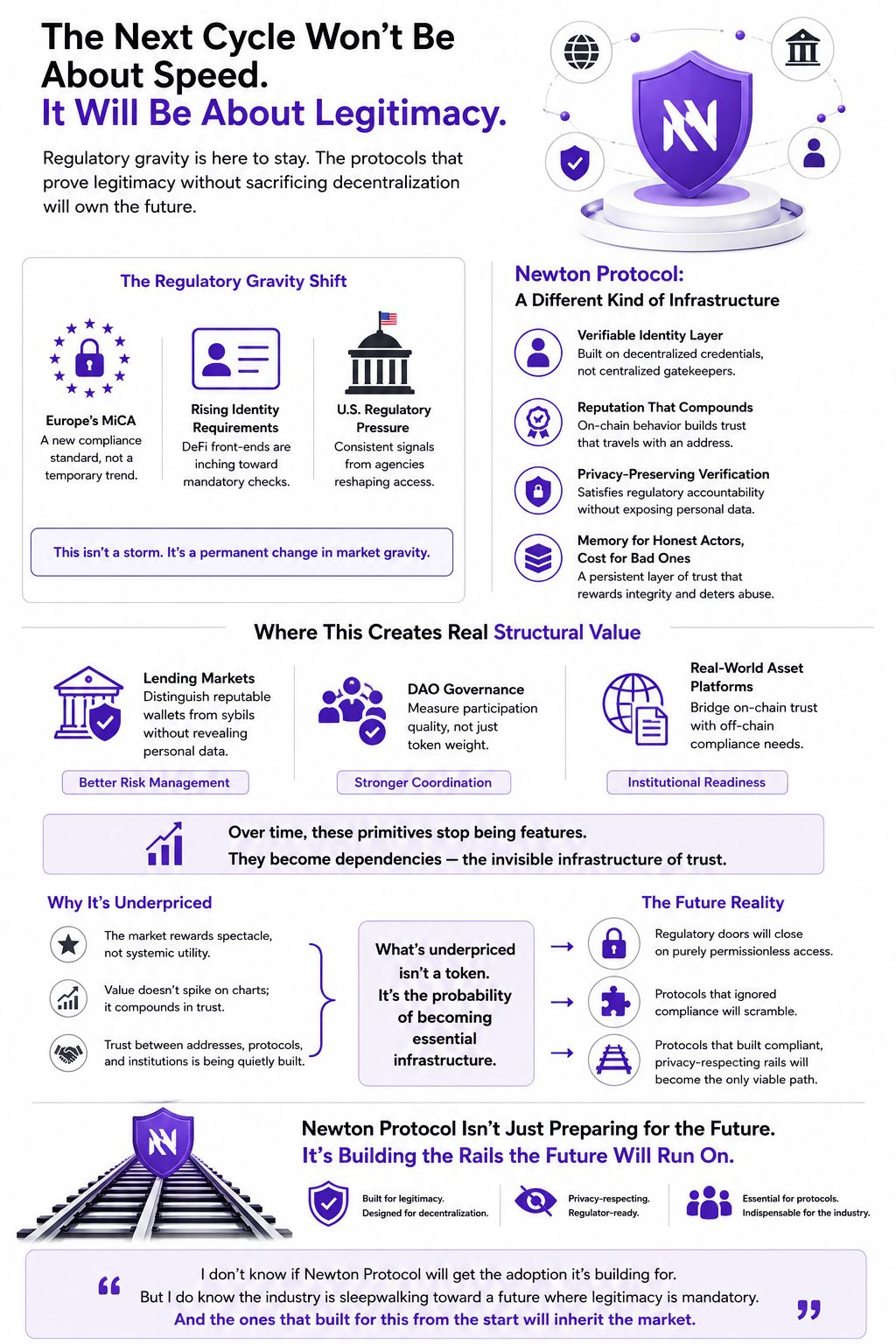
I don’t know if Newton Protocol will get the adoption it’s building for. I don’t know if the team can navigate the tension between regulatory acceptance and crypto’s cypherpunk roots. What I do know is that the industry is sleepwalking toward a future where legitimacy is mandatory, and the projects that don’t prepare will be forced to bolt on shallow compliance after the fact. The ones that built for this from the start will inherit a market that suddenly has no alternative. And that quiet, uncomfortable possibility is exactly what keeps me watching.