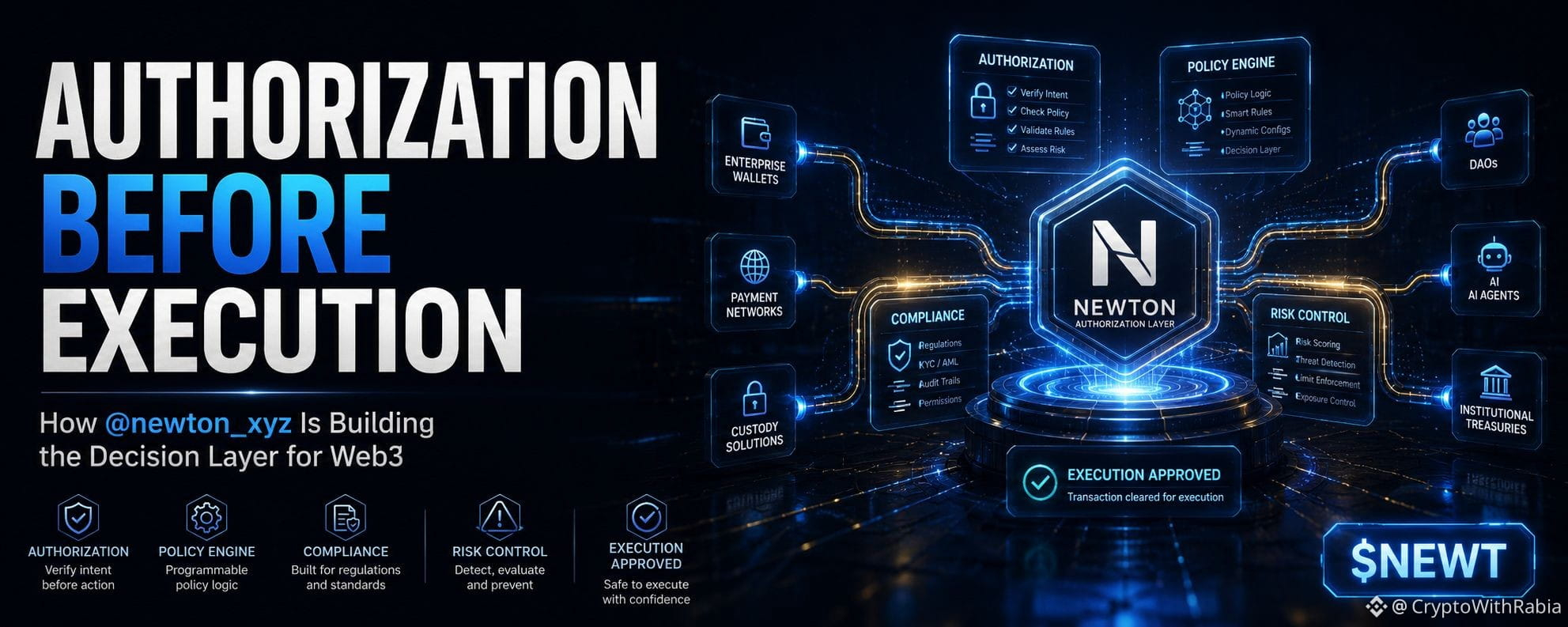
For years, blockchain innovation has focused on one question:
Can a transaction execute correctly?
What has received far less attention is an equally important question:
Should that transaction be allowed to execute at all?
This distinction may define the next generation of decentralized infrastructure.
While smart contracts guarantee deterministic execution, they rarely evaluate intent, organizational policy, or real-world compliance before value moves. The result is a system that is technically secure but often operationally inflexible.
That is exactly where @NewtonProtocol introduces a different architectural approach.
Instead of treating authorization as an off-chain responsibility, Newton moves programmable policy enforcement into the transaction flow itself. Every operation can be evaluated against configurable rules before execution, allowing organizations to define limits, permissions, spending thresholds, approved counterparties, or compliance requirements without modifying the application logic.
This creates a clear separation between execution and authorization.
That separation matters because decentralized applications are no longer built only for individual users. They increasingly serve DAOs, institutions, treasury managers, AI agents, payment networks, and enterprise workflows where every transaction carries operational and financial risk.
Imagine an autonomous treasury.
The contract knows how to move assets.
Newton helps determine whether the action satisfies governance policies before those assets move.
This design transforms authorization from a manual process into programmable infrastructure.
Another advantage is adaptability.
Instead of rewriting smart contracts every time governance rules evolve, organizations can adjust authorization policies while keeping execution logic consistent. This reduces operational complexity and allows applications to respond more efficiently to changing business requirements.
In my view, the long-term value of ($NEWT) is not simply another blockchain feature.
It is the possibility of making decentralized systems behave more like modern financial infrastructure—where trust is created not only through cryptography, but also through transparent, programmable decision making.
As institutional participation continues to expand, execution alone may no longer be enough.
The next evolution of Web3 could belong to protocols that understand when transactions should happen—not just how they happen.