
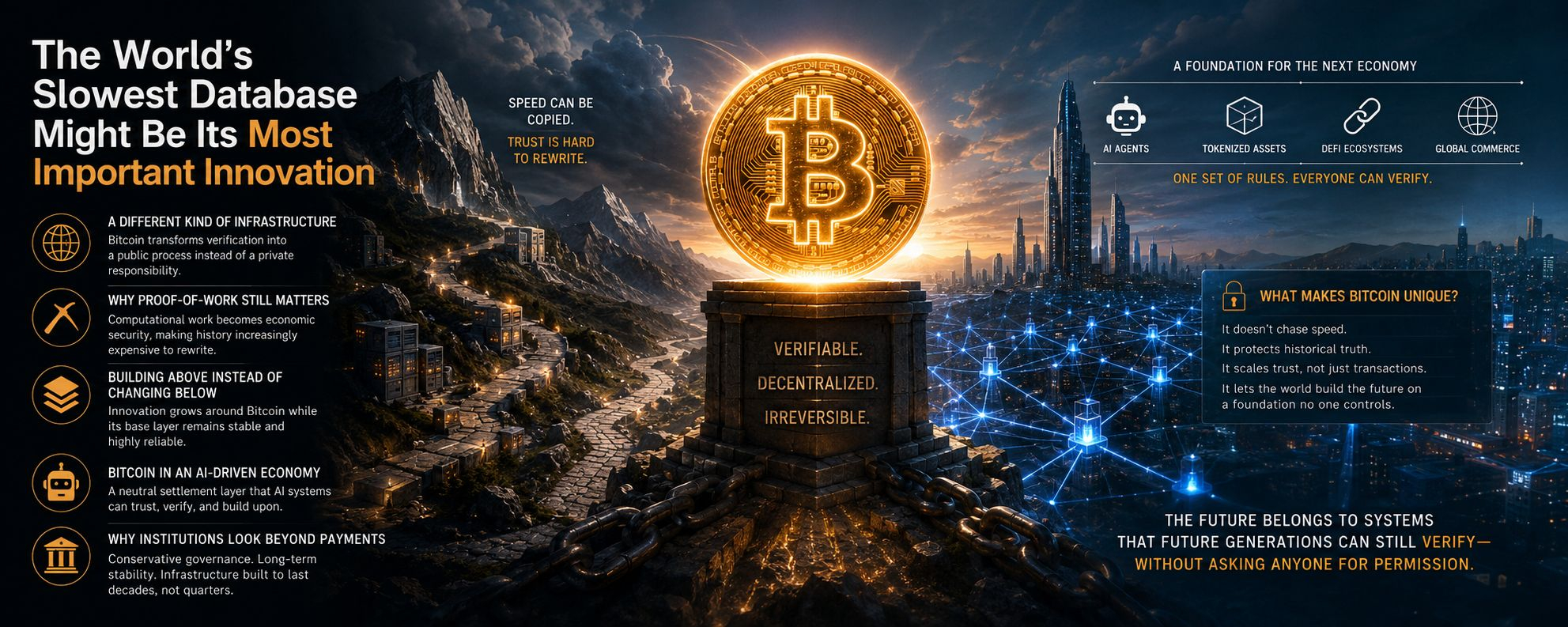
🚨 What if the most valuable network of the next decade isn't the one that processes the most transactions, but the one that is hardest to rewrite?
For years, technology has rewarded speed. Faster processors, lower latency, higher throughput, and near-instant communication have become the default benchmarks for progress. Bitcoin challenges that assumption. It deliberately sacrifices speed in exchange for something increasingly difficult to manufacture: irreversible trust.
That tradeoff may explain why Bitcoin continues to shape conversations far beyond digital payments.
🌍 A Different Kind of Infrastructure
Before Bitcoin, digital ownership always depended on an administrator. Whether transferring money, updating a land registry, or recording securities, someone ultimately controlled the database. Every participant had to trust that authority to preserve history accurately.
The weakness of this model isn't merely corruption. It's concentration. A single point of control creates a single point of failure, whether through technical outages, political pressure, cyberattacks, or simple human error.
Bitcoin introduced a fundamentally different architecture.
Instead of protecting a database with access controls, it protects history through distributed consensus. Thousands of independently operated nodes validate every block against the same rules. Any record that violates those rules is rejected automatically, regardless of who created it.
In other words, Bitcoin transformed verification into a public process instead of a private responsibility.
⚙️ Why Proof-of-Work Still Matters
Proof-of-Work is often discussed in terms of energy consumption, but its deeper purpose is frequently overlooked.
Imagine writing important agreements on sheets of steel instead of paper. Making each page requires significant effort, but altering completed pages becomes enormously expensive. Bitcoin applies a similar principle digitally.
Mining converts computational work into security. Every confirmed block represents accumulated economic cost, making historical manipulation increasingly impractical as additional blocks are added.
This design doesn't eliminate trust entirely—it redistributes it across open competition rather than centralized institutions.
The result is a ledger whose credibility grows from transparent incentives instead of organizational reputation.
🔗 Building Above Instead of Changing Below
Many blockchain ecosystems expand by continuously adding features to their base protocol. Bitcoin has generally taken another route.
Its base layer changes cautiously, while innovation increasingly happens around it.
The Lightning Network addresses payment scalability through off-chain settlement. Sidechains explore specialized functionality. Cross-chain bridges and tokenization frameworks seek to integrate Bitcoin liquidity into broader decentralized finance ecosystems without fundamentally redesigning Bitcoin's consensus rules.
This layered philosophy resembles modern transportation systems.
Highways rarely change direction once built. Instead, cities construct new roads, transit lines, and logistics networks that connect to stable infrastructure already trusted by millions.
Bitcoin follows a comparable path.
🤖 Bitcoin in an AI-Driven Economy
Artificial intelligence is beginning to automate increasingly complex decisions, from financial operations to supply chain management.
Yet autonomous software introduces a new question.
If AI agents exchange value independently, who determines which transactions actually occurred?
Private databases cannot easily solve this challenge when multiple organizations or competing AI systems participate. Each party maintains different incentives and different records.
Bitcoin offers a neutral settlement layer that no participant controls exclusively. AI systems can independently verify ownership, transaction history, and monetary issuance using identical public rules.
As machine-to-machine commerce expands, globally verifiable infrastructure may become just as important as computational intelligence itself.
🏛️ Why Institutions Look Beyond Payments
Institutional interest increasingly extends beyond Bitcoin as a payment asset.
Large financial organizations require settlement systems that remain operational across jurisdictions, organizational changes, and technological cycles measured in decades rather than quarters.
Bitcoin's conservative governance becomes relevant here.
Because protocol modifications undergo extensive review and broad community consensus, participants can build long-term infrastructure without expecting frequent rule changes.
Paradoxically, Bitcoin's reluctance to evolve rapidly may increase confidence for organizations responsible for safeguarding long-lived financial systems.
💡 The Bigger Question
Bitcoin is often compared against newer blockchains using metrics like transaction throughput or application diversity.
Those comparisons are useful, but they may overlook Bitcoin's primary contribution.
Its greatest innovation is demonstrating that digital history itself can become extraordinarily difficult to alter without requiring a central keeper of records.
In an era defined by AI-generated content, tokenized real-world assets, decentralized finance, and increasingly interconnected digital economies, trustworthy records may become more valuable than ever.
Perhaps the future won't belong solely to the fastest networks or the most feature-rich protocols.
It may belong to the systems that future generations can still verify—without asking anyone for permission.