
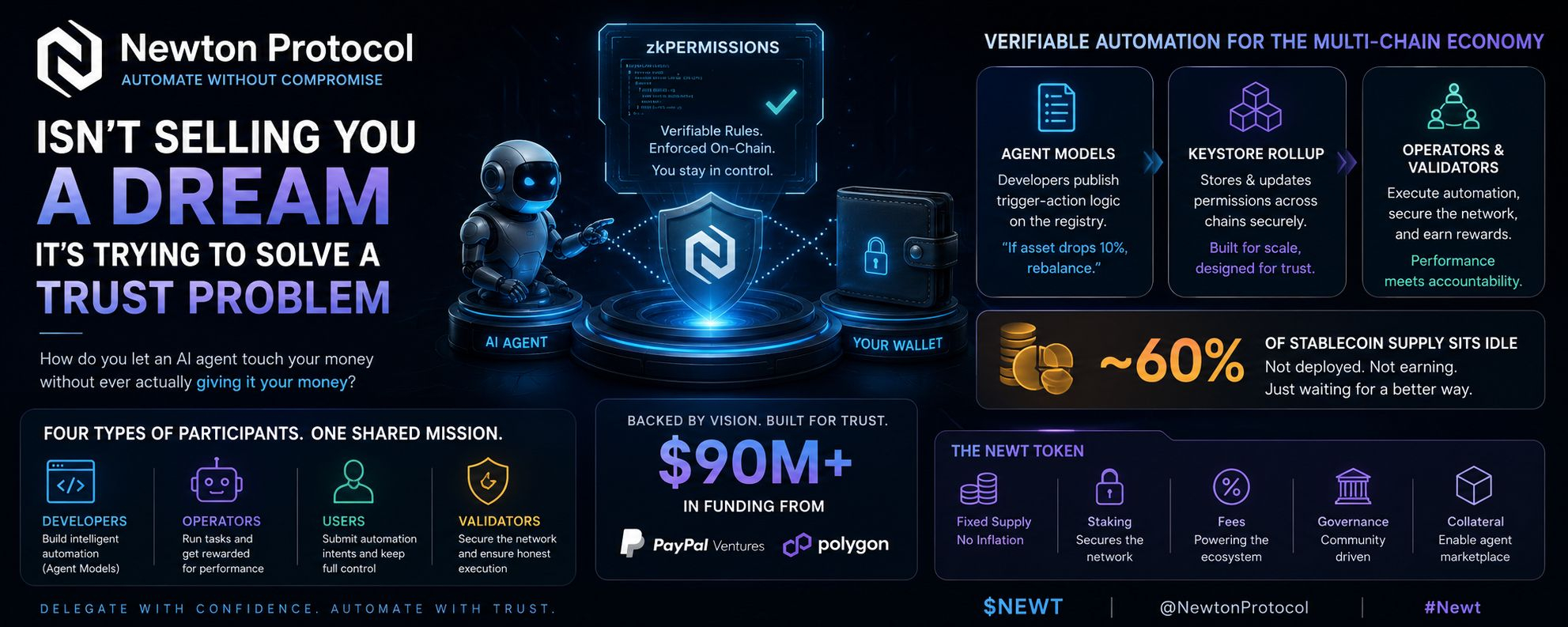
I'll be honest, I almost scrolled past Newton Protocol the first time I saw it. Another AI plus blockchain project, I thought. We've all seen enough of those to get numb to the pitch. But the more I dug into what Newton is actually building, the more I realized this one is trying to answer a much narrower, much harder question than "how do we bolt AI onto DeFi." It's asking: how do you let an AI agent touch your money without ever actually giving it your money?
That distinction matters more than it sounds like.
Right now, if you want a bot to trade for you, you're usually handing over your private keys to some centralized service and hoping for the best. We've watched that story end badly more than once. Newton's whole architecture is built around avoiding that exact failure mode. Instead of custody, it uses what the protocol calls zkPermissions programmable rules that define exactly what an agent is allowed to do, enforced through zero knowledge proofs and trusted execution environments, so agents follow the rules without ever gaining complete control . You're not trusting a person or a company. You're trusting math and code that can be checked.
Under the hood, there are three pieces doing the work. There's a registry where developers publish agent "models" essentially trigger action logic like "if this asset drops 10%, rebalance." There's a specialized rollup, sometimes called the Keystore, that handles storing and updating all those user permissions across chains. And there's a network of operators and validators who actually execute the automation and get paid for it. Four types of participants keep the whole thing running developers who build agents, operators who execute tasks, users who submit automation intents, and validators who secure the network . It's less a single app and more an entire economy built around one function: letting you delegate without losing control.
What actually convinced me this wasn't just another buzzword salad is the framing around capital inefficiency. Somewhere around 60% of stablecoin supply sits idle, not deployed anywhere useful, largely because managing positions across chains is too manual and too confusing for most people .
That's not a hypothetical problem. That's billions of dollars sitting there because the UX of DeFi is still, frankly, exhausting. If Newton can make "set a rule, walk away" actually safe, that's a real unlock not just for degens chasing yield, but for the kind of institutional capital that's been sitting on the sidelines waiting for something verifiable.
And there is real institutional interest here. The project has pulled in roughly $90 million in funding from backers including PayPal Ventures and Polygon , which tells me this isn't just a Twitter native pump project. Someone with actual due diligence looked at the architecture and decided it was worth betting on.
Still, I keep coming back to the same doubt I have with every ambitious infrastructure play: does the average person feel this problem badly enough today to change how they interact with their wallet? Verifiable automation is a beautiful idea on a whiteboard. But most people aren't thinking about TEEs and zkML proofs. They're thinking about whether the thing works, and whether they'll lose money if it doesn't.
There's also the competition question. Nothing stops a bigger, more established protocol from copying the zkPermissions model once it's proven out. Newton's edge right now is that it got there early and built the trust layer deliberately instead of bolting it on as an afterthought. Whether that edge holds depends entirely on execution whether the agent marketplace actually attracts good developers, whether operators stay honest, whether the whole flywheel of demand attracts builders attracts more more more demand actually spins up.
The other thing worth watching is the token model. NEWT has a fixed supply, no inflation, and it's woven into staking, fees, governance, and collateral for the agent marketplace. That's a sensible design on paper it means the token isn't just along for the ride, it's structurally necessary for the system to function. But sensible tokenomics have never been enough on their own. Plenty of well-designed tokens went nowhere because nobody used the underlying product.
So where does that leave Newton? Somewhere between "genuinely solving something real" and "still needs to prove people will actually show up." The architecture is thoughtful. The funding is credible. What's missing is the thing no whitepaper can manufacture: enough real users trusting the system enough to let go of the wheel.