
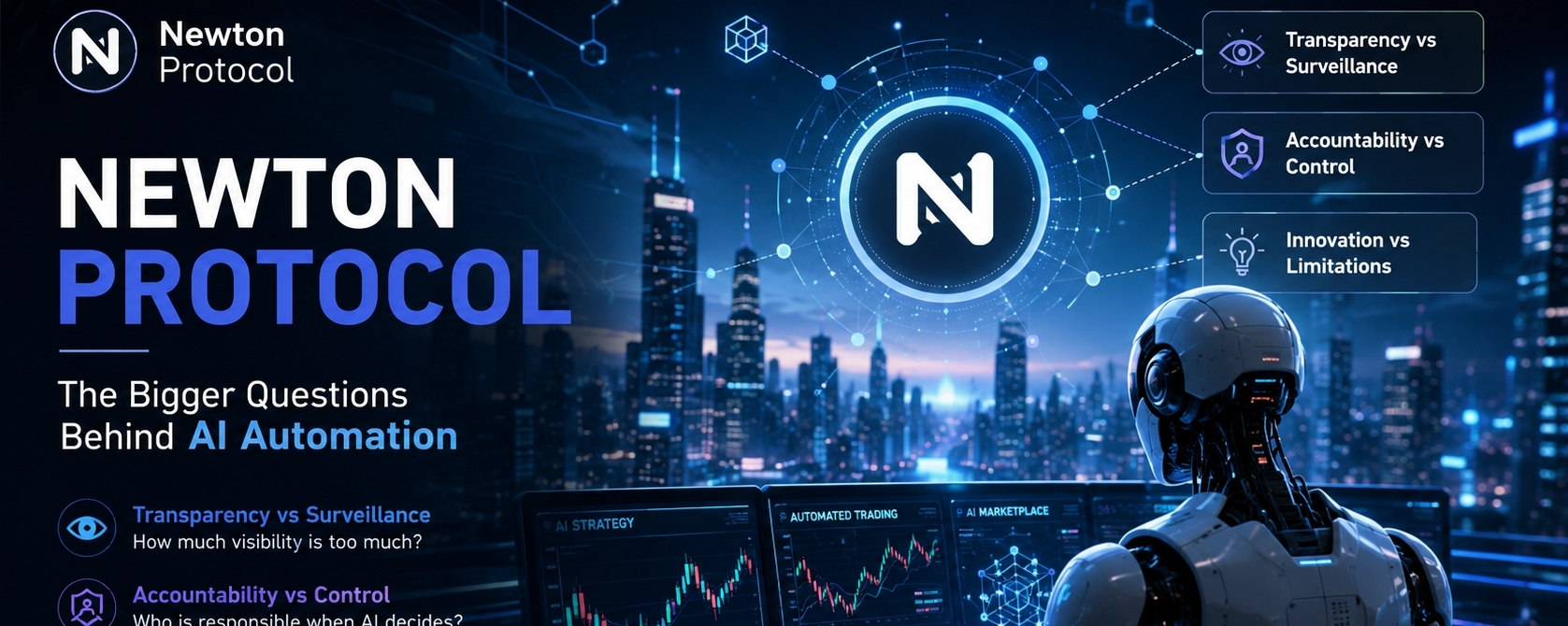

The idea behind Newton Protocol caught my attention because it seems to assume that AI won't just help people make decisions anymore it'll eventually make them on our behalf. That feels like a natural direction for the technology, but it also raises questions that are probably more important than the protocol itself.
Everyone talks about making AI systems more transparent, but transparency isn't automatically a good thing if it slowly turns into constant monitoring. The more actions are recorded and verified, the easier it becomes to understand what an AI is doing. At the same time, it becomes harder to separate accountability from surveillance. That trade-off doesn't have an obvious solution.
I also keep thinking about responsibility. If an AI agent executes a bad trade or makes an expensive mistake, where does the blame actually go? Saying it's decentralized doesn't really answer that. Technology can distribute decision-making, but it doesn't necessarily distribute accountability in a fair or practical way.
The marketplace for AI developers is another interesting piece. In theory, it could create more opportunities for builders and encourage experimentation. But open markets have a habit of rewarding what gets attention rather than what proves reliable over time. Those aren't always the same thing.
I don't think the success of something like Newton Protocol will depend on how many AI agents it attracts. It'll depend on whether people continue to trust systems that are becoming increasingly autonomous. Faster execution and better infrastructure matter, but trust is much harder to scale than technology.
That's probably the part I'm most curious about. The engineering challenges will eventually be solved one way or another. The human questions how much control we're willing to hand over, and how much uncertainty we're comfortable acceptingwill likely take much longer to answer.