Last month, I watched an AI complete a task that would have taken me nearly 42.8 minutes.
It analyzed market data, compared protocols, estimated risks, and even suggested how to rebalance a portfolio.
Honestly, it was impressive.
But the more I thought about it, the more one question kept bothering me.
What happens when AI makes a multi-million-dollar decision?
If a fund manager loses 2.8 million USDT, we know who made the mistake.
Someone reviews the decision.
Someone takes responsibility.
But when an AI agent manages assets across multiple chains, interacts with dozens of smart contracts, and executes transactions every second, responsibility becomes much less obvious.
The problem isn’t that AI can make bad decisions.
Humans do that every day.
The real difference is scale.
A human might make a handful of critical decisions in a day.
An AI could make thousands before anyone even notices something is wrong.
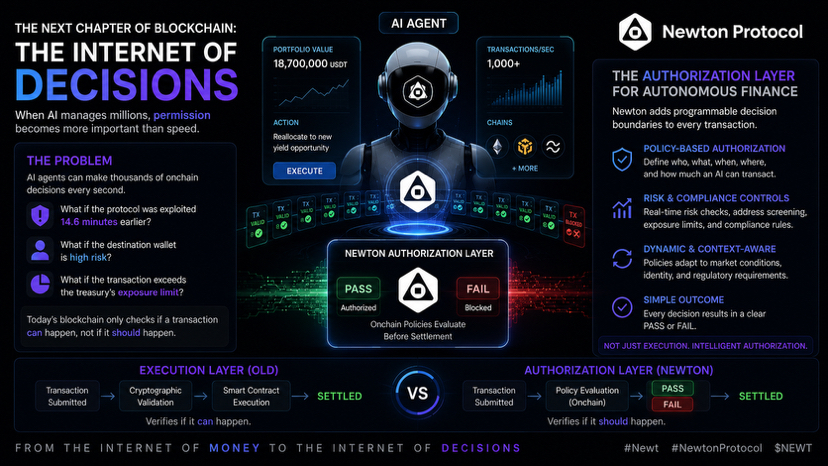
Imagine an AI managing 18.7 million USDT.
It identifies a new yield opportunity and starts reallocating capital.
Every transaction is technically valid.
Every signature has already been approved.
Every smart contract executes exactly as designed.
But what if the protocol was exploited 14.6 minutes earlier?
What if the destination wallet has just been flagged as high risk?
What if the transaction exceeds a treasury’s exposure limit?
Today’s blockchain infrastructure doesn’t ask those questions.
Execution has always been binary.
If a transaction is valid, it gets executed.
Blockchain verifies whether it can happen.
It rarely evaluates whether it should happen.
I think this is becoming one of the biggest infrastructure gaps as AI agents become more involved in finance.
Crypto spent years building programmable money.
Stablecoins made value move faster.
Smart contracts automated execution.
But autonomous finance introduces a different challenge.
Once AI begins acting on our behalf, the scarce resource is no longer speed.
It’s permission.
Who decides what an AI is allowed to do?
Under what conditions should it be allowed to move assets?
Can those rules adapt automatically based on identity, risk, compliance, or market conditions?
That’s why I find Newton Protocol particularly interesting.
Instead of building another execution layer, it introduces an onchain authorization layer that evaluates predefined policies before a transaction is settled.
The outcome is simple: pass or fail.
Yet that small change creates something blockchain has largely been missing—programmable decision boundaries.
Maybe the first chapter of blockchain was about building the Internet of Money.
The next chapter may be about building the Internet of Decisions.
And in that future, authorization could become just as important as execution.
#Newt #NewtonProtocol $NEWT $H $LAB