
After watching several crypto cycles unfold, I've come to realize that the industry often repeats familiar narratives with different protagonists. First it was DeFi reshaping finance, then the metaverse redefining the internet, and now AI has become the center of attention. We hear about autonomous agents, machine economies, and software capable of making decisions and interacting independently. Yet every time a new narrative emerges, I find myself asking the same question: who is actually using these systems today, and what real problem are they solving?
To me, that has always been crypto's biggest challenge. The issue isn't a shortage of funding or technical innovation. More often, the industry builds infrastructure first and searches for compelling use cases afterward. Protocols, token models, and incentive structures are launched with the expectation that meaningful adoption will eventually follow. AI-focused blockchains seem to be facing a similar test. The missing ingredient isn't necessarily better AI models or more computing power—it's demonstrating sustainable value beyond an attractive story.
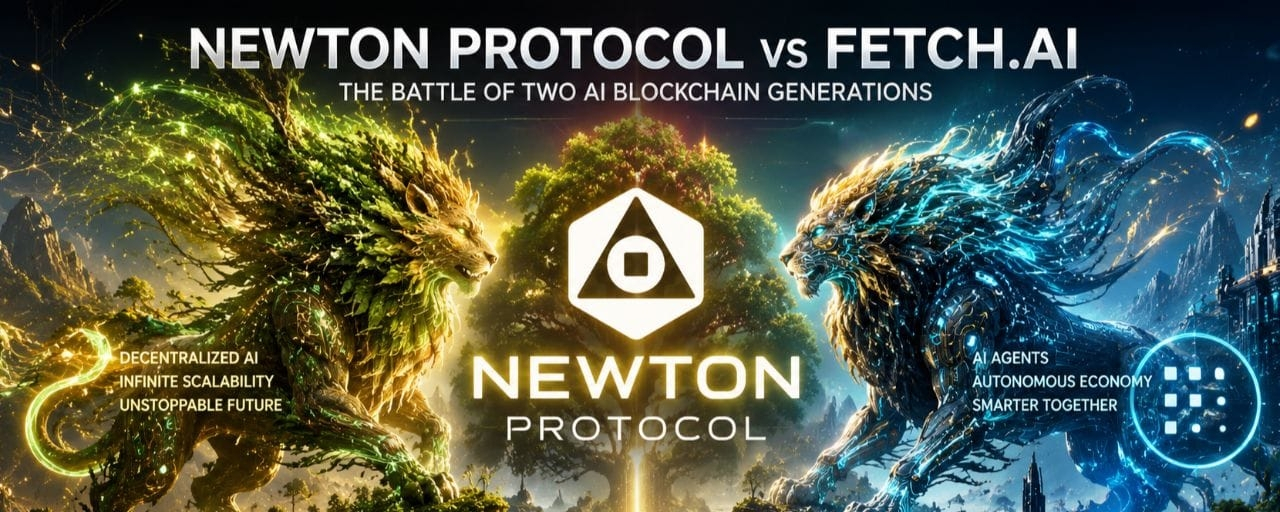
Viewed from that perspective, comparing Newton Protocol with Fetch.ai feels less like comparing two competing products and more like comparing two generations of ideas. Fetch.ai emerged early, when the concept of AI agents was still taking shape. Its vision centered on autonomous software entities that could communicate, negotiate, and coordinate with one another in decentralized environments. It's an ambitious concept, but after years of development, an important question remains: how large is the real-world demand for an independent on-chain agent economy?
Newton Protocol appears to approach the opportunity from a different angle. Instead of focusing primarily on building an entire ecosystem of autonomous agents, it seems more interested in the infrastructure that governs how AI behaves inside decentralized systems. The emphasis appears to be on coordinating, verifying, and establishing trust around AI-generated actions rather than simply expanding the number of intelligent agents operating on-chain.
That distinction stands out to me. Fetch.ai emphasizes creating an economy where autonomous agents interact freely, while Newton Protocol seems more concerned with ensuring those interactions are transparent, verifiable, and reliable. It's a less dramatic narrative, but sometimes the quieter infrastructure problems become the most important foundations for long-term adoption.
At the same time, I don't see this as a battle with a single winner. Crypto rarely follows the same competitive dynamics as traditional software markets. Some projects thrive for years because their narratives resonate with the market, while technically impressive projects may struggle simply because the timing isn't right. Fetch.ai had the advantage of becoming associated with the AI narrative early and building recognition around that position. Newton Protocol enters the conversation at a point where expectations are higher and investors are more skeptical, creating both opportunities and greater pressure to deliver.
Ultimately, architecture diagrams and whitepapers can explain a vision, but they cannot create adoption by themselves. Long-term success depends on whether people consistently use the network, whether someone is willing to pay for the value it provides, and whether that value remains meaningful even after the excitement surrounding the narrative fades.
That's why, when I compare Newton Protocol and Fetch.ai, I'm less interested in declaring a winner. What matters more is whether AI integrated with blockchain can solve genuine problems outside the crypto bubble—or whether this is simply another familiar cycle wrapped in a new technological narrative. For now, I think it's still too early to reach a final conclusion, and only real-world adoption over time will provide the answer.