
I.Why Has Grayscale Turned Its Attention Back to Solana?
Over the past few years, two words have almost always defined Solana: performance and memecoins.
As one of the leading Layer 1 blockchains from the previous market cycle, Solana rose to prominence thanks to its high throughput, low transaction costs, and near-instant finality. At the same time, ecosystem projects such as BONK, dogwifhat (WIF), and Pump.fun turned Solana into the epicenter of the memecoin boom. Yet this perception has also overshadowed a deeper transformation taking place across the network.
Recently, digital asset manager Grayscale published its latest report, "Solana: Crypto's Financial Bazaar," offering a comprehensive reassessment of Solana's investment thesis.
Perhaps the report's most important takeaway is not another discussion of transaction speed or technical performance. Instead, Grayscale argues that Solana is evolving from a high-performance blockchain into a platform capable of supporting large-scale economic activity.
Rather than describing Solana as simply the "fastest blockchain," Grayscale introduces a new concept: Crypto's Financial Bazaar.
A bazaar, in this context, is not merely a financial marketplace. It represents a vibrant digital economy where developers continuously build applications, users trade, borrow, lend, invest and make payments, while capital, information and value circulate freely across the network.
This framing signals a fundamental shift in how institutional investors evaluate Solana.
During the previous bull market, investors debated whether Solana's throughput could outperform competing blockchains. Today, the focus has shifted toward a different question: Can Solana continuously attract developers, retain users, and build lasting network effects?
The report suggests that this is not only a reassessment of Solana itself, but also a broader change in how the market values blockchain networks.
II.Blockchain Competition Has Entered a New Era
Looking back at the evolution of Layer 1 blockchains, it is clear that the competitive landscape has fundamentally changed.
In 2021, performance was everything.
Ethereum emphasized decentralization and security. Solana differentiated itself through speed and scalability. BNB Chain attracted users with lower transaction costs. Later, networks such as Aptos, Sui and Base entered the race, with TPS, gas fees and block production speeds becoming the primary benchmarks for evaluating public blockchains.
Today, however, infrastructure has become increasingly commoditized.
Many modern blockchains already offer near-instant settlement and extremely low transaction costs. As a result, technical performance alone is no longer enough to establish a sustainable competitive advantage.
Grayscale argues that what ultimately determines the long-term value of a blockchain is not its infrastructure, but the economic activity taking place on top of it.
Institutional investors are asking a different set of questions:
· How many real users are active every day?
· How much genuine economic activity occurs on-chain?
· How much revenue does the ecosystem generate?
· Can the application ecosystem sustain long-term growth?
This mirrors the evolution of the Internet.
In its early years, Internet companies competed through server capacity, bandwidth and page loading speed. As the industry matured, investors shifted their attention toward user growth, transaction volume, revenue generation and ecosystem strength.
Blockchain networks are now undergoing a similar transition.
TPS defines a network's theoretical capacity. Economic activity defines its actual value.
From this perspective, Solana's strengths have also evolved.
According to Grayscale, Solana now supports more than 1,000 decentralized applications, processes over 100 million daily transactions, and serves approximately 4.3 million daily active users, while ecosystem applications continue generating meaningful transaction fees and revenue.
These metrics suggest that Solana's competitive advantage is gradually shifting from technical performance toward application-driven growth.
For institutional investors, a network capable of continuously attracting developers, users and capital represents a far more compelling long-term investment than one that simply boasts higher throughput.
This explains why Grayscale devoted the majority of its report to applications rather than protocol-level innovations.
III. Three Applications That Define Solana's Next Growth Flywheel
Instead of highlighting a long list of successful projects, Grayscale focuses on three representative applications: Jupiter, Pump.fun and Helium (along with the broader DePIN sector).
Although these projects belong to very different categories—DeFi, consumer applications and decentralized physical infrastructure—they collectively illustrate Solana's evolving growth model.
Jupiter: Building the Financial Infrastructure
Many users first encountered Jupiter as a DEX aggregator.
Grayscale, however, argues that Jupiter has evolved far beyond this role.
In traditional financial markets, exchanges, brokers, market makers and clearing houses collectively provide market liquidity. Within blockchain ecosystems, DEX aggregators perform a similar function by connecting fragmented liquidity sources and routing transactions through the most efficient trading paths.
As more DeFi protocols continue launching on Solana, Jupiter has become one of the ecosystem's most important liquidity hubs.
Moreover, its product suite has expanded beyond token swaps into perpetual futures, launchpad services and cross-chain trading, positioning Jupiter as a comprehensive on-chain financial platform rather than merely a trading interface.
Its evolution demonstrates that Solana is increasingly capable of supporting sophisticated financial activity at scale.
Pump.fun: More Than a Memecoin Platform
Among the three applications, Pump.fun is perhaps the most controversial.
Over the past year, it has become synonymous with Solana's memecoin economy and is frequently criticized as a symbol of speculative excess.
Nevertheless, Grayscale intentionally includes Pump.fun among Solana's flagship applications.
The reason is straightforward.
Pump.fun demonstrates something that relatively few blockchain applications have achieved: the ability to consistently attract mainstream users while generating meaningful revenue.
According to Grayscale, Pump.fun has approximately 2 million monthly active users and generates around $1.2 million in daily revenue, making it one of the highest-grossing applications across the crypto industry.
For institutional investors, these business fundamentals matter far more than its association with memecoins.
From an Internet perspective, successful consumer platforms are defined by sustained user engagement, network effects and recurring revenue.
Pump.fun therefore serves as proof that Solana is capable not only of supporting financial infrastructure but also consumer-scale Internet applications.
More importantly, it stress-tested the network under periods of extraordinary activity, demonstrating Solana's ability to process massive volumes of transactions while maintaining usability.
Helium and DePIN: Extending Blockchain Into the Physical World
The third pillar highlighted by Grayscale is Decentralized Physical Infrastructure Networks (DePIN).
Unlike DeFi or memecoins, DePIN focuses on coordinating real-world infrastructure through blockchain technology.
Helium represents one of the most prominent examples, enabling communities to build decentralized wireless communication networks through distributed hotspot deployment.
Meanwhile, projects such as Geodnet provide high-precision positioning services that support autonomous vehicles, drones, robotics and other emerging industries.
Although these projects receive far less attention than speculative crypto assets, they represent an important long-term opportunity.
They illustrate how Solana's ecosystem is expanding beyond purely digital assets into real-world infrastructure.
From Grayscale's perspective, these applications broaden Solana's addressable market by connecting blockchain technology with telecommunications, artificial intelligence, the Internet of Things and other real-world industries.
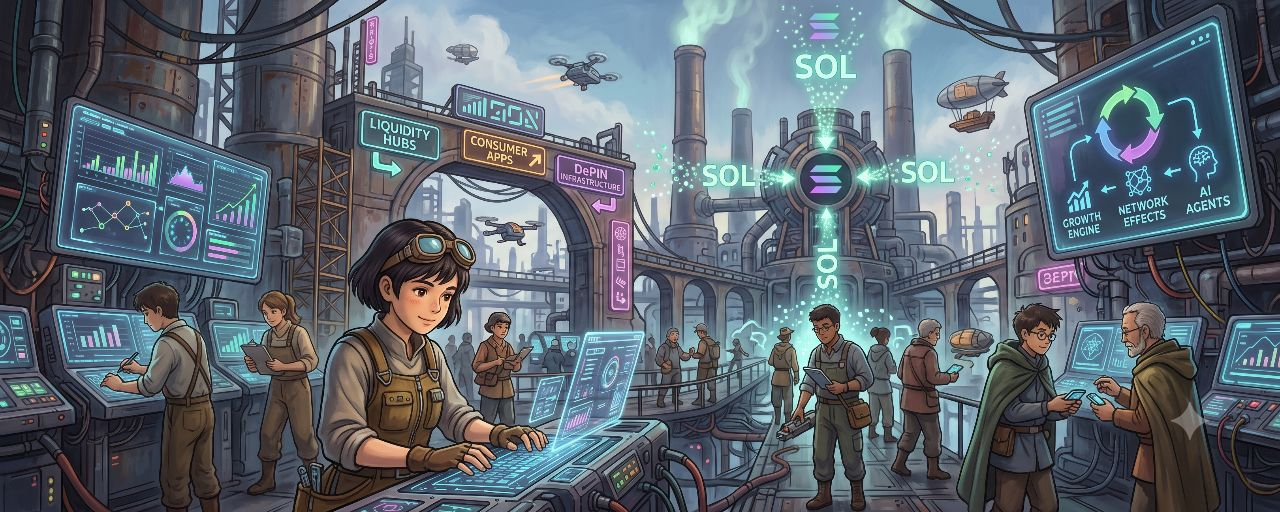
Taken together, Jupiter, Pump.fun and Helium outline a clear growth framework:
Financial infrastructure attracts liquidity.
Consumer applications attract users.
Physical infrastructure creates long-term economic demand.
As these three pillars reinforce one another, Solana's value proposition gradually shifts away from pure technical performance toward a sustainable, application-driven digital economy.
IV. From Memecoins to AI — Solana's Strategic Shift
If Grayscale's report explains what Solana is today, recent developments from the Solana Foundation reveal where the network is heading next.
Over the past several months, the Foundation's messaging has changed significantly.
Instead of emphasizing throughput, NFTs or memecoins, official communications increasingly focus on AI agents, stablecoins, payments, real-world assets (RWAs), tokenization and DePIN.
This is far more than a marketing adjustment.
It reflects Solana's ambition to position itself as infrastructure for the next generation of digital finance.
At several recent industry conferences, Solana Foundation President Lily Liu argued that blockchain's next major opportunity lies not only in serving human users, but also autonomous AI agents.
As AI systems begin purchasing data, renting computing resources and making machine-to-machine payments autonomously, blockchain networks capable of supporting high-frequency, low-cost transactions could become critical financial infrastructure.
Solana aims to become precisely that settlement layer.
V. Why Institutions Are Paying Attention Again
Grayscale is not alone.
Over the past year, asset managers, investment banks and research firms have increasingly revisited Solana's long-term investment potential.
Three factors explain this renewed interest.
First, Solana's application ecosystem has matured.
Projects like Jupiter, Pump.fun and Helium demonstrate that the network now supports multiple sustainable business models beyond speculative trading.
Second, stablecoins and payments have become strategic priorities.
As tokenized assets and digital payments continue expanding globally, Solana's efficiency and low transaction costs provide a compelling foundation for financial infrastructure.
Third, developer activity remains robust.
A healthy ecosystem depends on continuous innovation, and Solana continues attracting builders across DeFi, wallets, AI, payments and decentralized infrastructure.
Nevertheless, challenges remain.
Questions surrounding value capture, ecosystem sustainability, decentralization and long-term institutional adoption will continue shaping Solana's future trajectory.
VI. Grayscale Is Revaluing More Than Solana
Perhaps the most important insight from Grayscale's report is that it is not merely revaluing Solana—it is redefining how public blockchains should be evaluated.
During the previous market cycle, investors compared TPS, gas fees and consensus mechanisms.
Today, the more relevant questions are:
· Which network attracts the most users?
· Which ecosystem generates sustainable economic activity?
· Which blockchain supports real-world financial applications?
· Which platform can power AI, payments and tokenized assets?
The competitive landscape has fundamentally changed.
Blockchains are no longer competing solely as infrastructure.
They are competing as digital economies.
TPS still matters, but it increasingly resembles the maximum speed limit of a highway.
The true measure of a city's prosperity is not how wide its roads are, but how many people live, work, build businesses and create value there every day.
If Solana's previous narrative centered on performance, its next chapter will be defined by economic activity.
That, ultimately, is the central message of Grayscale's latest research.