
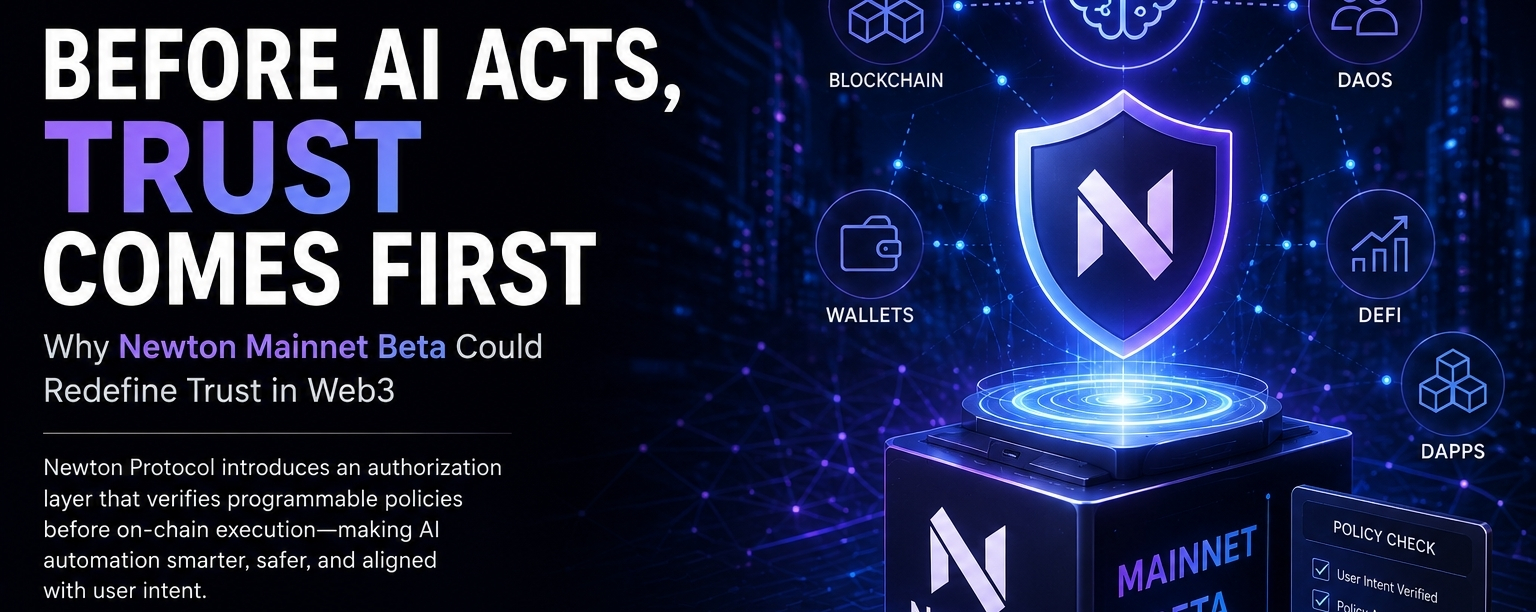
@NewtonProtocol Newton Mainnet Beta: Why Authorization Could Become the Missing Layer for AI in Web3
Artificial intelligence is changing the way people interact with technology. Over the past few years, AI has evolved from a simple assistant into something capable of analyzing information, making recommendations, writing code, managing workflows, and even preparing blockchain transactions. While these capabilities are impressive, they also introduce an important question that I believe deserves more attention: Who decides what AI is allowed to do?
Many discussions around AI focus on making models smarter or faster. In blockchain, conversations usually revolve around scalability, transaction speed, and lower fees. These are important goals, but I think another challenge is becoming increasingly significant as AI agents begin interacting with decentralized applications. Intelligence alone is not enough. Every automated action should follow clear rules, and users should know those rules are being respected before anything is executed on-chain.
This is one of the reasons I became interested in @NewtonProtocol. Rather than concentrating only on transaction execution, Newton introduces an authorization layer designed to evaluate programmable policies before blockchain actions are finalized. That idea immediately stood out because it changes the conversation. Instead of asking whether AI can perform an action, it encourages developers and users to ask whether AI should perform that action under a specific set of conditions.
At first glance, this may sound like a small technical improvement, but I believe it has much broader implications. Traditional blockchain infrastructure is excellent at verifying signatures and executing transactions according to protocol rules. However, the rise of AI-powered automation introduces situations where an additional verification layer becomes increasingly valuable. When intelligent systems are making decisions on behalf of users, simply checking whether a transaction is correctly signed may not always be enough.
Imagine an AI agent managing a digital wallet, participating in DeFi strategies, interacting with decentralized exchanges, or coordinating treasury operations for a DAO. These systems could save time and improve efficiency, but they also require clear boundaries. Users need confidence that automation cannot exceed permissions or behave unexpectedly. Authorization provides a framework for defining those boundaries before assets or data are affected.
That is why I think the Newton Mainnet Beta represents more than another network launch. Beta releases provide developers with an opportunity to move beyond theoretical discussions and test ideas in real environments. Every interaction, every application, and every piece of feedback contributes to improving the protocol before broader adoption. Real-world experimentation often reveals practical insights that cannot be discovered through documentation alone.
Another aspect I appreciate about Newton is that it does not attempt to replace blockchain security. Instead, it complements existing security models by introducing another decision layer. In many situations, preventing an unwanted transaction is significantly better than attempting to recover from one after execution. Prevention is often less expensive, less disruptive, and far more reliable than recovery.
As decentralized AI continues developing, I believe policy-driven authorization could become an important building block for future applications. Developers increasingly want software that can perform complex tasks automatically, but automation without clear limitations creates unnecessary risks. A system capable of verifying whether an action complies with predefined policies before execution offers a more balanced approach between innovation and user protection.
The Mainnet Beta also creates opportunities for developers to experiment with entirely new application designs. Rather than relying exclusively on permissions embedded within smart contracts, projects can explore workflows where authorization logic plays a more visible role. This may improve transparency for both developers and users because decision-making processes become easier to understand and audit.
From a broader industry perspective, I think blockchain is gradually entering a new stage. The first generation focused on decentralization. The next generation emphasized scalability and usability. Now, with AI becoming part of everyday digital experiences, trust in automated decision-making may become one of the industry's defining challenges. Infrastructure capable of verifying decisions before execution could become just as valuable as infrastructure capable of processing thousands of transactions per second.
Another reason I find this direction interesting is that it encourages responsible innovation. AI should not simply be powerful; it should also be predictable, transparent, and accountable. Users deserve confidence that automated systems operate within clearly defined rules rather than acting without meaningful oversight. Authorization layers help transform that expectation into technical reality.
Of course, every emerging technology faces challenges. Adoption depends on developer interest, community participation, ecosystem growth, and continuous improvement. The Mainnet Beta is only one milestone within a much longer journey. Nevertheless, every successful blockchain project begins with practical experimentation, constructive feedback, and gradual refinement. Those early stages often determine whether a promising concept eventually becomes widely adopted.
Looking ahead, I will be interested in seeing how developers integrate Newton Protocol into real applications. It will also be fascinating to observe whether authorization-based infrastructure becomes a standard component of AI-powered decentralized systems over the coming years. If automation continues expanding across Web3, solutions that improve trust without sacrificing decentralization could become increasingly important.
Ultimately, I believe the future of blockchain will not be defined only by faster networks or lower transaction costs. Long-term success will also depend on creating systems that users genuinely trust. AI will continue growing more capable, but capability alone is not enough. Trust must grow alongside intelligence.
That is why I see Newton Protocol as a project worth following. By exploring authorization before execution, it addresses a challenge that many discussions about AI and blockchain still overlook. Whether this approach becomes an industry standard remains to be seen, but the idea itself is both practical and timely. The Newton Mainnet Beta is an important opportunity to test that vision in a real-world environment, and I look forward to seeing how the ecosystem develops in the months ahead.