
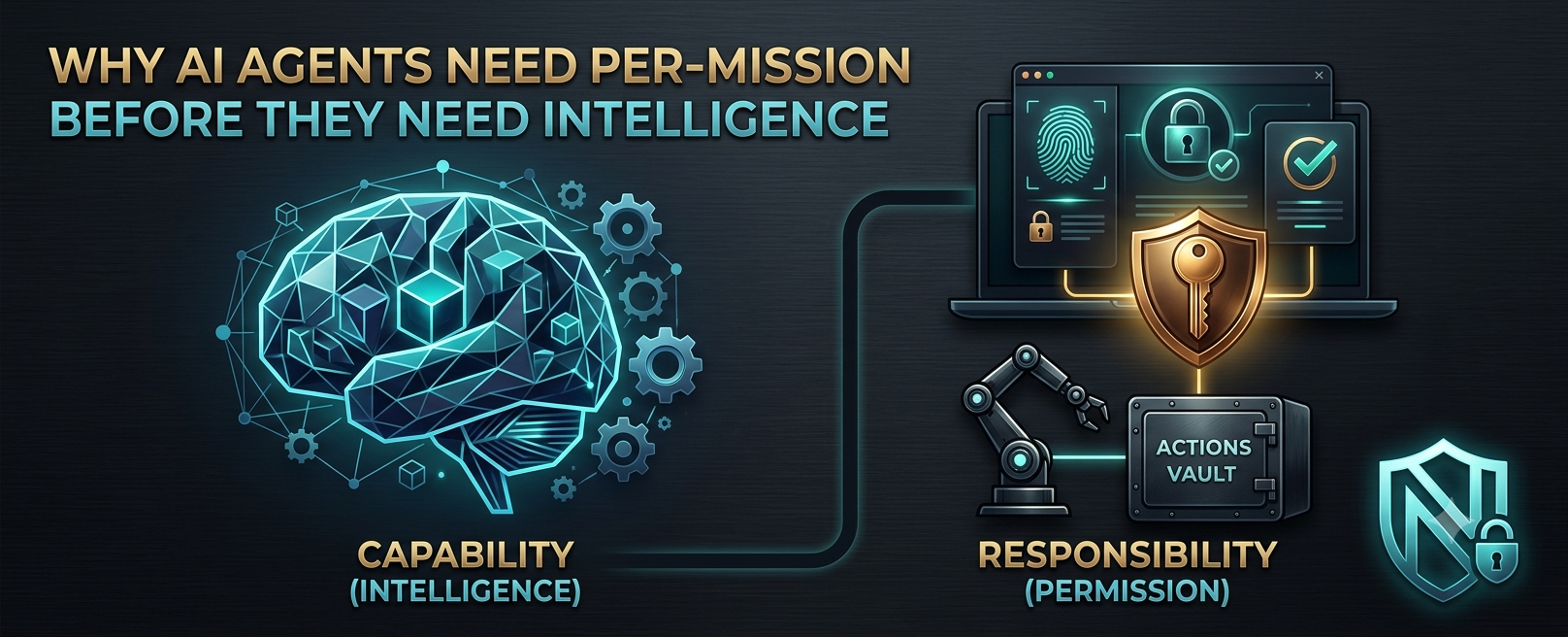
I was a few pages into Newton Protocol thinking I already knew how the story was going to end. I expected another conversation around AI infrastructure, autonomous agents, and systems becoming smarter over time. Lately a lot of projects seem to follow that path. Better models, faster decisions, more automation. After a while, you almost start predicting what comes next before you finish reading.
Then somewhere in the middle of it, I caught myself slowing down.
Not because the material was difficult.
Because one idea kept pulling my attention away from everything else.
People spend a lot of time asking how intelligent AI agents can become. I found myself thinking about a different question instead: if these systems eventually start handling wallets, moving assets, making trades, or interacting with financial systems on their own, who decides what they should actually be allowed to do?
That felt like a bigger question than intelligence itself.
Right now, when most people think about AI agents, they picture something useful helping with tasks. Maybe it organizes information, searches through data, or saves people time. But once an agent starts making decisions connected to money, things change very quickly.
Because intelligence alone does not automatically create judgment.
And capability does not automatically create responsibility.
That was where Newton started becoming interesting to me.
The way I understood it, Newton did not feel like it was trying to answer "How do we make AI smarter?" It felt closer to asking "How do we make sure AI acts within boundaries?"
When I stripped away the technical wording, the idea itself felt pretty simple. Instead of giving an AI system unlimited freedom, place conditions around actions before they happen.
Can this agent perform this action?
Under what circumstances?
What should be checked first?
Should some actions require stronger verification than others?
Newton seems to approach that through policy rules, identity checks, privacy-focused verification, and systems designed to confirm that requirements were actually met before something moves forward. Reading through it, I kept thinking less about AI itself and more about guardrails.
At the same time, I kept a few doubts in the back of my mind.
The design is not simple. Developers already work with enough moving parts, so asking them to bring in another layer is not a small ask. Some privacy technologies connected to the broader direction, like MPC and Fully Homomorphic Encryption, still feel more like a long road ahead than something people use every day. There are also questions around permissioned operators and whether certain trade-offs eventually appear around decentralization.
And I kept wondering about speed too.
Rules are useful. Rules create safety. But rules can also introduce extra steps. If AI agents eventually operate extremely fast, every checkpoint added to the process matters.
None of those thoughts felt negative while I was reading.
They felt like real questions.
I closed Newton with a feeling I was not expecting when I started.
I went in thinking about intelligence.
I came out thinking about permission.
Because once machines start making financial decisions, being smart may not be enough anymore. Knowing what an agent can do matters. But knowing what it should do might matter even more.