Market's been doing that thing lately where nothing moves for six hours and then everything moves at once. I was half-watching a few pairs, half-scrolling, and honestly not doing much useful with my time. So I ended up down a rabbit hole instead — someone in a group chat mentioned "AI employees" and @NewtonProtocol in the same sentence and I couldn't tell if that was marketing or an actual claim.
So I started looking at what $NEWT actually does. Not the pitch deck version, the mechanism version.
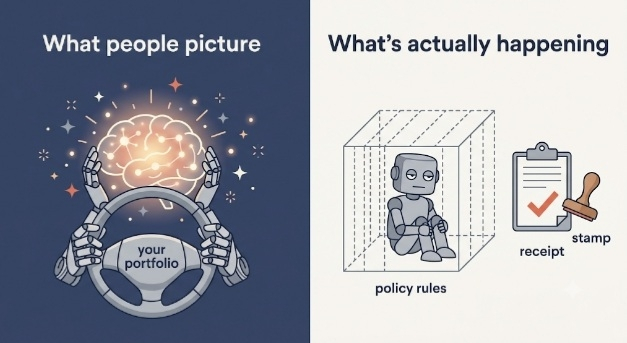
And here's where it clicked for me, sort of sideways from what I expected: everyone talking about this is framing it as "AI gets smart enough to trade for you." Like the story is about the AI. But the more I read, the more I think that's backwards. #newt isn't betting that the AI is trustworthy. It's built on the assumption that it isn't — that the agent will eventually do something dumb, get manipulated, or just misread a market — and the entire product is the cage around it, not the brain inside it.
That's a weird thing to market as "AI employees," when the real pitch is closer to "we assume your AI employee might screw up, so we built a system where it physically can't screw up beyond a certain point."
The mechanism is pretty simple once you strip the jargon. Every action an agent wants to take — a swap, a rebalance, a payment — gets checked against rules you set beforehand, inside a sealed execution environment, and then a cryptographic proof gets generated showing the action stayed inside those rules. You're not trusting the AI's judgment in the moment. You're trusting that the judgment was already boxed in before it acted, and you get a receipt proving it stayed in the box. Most people assume "AI agent" means the AI decides. Here, the AI proposes and the policy layer disposes — and there's a signed piece of paper about it after the fact.
Okay but here's the part that bothers me, and I keep going back and forth on it. Policies are still written by humans, in advance, based on conditions humans anticipated. The whole pitch is "verifiable automation" — but verifiable just means it followed the rule, not that the rule was the right rule in that moment. If the market does something genuinely weird, an agent can follow every guardrail perfectly and still make a call that loses you money, and the receipt will just calmly confirm that yes, it lost your money exactly as permitted. Verification isn't the same thing as good judgment, and I think that distinction gets flattened in a lot of the coverage I read. It's giving people the feeling of safety — the audit trail — without actually promising the outcome will be smart, just that it'll be accountable. Those aren't the same comfort, even though they get sold as one.
I'm also not totally sold on how this holds up once agents start composing with other agents across chains. One well-scoped agent with tight permissions is one thing. A marketplace of agents, some built by strangers, all interacting with your funds under policies you maybe didn't read closely enough — that's a different risk surface. The trust-minimization story works cleanly for a single actor. I'm less convinced it scales the same way once there are a hundred of them talking to each other.
Where this actually matters, I think, is less "should I let an AI trade for me" and more "who bears the cost when the policy itself was wrong." Institutions probably care about this a lot — compliance teams love a signed receipt. Retail users might just see "AI agent, sounds automated, sounds safe" and skip the part where the safety is only as good as the rules they set up front, which most people won't read carefully. That gap between what the branding implies and what the architecture actually guarantees feels like the thing worth sitting with, more than whether the AI itself is impressive.
Anyway. I didn't even open a chart after that, just kept rereading the docs trying to figure out where the actual failure mode sits. Market's still doing its quiet-then-violent thing. I'll probably circle back to this once there's real usage data instead of launch numbers.