
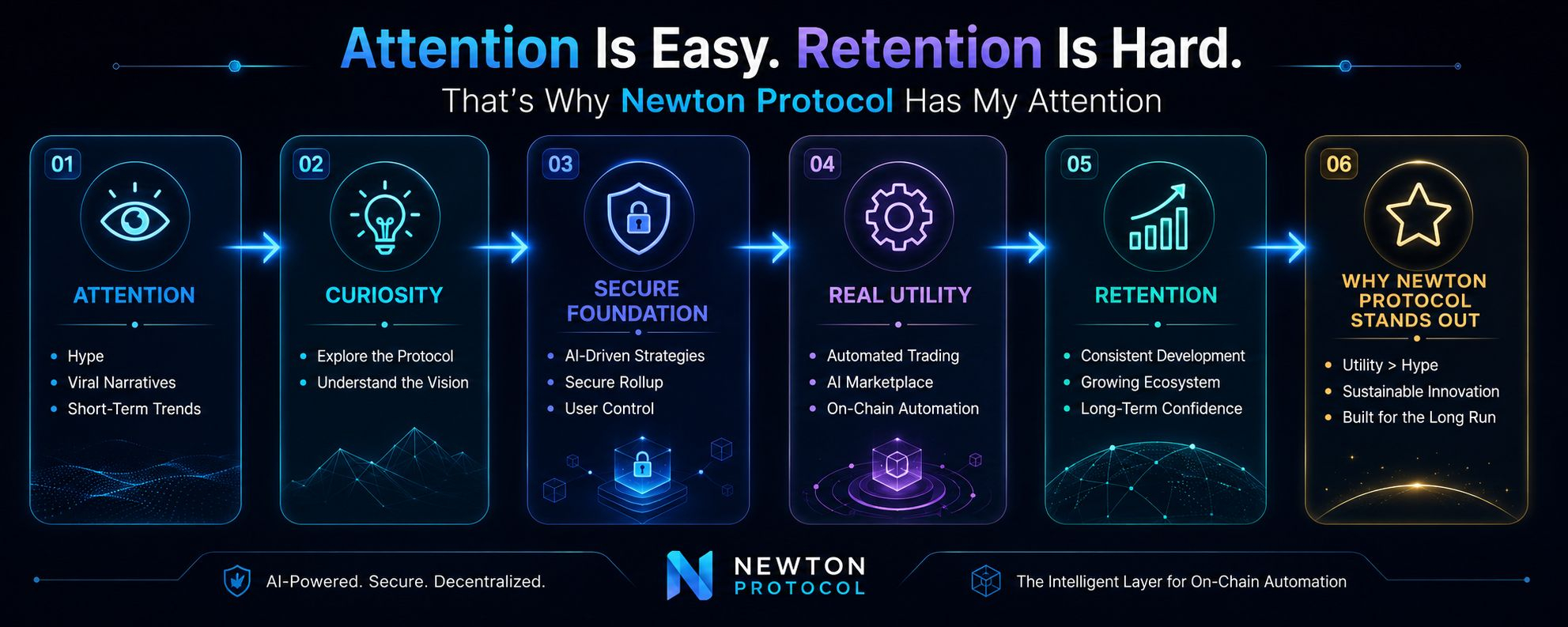
One thing crypto has taught me over the years is that excitement fades much faster than people expect.
I've watched projects explode in popularity, attract huge communities almost overnight, and then slowly disappear once the rewards became less attractive. It happened so many times that I eventually stopped judging projects by how much attention they receive. Attention is easy to generate. Keeping people around after the excitement fades is the difficult part.
That's probably why Newton Protocol ended up staying in my mind longer than I expected.
At first, I assumed it was just another project combining AI with blockchain because that's where the market's attention is right now. We've seen plenty of those. Some had impressive presentations. Some had big announcements. Most of them struggled when real users started behaving like... well, real crypto users.
People don't always use a protocol the way the team imagines.
They optimize.
They calculate.
They look for the fastest way to extract value.
That isn't necessarily a criticism of users. It's simply how incentives work. Crypto rewards efficiency, and if an ecosystem accidentally rewards extraction more than participation, people will naturally follow that path.
That's why I keep coming back to economics instead of marketing.
Newton Protocol is building a secure rollup designed for AI-driven strategies, automated execution, and a marketplace where developers can create AI agents. On paper, that makes sense. As more on-chain activity becomes automated, having infrastructure built specifically for AI interactions feels like a logical direction rather than just another trend.
But good technology doesn't automatically create a healthy ecosystem.
I've seen technically impressive projects struggle because the incentives underneath weren't strong enough. Once rewards slowed down, activity disappeared. Liquidity became thinner. Communities became quieter. The charts still existed, but the energy didn't.
That's the part I always pay attention to now.
I find myself wondering what happens when Newton is no longer the new project everyone is talking about.
Will developers still be building?
Will users still find reasons to stay?
Will the ecosystem create enough value internally that people don't immediately look for the exit?
Those questions matter more to me than launch-day numbers.
Lately, I've noticed Newton Protocol spending more effort on expanding its developer ecosystem and AI infrastructure instead of focusing only on short-term attention. If more builders create useful AI agents and those agents actually solve repetitive on-chain problems, that could gradually strengthen the network from within instead of relying purely on speculation.
Of course, that's still something that has to be proven.
Crypto has a funny way of exposing weak assumptions.
A dashboard can show thousands of active wallets, but that doesn't necessarily mean thousands of committed users.
High transaction volume can look impressive until you realize much of it comes from the same farming behavior repeating itself.
Growth can be real.
Growth can also be rented.
I've become much more careful about telling those two apart.
One thing I've learned is that healthy ecosystems usually create a little friction. Not the frustrating kind that makes people leave, but the kind that encourages people to build a reputation, participate, contribute, and think beyond today's rewards.
Without that, everyone becomes temporary.
And temporary communities rarely survive difficult markets.
That's another reason I think incentive design deserves more attention than marketing campaigns. A clever advertisement might bring people in, but it won't convince them to stay. Only the system itself can do that.
If AI becomes a bigger part of blockchain over the next few years, projects like Newton Protocol will face an even bigger challenge. Automated agents can make networks more efficient, but they can also move capital faster than ever before. That means the underlying economy has to be even more resilient. Weak incentive models won't simply struggle—they'll be exposed more quickly.
Maybe that's why I don't feel either overly optimistic or overly skeptical.
I'm simply paying attention.
I've seen enough market cycles to know that the strongest projects usually reveal themselves slowly. They aren't defined by the loudest announcements or the biggest spikes in attention. They're defined by how they behave once the market stops cheering.
Newton Protocol still has plenty to prove, and I actually think that's healthy. Every serious project should be questioned. Every economic model should be tested under pressure. That's the only way to know whether people are staying because the ecosystem creates lasting value—or because the rewards haven't ended yet.
For now, I'm not watching Newton Protocol because I think I already know how the story ends.
I'm watching because the questions it raises about AI, automation, user behavior, and sustainable incentives are far more interesting than the hype surrounding them.
And in crypto, those questions usually matter much more than the answers people rush to give.