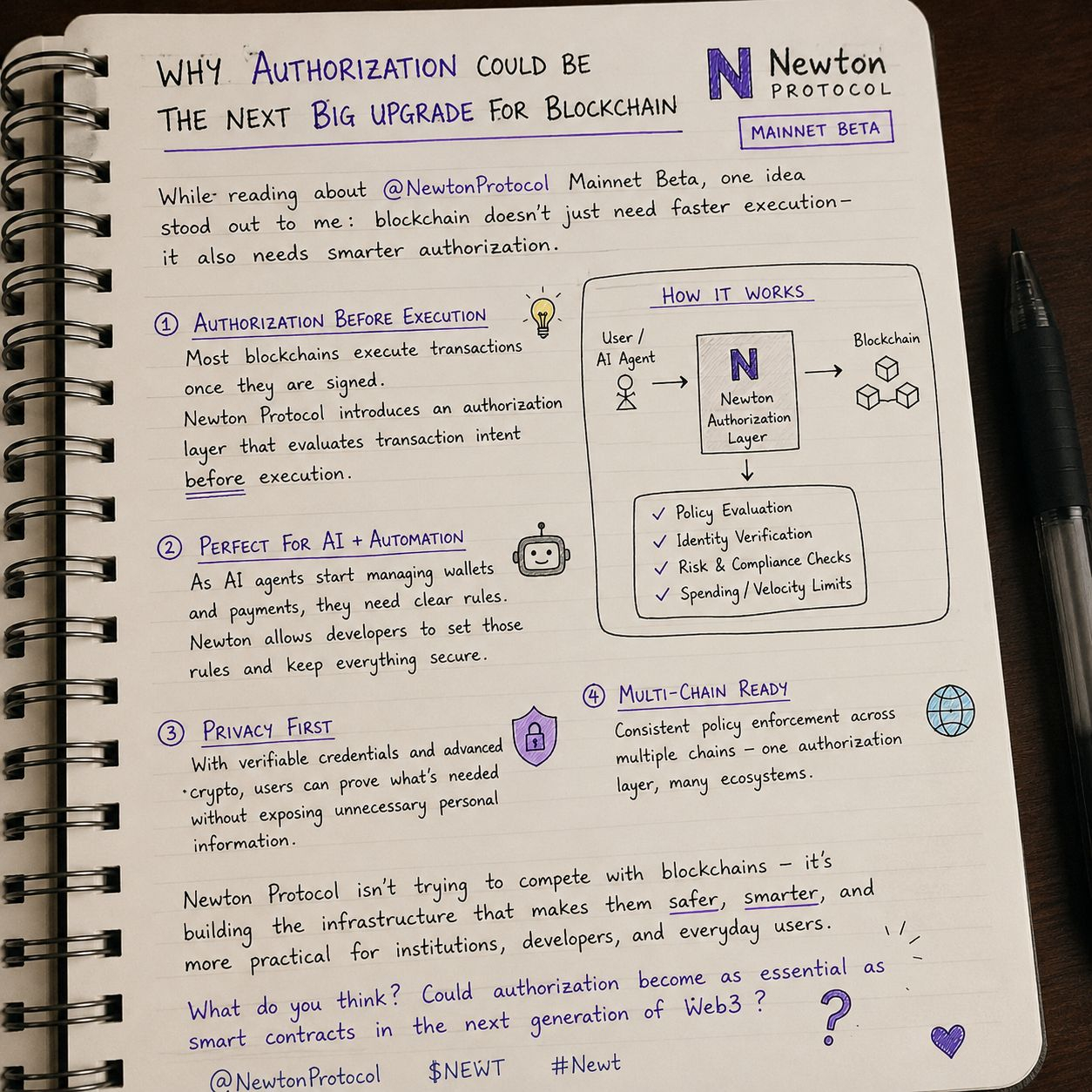
While reading about @NewtonProtocol Mainnet Beta, one idea stood out to me: blockchain doesn't just need faster execution—it also needs smarter authorization.
Today, most blockchains execute transactions once they are signed. Newton Protocol introduces an authorization layer that evaluates transaction intent before execution. Instead of replacing existing blockchains, it works alongside them by applying programmable policies such as compliance checks, spending limits, identity verification, and risk controls before a transaction reaches the chain.
This approach could become especially important as AI agents begin managing wallets and automated payments. AI can move at machine speed, but it also needs clear rules. Newton's authorization layer allows developers to define those rules while maintaining security and transparency.
Another feature I find interesting is Newton's privacy-first architecture. Through verifiable credentials and advanced cryptographic techniques, users can prove they meet certain requirements without exposing unnecessary personal information. This creates a balance between privacy and compliance that many Web3 applications will need.
The protocol is also designed for a multi-chain future. Instead of building separate authorization systems for every network, Newton aims to provide consistent policy enforcement across supported chains. That could simplify development while improving security across ecosystems.
To me, Newton Protocol isn't trying to compete with blockchains—it is building the infrastructure that helps them become safer, smarter, and more practical for institutions, developers, and everyday users. If the Mainnet Beta delivers on this vision, authorization could become one of the most important building blocks of on-chain finance.
What do you think? Could authorization become as essential as smart contracts in the next generation of Web3?