
I've stopped getting excited every time crypto discovers a new narrative.
First it was NFTs. Then GameFi. Then Layer 2s. Then restaking. Now almost everything has "AI" somewhere in the pitch deck. Sometimes I wonder if we're building products or just chasing whatever gets the most attention this month.
That's why I tried looking at Newton Protocol (NEWT) without the AI label for a minute.
If you ignore the buzzwords, what is it actually trying to build?
From what I understand, Newton isn't trying to replace traders or convince everyone that AI should control their money. It's trying to solve a much simpler problem.
How do you let software help manage your assets... without giving it unlimited power?
That question feels more important than people realize.
Right now, using AI in crypto usually comes with an uncomfortable trade-off. The smarter you want the automation to be, the more authority you end up giving it. And honestly... that has never sat well with me.
One bad prompt.
One bug.
One exploit.
Or worse... a prompt injection attack that manipulates an autonomous agent into executing something you never intended. Once LLM-powered agents start interacting directly with wallets, this stops being a theoretical discussion. It becomes a security problem.
That's where Newton's approach starts making sense.
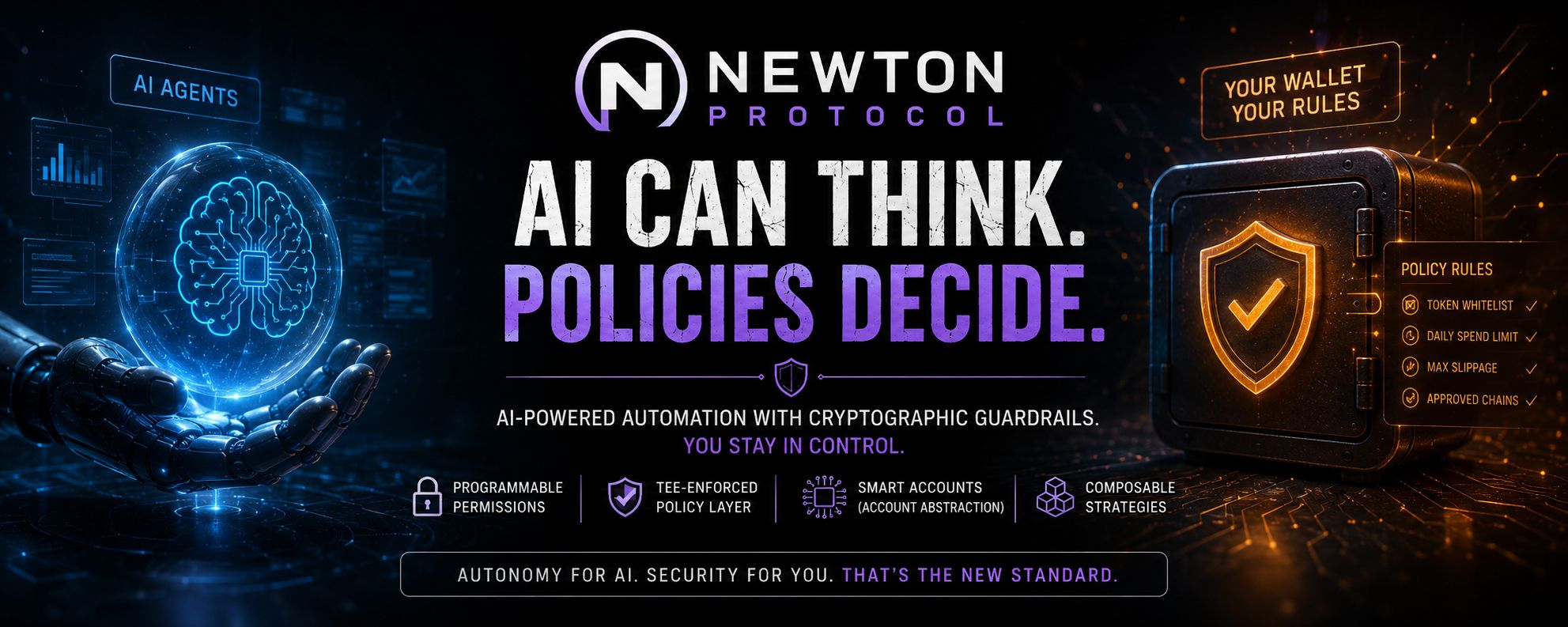
Instead of relying on software rules alone, it uses programmable policies through smart accounts built on Account Abstraction. In simple terms, the AI isn't "trusted" with your wallet. The wallet itself decides what the AI is allowed to do. If a policy says the agent can only swap approved tokens or spend below a certain limit, it simply cannot go beyond those permissions because the restrictions are enforced directly at the decentralized policy layer using Trusted Execution Environments (TEEs), not as a suggestion the AI can ignore.
That's a completely different security model.
The AI doesn't become more trustworthy.
Its authority becomes cryptographically limited.
I actually like that philosophy because crypto has always been about removing unnecessary trust, not creating more of it.
Look... automation isn't new. We've had trading bots for years. We've had portfolio trackers, copy trading, and smart contract vaults. AI just makes those tools more flexible.
But flexibility without guardrails eventually becomes a liability.
Newton seems less interested in building the smartest AI and more interested in building the safest execution layer around it.
There's a big difference.
Another part that caught my attention is the idea of developers publishing AI strategies that other users can access. If that ecosystem grows, Newton could end up looking more like a composable primitives layer than just another speculative utility token.
Of course...
That's also where execution becomes difficult.
Building technology is only half the job.
Getting developers to spend months building on your network is much harder. Crypto history is full of technically impressive projects that nobody actually used.
We've all seen ghost chains.
Fast transactions.
Low fees.
Beautiful documentation.
Zero TVL.
Barely any active wallets.
Completely empty dashboards.
Technology alone has never guaranteed adoption, and Newton doesn't get a free pass just because AI is the latest narrative.
Then there's the market itself.
People love simple stories. "This AI token will change everything" is much easier to sell than "this protocol provides programmable permission management for autonomous on-chain execution."
Infrastructure rarely becomes the loudest project on Crypto Twitter.
But the projects that quietly solve real problems often last longer than the ones generating daily headlines.
Honestly, I think Newton is betting on something bigger than today's market cycle. If autonomous agents eventually manage portfolios, execute cross-chain trades, optimize yield, or handle DAO treasuries, someone has to build the permission layer that keeps those agents under control.
That layer won't be flashy.
It probably won't become the next meme.
But it's the kind of plumbing that becomes valuable only after people realize they can't safely automate without it.
That said, I'm still cautious.
Security architectures only earn credibility after surviving real-world attacks.
Developer ecosystems take years to mature.
And AI regulation is still evolving, especially when software starts making financial decisions on behalf of users.
Those aren't small challenges.
Anyway... I'd rather see projects trying to solve practical infrastructure problems than launching another blockchain promising a million transactions per second while nobody actually uses it.
Newton isn't asking people to trust AI more.
It's trying to make trust less important by enforcing cryptographic permissions before an AI can ever touch your assets.
For me, that's the real idea worth watching.
Maybe Newton becomes a core security layer for agentic finance.
Maybe developers ignore it and move somewhere else.
Crypto has surprised me enough times that I wouldn't confidently bet on either outcome.
For now, I'm watching the signals that actually matter.
Not the token price.
Not influencer excitement.
Not trending hashtags.
I want to see developers building real applications, users trusting those applications with real capital, and on-chain metrics proving the network is alive. Growing TVL, consistent active wallets, and sustained usage will tell me far more than any marketing campaign ever could.
Because in crypto, narratives come and go.
Useful infrastructure usually sticks around.