
 I went back through my weekend notes today because one small thing kept bothering me.
While testing @NewtonProtocol ls pre-transaction enforcement flow, one transaction just... waited. Nothing failed, nothing was rejected, and eventually it settled. It simply took a few seconds longer than I expected.
My first reaction was, "The operator is probably just busy."
I would've left it at that if I hadn't refreshed the dashboard and seen the same operator handle another transaction almost immediately while mine was still sitting there.
That was the moment I realized I was making assumptions without actually knowing what had happened.
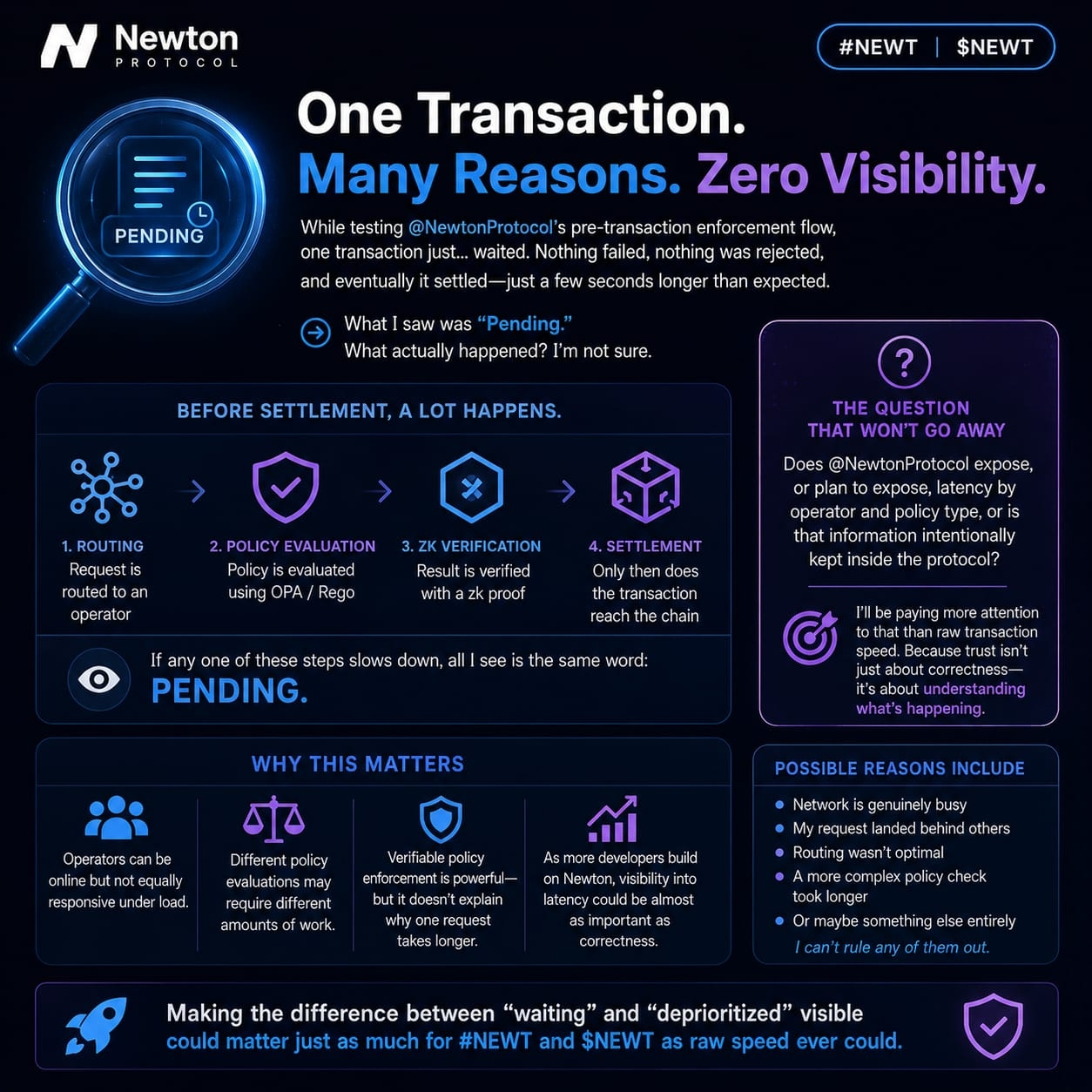
The more I thought about it, the more I realized how much takes place before a transaction reaches the chain. It isn't one action. A request gets routed, the policy has to be evaluated with OPA/Rego, the result is verified with a zk proof, and only then does settlement happen.
If any one of those steps slows down, all I see is the same word:
Pending.
But "pending" covers a lot of different possibilities.
Maybe the network is genuinely busy.
Maybe my request landed behind several others.
Maybe routing wasn't ideal.
Or maybe a more complex policy check simply wasn't handled as quickly as an easier one.
From where I'm sitting, those all look identical.
That got me thinking about operators.
Being online and being responsive aren't necessarily the same thing. An operator can be active, staked, and part of the AVS while still taking longer to process certain requests than others. And if different policy evaluations require different amounts of work, I think it's fair to ask whether every request naturally receives the same level of attention under load.
I'm not suggesting anyone is doing something wrong.
Honestly, I don't know.
That's exactly what makes it interesting.
Newton builds around verifiable policy enforcement, which is a strong idea. The zk proof tells me the policy was evaluated correctly. What it doesn't tell me is why one request took noticeably longer than another.
Maybe there's a perfectly reasonable explanation.
Maybe there are routing decisions happening that users aren't supposed to notice.
Maybe everything I observed was just coincidence.
I can't rule any of those out.
What I do think is that as more developers build on @NewtonProtocol understanding why a transaction is waiting could become almost as important as knowing that it was verified correctly. Trust isn't only about correctness. It's also about being able to make sense of what you're seeing.
At the same time, I don't think publishing every internal metric is automatically the answer either. Too much transparency can create its own incentives and unintended behavior. There's probably a balance somewhere in the middle.
One question has been stuck in my head ever since that test:
Does @NewtonProtocol expose, or plan to expose, latency by operator and policy type, or is that information intentionally kept inside the protocol?
I'll be paying more attention to that than raw transaction speed. For me, one of the most interesting things to watch next is whether the network eventually gives users a way to tell the difference between a transaction that's simply waiting and one that's quietly being deprioritized. That answer could matter just as much as anything else for #NEWT and $NEWT