
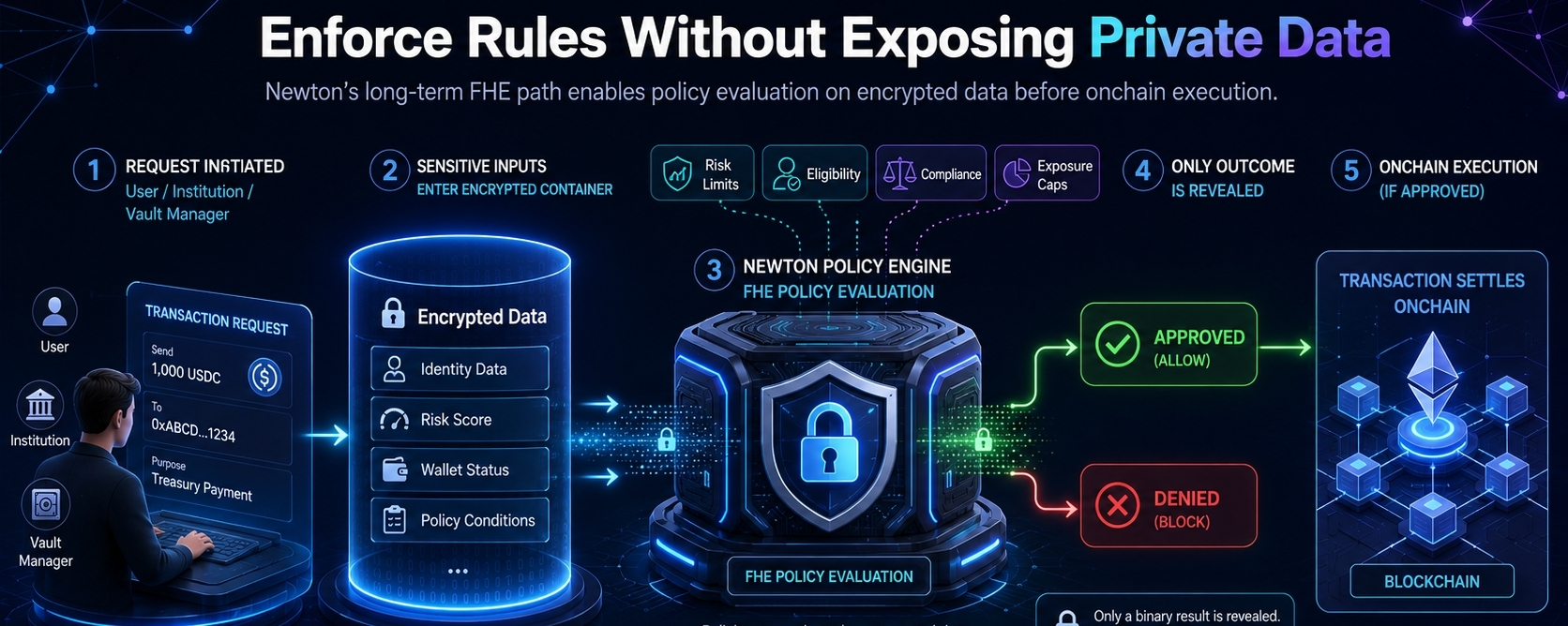

When I look at Newton’s long-term FHE direction, I do not see it as just another technical feature being added to a crypto protocol. I see it as a response to a problem that keeps showing up again and again in this space: how do we prove that rules are being followed without exposing everything behind those rules?
I think this matters because crypto has always leaned heavily on visibility. That is part of what made it powerful in the first place. Anyone can check what happened. Anyone can trace a transaction. Anyone can verify the state of a contract. I still think that openness is one of crypto’s strongest ideas.
But I also think it creates a real problem once more serious financial activity starts moving onchain.
I keep coming back to simple examples. A vault manager may need to prove that they are not taking too much risk. A stablecoin transfer may need to pass certain checks before it settles. A tokenized real-world asset may only be allowed to move between eligible users. An AI agent may need strict limits so it does not move funds outside its intended role.
In all of these cases, I can understand why a rule needs to exist. That part is easy. What is harder is figuring out how to check the rule without exposing private information that should never be public in the first place.
That is where Newton becomes interesting to me.
The way I understand it, Newton is trying to put policy checks in front of transactions before they execute. So instead of waiting for a risky action to happen and then reviewing it later, the system checks the action first. If it fits the policy, it can continue. If it does not, it gets stopped before settlement.
I like that idea because it feels more practical than simple monitoring. Monitoring can tell you what went wrong after the damage is already done. A policy layer tries to stop the wrong action before it happens. That difference may sound small, but in financial systems, it matters a lot.
I see the clearest example in vault management. A vault curator can promise depositors that they will follow a certain strategy, avoid certain markets, respect exposure limits, or keep fees inside a defined range. But promises are still promises. They depend on trust, reputation, and sometimes manual review.
Newton’s VaultKit points toward something stricter. It suggests that those promises can become transaction-level rules. If the curator tries to do something outside the allowed boundaries, the action can be blocked before it reaches the vault.
I think that is important because Newton does not need to replace the vault itself. It can sit between the curator and the vault, which makes the idea feel less disruptive and more usable. Builders usually do not want to throw away what already works. They want better controls without rebuilding everything from scratch.
But once I think about that policy layer for more than a minute, the privacy issue becomes impossible to ignore.
A policy engine needs information. It might need price data, wallet information, risk ratings, exposure levels, eligibility status, or other sensitive inputs. If every policy check exposes those inputs, then the system creates a new problem while trying to solve the original one.
That is why I find Newton’s long-term FHE path worth paying attention to.
Fully Homomorphic Encryption sounds complicated, but the basic idea is simple enough. It allows computation to happen on encrypted data. In other words, the system can check something without opening the private information first. The data stays encrypted, the rule still runs, and only the final result is revealed.
For Newton, I do not think the final result needs to be dramatic. Most of the time, the system only needs to answer one question.
Is this action allowed or not?
That is it.
And honestly, that small answer may be the whole point. A vault does not need to reveal every detail behind its risk model. It only needs to prove that a proposed move stays inside the allowed limits. A user does not need to reveal every identity detail to a smart contract. The contract may only need to know whether the user passed the required check. A compliance system does not need to publish sensitive information onchain. It only needs to produce a decision that the transaction can rely on.
I think this is where crypto needs to mature. For years, the default answer has been to make everything visible. That works for some things. It works for balances, transfers, and contract states. But it does not work for every type of financial data. Some information needs to stay private, even when the result needs to be verified.
So the better model, at least in my view, is not total secrecy and not total exposure. It is selective proof. Reveal the decision. Keep the unnecessary details closed.
Newton’s privacy path seems to move in that direction step by step. Basic encryption protects data from being openly visible. Threshold decryption reduces the risk of one party controlling the full key. Multi-party computation can let several operators work with private inputs without any single one seeing the full picture. FHE is the more ambitious version, where the policy can be checked while the data stays encrypted from beginning to end.
I do not want to make FHE sound easier than it is. It is not a simple switch. It is still heavy, slow compared with normal computation, and difficult to use at scale. I think anyone looking at Newton should be honest about that. FHE should be seen as a long-term path, not something that instantly changes everything overnight.
Still, I think Newton’s use case makes sense for it because policy checks are usually narrow. The system may only need to compare numbers, check thresholds, confirm permissions, or return a yes-or-no answer. That feels more realistic than trying to run huge private workloads on encrypted data.
That is also why Newton’s recent direction feels important to me. Its mainnet beta, VaultKit rollout, and data partnerships suggest that the protocol is trying to build useful authorization infrastructure first. Price feeds, risk ratings, and external data can all become part of policy decisions. Once that policy layer has real usage, stronger privacy becomes much more meaningful.
I do not think the real question is whether Newton can talk about FHE. Many projects can talk about advanced cryptography. The real question is whether Newton can build a policy system that people actually use before full FHE becomes practical.
That is what I would watch.
I would watch whether developers find the policies easy to write. I would watch whether vault managers can enforce rules without making their operations painful. I would watch whether institutions see value in private policy checks. I would watch whether users can interact with the system without feeling like they are dealing with something overly complex.
From an investor’s point of view, I would not treat FHE as a short-term price trigger. I think that would be the wrong way to read the story. The stronger signal is adoption. Are real applications using Newton? Are vaults relying on it for actual controls? Are data providers improving the quality of policy decisions? Are operators reliable? Are authorization receipts becoming useful?
If those things grow, then FHE becomes more than a future idea. It becomes a privacy upgrade for a network that already has a reason to exist.
The bigger point, at least for me, is that crypto does not need to choose between exposing everything and trusting blindly. That choice feels too limited. The more interesting future is one where a system can prove that a rule was followed without showing every private detail used to reach that decision.
That is why I think Newton’s FHE path is worth watching, even if it is still early and technically difficult.
It points toward private verification. And I think private verification is one of the missing pieces if crypto wants to support vaults, RWAs, stablecoins, lending markets, institutional wallets, and AI agents in a more serious way.
The most useful financial systems may not be the ones that reveal the most information. They may be the ones that reveal only what is necessary.
That is how I see Newton’s long-term FHE vision. A transaction does not always need to tell the whole story. Sometimes it only needs to prove that it was allowed.