
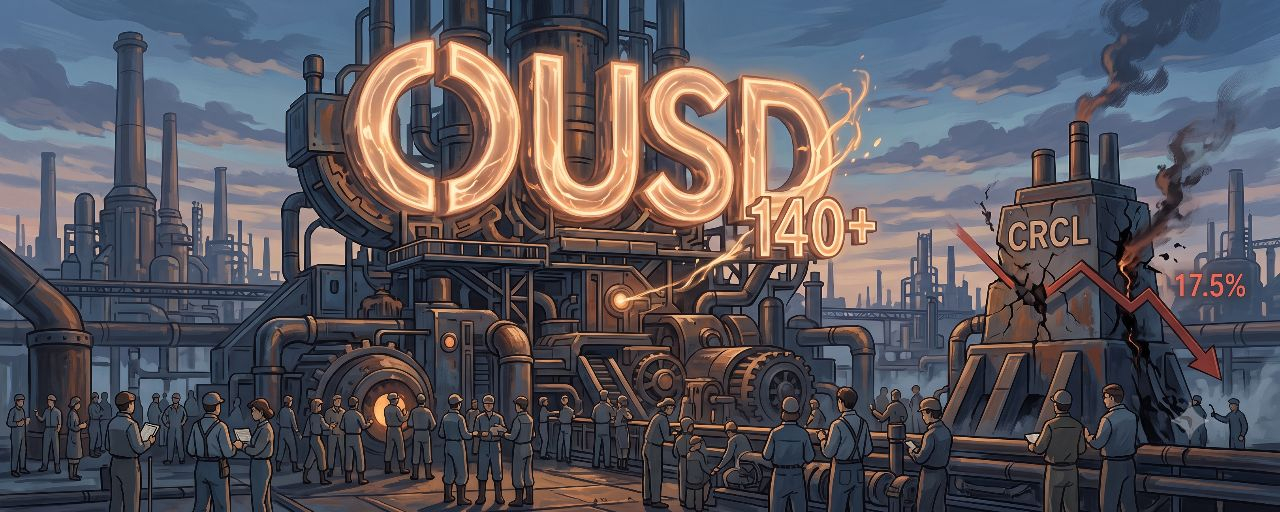
Yesterday, a new stablecoin announcement quickly dominated discussions across the crypto community and U.S. equity investors. More than 140 companies and institutions jointly introduced Open USD (OUSD), while Circle (CRCL) shares immediately fell by approximately 17.5%. At the same time, the latest Russell index rebalancing triggered additional selling pressure from passive funds. This event goes beyond the launch of a single product. It marks the accelerating integration of stablecoins from crypto-native tools into mainstream financial payment infrastructure, while prompting the market to reassess the real competitive impact of traditional financial giants entering the space. Below is a comprehensive breakdown of the event, OUSD, and its implications from multiple perspectives.
Complete Timeline of the Event
On June 30, the Open Standard Alliance officially published its introduction to OUSD. The alliance consists of more than 140 members, including traditional banks, payment networks, asset managers, technology companies, and crypto projects. OUSD is positioned as a U.S. dollar stablecoin designed for the internet economy. It features zero minting and redemption fees, reserve yield sharing, and a partner-governed model. The stablecoin is scheduled to launch on chains including Solana and Base in the second half of 2026.
At nearly the same time, FTSE Russell removed Circle (CRCL) from five major Russell Growth Indexes during its latest annual index reconstitution, including the Russell 1000 Growth, Russell 3000 Growth, and Russell Midcap Growth indexes. These indexes serve as key benchmarks for passive investment globally and are closely tracked by numerous index funds and ETFs. Any constituent adjustment automatically triggers mechanical buying or selling by passive funds, directly affecting stock liquidity.
The combination of the OUSD announcement and the index removal led to an approximately 17.5% decline in CRCL's share price in a single trading session, wiping out roughly $3.6 billion in market value. Circle founder Jeremy Allaire responded by emphasizing USDC's existing scale and adoption, while Tether expressed an open attitude toward additional competition. The event sparked extensive discussion across social media and trading platforms, leading investors to reassess the competitive landscape of the stablecoin industry.
OUSD: Background, Reserve Structure, and Key Participants
Open Standard is an open infrastructure alliance jointly established by enterprises with the goal of building a stablecoin system better suited for commercial and internet use. The alliance brings together participants from traditional finance, payment technology, and crypto, representing a practical step toward integrating mainstream finance with blockchain technology.
Its core members include major financial institutions and technology companies such as BlackRock, Visa, Mastercard, BNY, Standard Chartered, Stripe, Google, Samsung Electronics, IBM, and Shopify, alongside crypto and Web3 participants including Coinbase, OKX, Bybit, Bitget Wallet, Ripple, Crypto.com, Fireblocks, Gemini, MetaMask, Aave, Solana, and Base.
At present, OUSD's official documentation has not disclosed detailed information regarding its reserve composition. Based on the alliance's overall design philosophy, reserves are expected to primarily consist of highly liquid, low-risk assets such as U.S. dollars and short-term U.S. Treasury securities, likely managed by professional institutions including BlackRock. This approach is similar to USDC's transparent reserve model, while placing additional emphasis on reserve yield sharing. More details regarding reserve composition and audit arrangements are expected after the official launch.
Key Features and Advantages of OUSD
OUSD's design focuses heavily on practicality.
The first feature is zero minting and redemption fees, which significantly reduce transaction costs for institutions and high-volume users.
The second is reserve yield sharing. Partners receive a portion of the reserve interest income, strengthening incentives for ecosystem participation and encouraging broader institutional adoption through aligned economic interests.
The third is its extensive ecosystem support. Payment infrastructure from Visa and Mastercard, asset management capabilities from BlackRock, merchant integration through Stripe, and liquidity support from crypto platforms including Coinbase, OKX, Bybit, and Bitget Wallet provide OUSD with strong credibility and circulation potential from day one. Its alliance-based governance model also makes it attractive to developers and enterprises seeking an open architecture.
These features make OUSD particularly appealing for cross-border payments, corporate settlement, and internet commerce, especially for institutions looking to reduce costs while sharing reserve-generated returns.
The Practical Challenges Facing OUSD
Any new project ultimately requires execution to prove itself.
Decision-making across a large alliance requires coordination among many stakeholders, which may slow execution compared to a single-company structure. Balancing the interests of numerous participants will also require continuous coordination.
Meanwhile, USDC and USDT have already established strong network effects. To gain meaningful market share, OUSD must rapidly build real-world use cases and liquidity. As the project remains in its early preparation stage, the effectiveness of its post-launch execution will become one of the market's primary areas of focus.
How OUSD Could Impact CRCL
Increased Short-Term Competitive Pressure
OUSD's zero-fee model and reserve yield sharing directly challenge USDC's reserve interest revenue model. Investors have become increasingly concerned about Circle's future profitability. Combined with passive selling resulting from Russell index removal, these factors contributed to the sharp decline in CRCL's stock price.
Market Expansion Driven by Institutional Participation
The participation of traditional giants such as Visa, Mastercard, and BlackRock could significantly accelerate stablecoin adoption across mainstream payments and institutional finance, expanding the industry's total addressable market. As a publicly listed and regulated stablecoin issuer, Circle could ultimately benefit from participating in a much larger market.
Valuation and Trading Characteristics
Short-term sentiment has increased CRCL's volatility while also bringing valuations back toward more rational levels. If Circle continues expanding its payment network, blockchain infrastructure, and enterprise services, its Q2 earnings could become an important catalyst for recovery.
Long-Term Moat Under Review
The alliance model behind OUSD tests Circle's pace of innovation and ecosystem stickiness. However, USDC's existing circulation of tens of billions of dollars, mature application ecosystem, and regulatory advantages remain significant competitive buffers.
Overall, OUSD presents a combination of short-term headwinds for CRCL and long-term positives for the stablecoin industry. The ultimate outcome will largely depend on Circle's execution capabilities and continued demand growth for regulated stablecoins.
A Broader Look at the Stablecoin Industry
Stablecoins are gradually becoming one of the most important bridges connecting traditional finance with blockchain technology. The emergence of OUSD further accelerates this transition as banks and payment institutions begin actively participating in industry standards and infrastructure development.
From a business model perspective, zero fees combined with reserve yield sharing introduce a new incentive structure. This model encourages broader ecosystem participation, lowers service costs, and supports wider adoption.
Regulatory and macroeconomic conditions continue to shape the industry. Regulatory frameworks are creating clearer paths for compliant stablecoins, while increased competition is encouraging greater transparency and stronger risk management. U.S. dollar liquidity, interest rates, and global payment demand remain the key underlying macro drivers.
The participation of crypto platforms such as Coinbase, OKX, Bybit, and Bitget Wallet demonstrates that institutions increasingly prefer multi-platform strategies. The broad involvement of traditional banks and technology companies further reinforces the trend of stablecoins evolving into mainstream payment infrastructure. Rather than simply redistributing existing market share, the industry's overall market size is likely to expand as more high-quality participants enter the ecosystem.
Final Thoughts
The launch of OUSD, combined with the latest index rebalancing, highlights the beginning of a new phase in stablecoin competition. While short-term volatility has created adjustment pressure, it also reflects the normal evolution of a maturing industry.
Circle and every other participant will ultimately need to respond through execution rather than narratives.
Over the coming months, the progress of OUSD's launch, Circle's financial results, and changes in stablecoin circulation and adoption will serve as important indicators for evaluating the competitive strengths of each player. The stablecoin story is far from over. It is evolving from a crypto-native utility into a critical component of global payments and financial infrastructure. Beyond price movements, investors should pay closer attention to real business adoption and ecosystem partnerships.
Disclaimer: This article is for informational purposes only and does not constitute investment advice. The cryptocurrency market is highly volatile and involves substantial risk. Please conduct your own research and make independent investment decisions.