

The part of DeFi vaults that most people do not talk about enough is not the APY.
It is the control layer behind the APY.
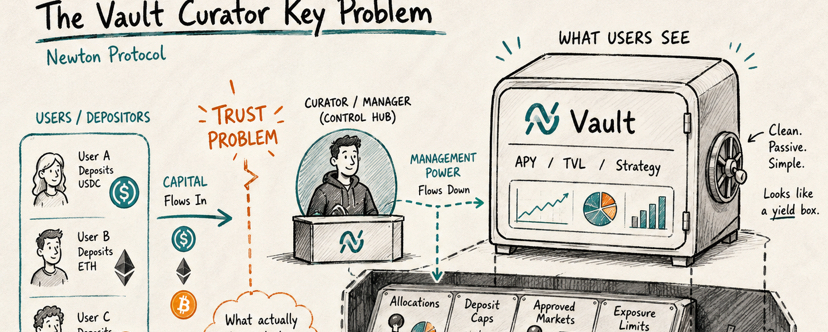
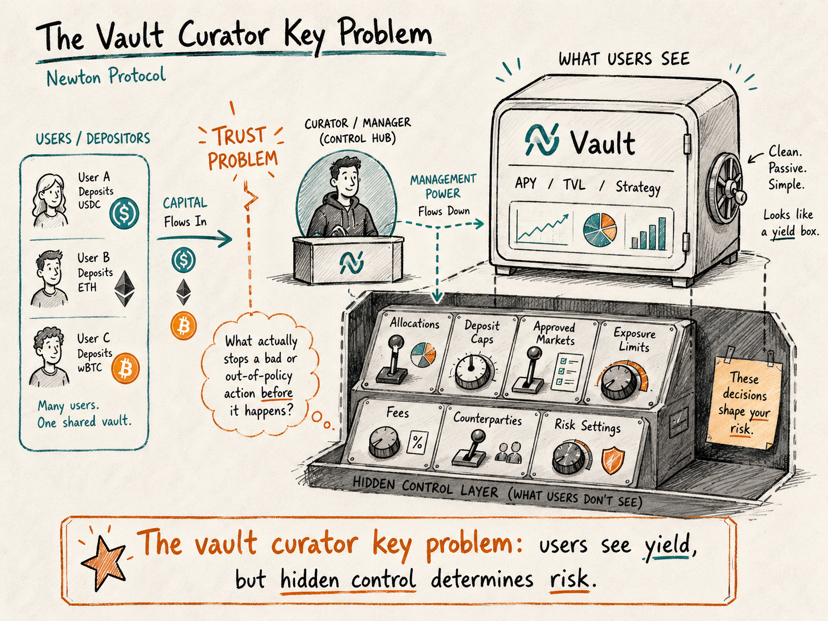
A vault can look clean from the outside. It may show deposits, yield, supported markets, strategy information, and a curator name. Users may see the vault as a passive product: deposit funds, let the manager optimize, earn yield. But under the surface, a vault is not passive at all. It is a system where someone or something is making decisions about capital.
That is where the real question begins.
Who decides where the money goes?
Who decides which markets are safe?
Who decides how much exposure is allowed?
Who decides whether the vault can change fees?
Who decides if one asset, one protocol, or one counterparty becomes too risky?
In many vault systems, the curator or manager has a lot of power. That power may be necessary because a vault needs active decisions. But it also creates a trust problem. The vault may say it follows a mandate, but users still depend on the curator not to move outside that mandate.
This is what I call the vault curator key problem.
The key is not only a technical admin key. It is the practical power to influence the vault’s direction. A curator may control allocations, deposit caps, markets, risk settings, exposure limits, fee settings, and strategy choices. Even when those controls are visible, the enforcement is often not strong enough.
The user is still left asking one uncomfortable question:
What actually stops a bad or out-of-policy action before it happens?
This is where Newton Protocol becomes relevant to me.
Newton is not just trying to add another analytics layer around vaults. The stronger idea is that Newton can turn vault rules into pre-settlement policy checks. Instead of only trusting that a curator will follow the rules, the transaction itself can be required to pass those rules before execution.
That is a very important shift.
A normal vault rule can be written in a document. A Newton policy can become a gate in the transaction path.
This matters because a vault mandate is only useful if it can stop actions that break the mandate. If a curator says the vault will only allocate to certain markets, the system should be able to block an allocation outside those markets. If a vault says it will not exceed a certain leverage level, the transaction should fail before the vault crosses that line. If a vault says it will not interact with risky counterparties, that check should happen before funds move.
Otherwise, the vault is asking users to trust the manager.
Trust is not always bad. Every financial product has some level of trust. But DeFi was not built to recreate the same hidden trust structure with a blockchain explorer attached to it. DeFi should make rules more visible, more verifiable, and more enforceable.
That is why Newton’s architecture is interesting.
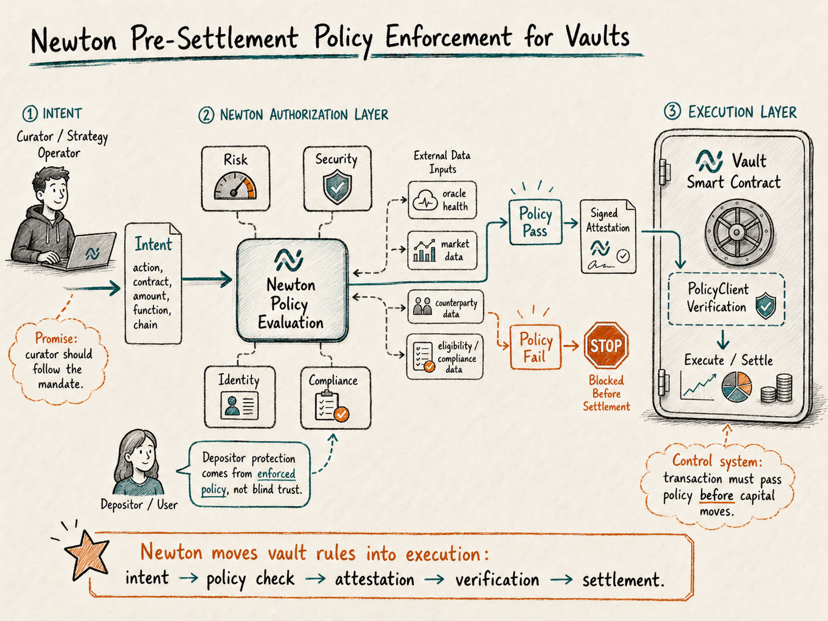
Newton adds an authorization layer between intent and settlement. A vault action starts as an intent. The intent describes the exact transaction: what action is being requested, which contract is involved, what amount is moving, what function is being called, and on which chain. Newton can then evaluate that exact intent against an active policy.
If the intent passes, operators produce a signed attestation. The vault’s smart contract can verify that attestation through the PolicyClient before allowing execution. If the intent fails the policy, the action should not execute.
This is not just monitoring.
Monitoring tells users what happened. Newton’s model is about deciding what is allowed before it happens.
That difference matters a lot in vaults.
A vault curator may need flexibility, but flexibility without hard limits can become a risk. If a vault can change allocations quickly, it can respond to market opportunities. But it can also create strategy drift. A vault may start with a conservative mandate and later move into more aggressive positions. The user may not notice until after risk has already increased.
Deposit caps are another example.
A curator may control how much capital a vault can accept. This sounds simple, but it affects risk. Too much capital in a thin market can create liquidity problems. Too much exposure to one strategy can weaken exits. A vault may need rules that prevent it from growing beyond safe capacity for a specific market.
If those caps are only manually managed, users are trusting the curator to act on time. A policy based system can make the cap part of the execution condition.
Markets are also important.
A vault may be allowed to interact only with approved protocols or assets. This is common in serious strategy design. Users deposit because they believe the vault has a defined risk box. If the curator can later move funds into a different protocol without a strong rule check, the user’s original risk assumption changes.
Newton can help here because the policy can define what types of actions are allowed. A vault transaction can be checked against approved markets, approved assets, counterparty conditions, oracle health, and other risk rules before the smart contract accepts the action.
Fees are another quiet control point.
People often focus on yield, but fees shape user outcomes. A curator may have control over performance fees, management fees, or strategy-related costs. If these can change without strong limits, users again depend on trust. A vault can look attractive at entry but become less attractive if fee settings change later.
A better system would make fee boundaries explicit and enforceable. The policy should define what can change, by how much, and under what conditions. If a proposed action breaks that policy, it should not pass.
This is why I think the vault curator problem is not only about one malicious actor. It is also about weak system design.
A curator does not need to be evil for users to face risk. They can make a poor decision. They can react late. They can misread market data. They can take more risk than users expected. They can change a parameter that looks small but has large downstream effects. They can rely on offchain checks that fail under pressure.
In fast markets, soft controls are not enough.
If a rule matters, it should sit before execution.
Newton’s strongest vault angle is exactly that: it can make the vault’s rules active before settlement. The transaction does not just go through and get reviewed later. It has to prove that it passed the policy.
This creates a better relationship between curators and depositors.
The goal is not to remove curators. Vaults still need strategy makers. They still need people or systems that understand markets, liquidity, risk, and yield opportunities. The goal is to reduce blind trust in curator discretion.
A good curator should actually benefit from enforceable policies because it makes their mandate clearer. They can show depositors that the vault does not only depend on personal discipline. It has rules that the transaction path must respect.
That can make vaults more credible.
For depositors, the question changes from Do I trust this curator? to What policy does this vault enforce before funds move?
That is a much stronger question.
It also fits the direction DeFi is heading. Simple yield farming does not need the same level of structure as institutional DeFi, RWAs, stablecoin systems, and automated strategies. But as more serious capital enters, the basic expectation changes. Larger users do not only ask about returns. They ask about controls.
What is the exposure limit?
What is the counterparty risk?
What stops the vault from using an unapproved market?
What happens if oracle data is unhealthy?
Can the strategy change without permission?
Can the curator bypass the rules?
Can a dangerous action be blocked before settlement?
Newton gives builders a way to answer these questions with execution logic instead of only words.
The four enforcement domains around Newton make sense in this vault context: compliance, identity, security, and risk.
Compliance can help avoid blocked or restricted interactions. Identity can support eligibility rules where needed. Security can block dangerous addresses or risky contract interactions. Risk can check things like APY conditions, leverage, counterparty exposure, oracle health, and market quality.
For vaults, risk is the most obvious domain, but the others matter too. A vault that wants serious capital may need all of these checks working together. The point is not to make every vault restrictive. The point is to let each vault define the rules it needs and enforce them before execution.
That is where Newton’s policy model becomes more powerful than a simple rule inside one contract.
Real vault policies may need outside data. They may need market data, risk data, identity data, compliance data, wallet data, or oracle data. A smart contract alone cannot easily manage all of that in a clean way. Newton’s model allows richer policy evaluation outside the core contract while still giving the contract a verifiable result.
That is the practical architecture.
The policy defines the rule.
The intent defines the exact action.
The task sends that action for evaluation.
The attestation proves the result.
The PolicyClient verifies the proof before execution.
This is how a vault rule moves from a statement into an enforceable condition.
To me, this is the difference between a vault with a promise and a vault with a control system.
A promise says the manager should behave.
A control system says the transaction cannot execute unless it passes.
That is a major difference.
It also changes how users can judge vaults. Today, many users judge vaults by APY, TVL, curator reputation, and supported assets. Those things still matter. But if Newton-style policy enforcement becomes more common, users may also start judging vaults by policy quality.
Does the vault have clear allocation limits?
Does it enforce market eligibility?
Does it check oracle health?
Does it limit counterparty exposure?
Does it restrict fee changes?
Does it block risky interactions?
Does it provide proof that these checks happened?
That would be a healthier market. It would push vaults to compete not only on yield, but also on enforceable risk design.
This is important because high APY without strong controls can become a trap. Users often enter vaults because the numbers look attractive. But yield is only one side of the story. The other side is how much freedom the vault has to take risk in order to produce that yield.
If the vault’s risk limits are not enforceable, the user may be buying a different product than they think.
Newton can help make that product boundary clearer.
This is why I see Newton’s vault focus as a strong first use case. Vaults already have the exact problem Newton is built to solve. They need flexible management, but they also need enforceable constraints. They need offchain data, but they also need onchain proof. They need curator judgment, but they also need user protection.
That balance is hard.
If rules are too rigid, the vault cannot adapt.
If rules are too soft, users carry hidden risk.
Newton sits in the middle by making rules programmable, checkable, and enforceable before settlement.
This does not mean every vault becomes safe automatically. A bad policy is still a bad policy. A weak rule can still allow risky behavior. Builders still need to design good policies. Users still need to understand what a vault allows. Newton does not remove the need for judgment.
But it improves the enforcement layer.
That is the real point.
The future of DeFi vaults should not be based only on curator reputation. It should be based on visible mandates, strong policy logic, and transaction level enforcement.
This is where NEWT has a deeper story than market hype. If Newton becomes the layer that vaults use to prove actions passed policy before execution, then the token narrative becomes connected to real infrastructure demand. The value is not just attention. The value is whether serious apps start depending on Newton for authorization.
The metric I would watch is not only the number of posts about Newton. I would watch how many vaults, smart accounts, stablecoin systems, and RWA products actually integrate policy checks into their execution path.
Because that is where the project becomes hard to ignore.
The vault curator key problem is simple but serious. Curators need control to manage capital, but users need protection from unchecked control. DeFi cannot solve that only with nice dashboards or public transaction history. Seeing what happened is useful, but it is not the same as stopping what should not happen.
Newton’s strongest idea is that vault rules should not sit outside execution.
They should become part of execution.
A vault manager can still make decisions. But the transaction should have to pass the vault’s active policy before capital moves.
That is the kind of infrastructure DeFi needs if it wants to handle more serious capital. Not just more yield. Not just more vaults. Not just more strategies.
More enforceable control.
My personal take is that the next important DeFi vault competition will not only be about who offers the highest return. It will be about who can prove the cleanest rule system around that return.
And if Newton becomes the layer that helps vaults prove those rules before settlement, then NEWT is not just part of a campaign narrative.
It becomes part of the next vault design standard.
