
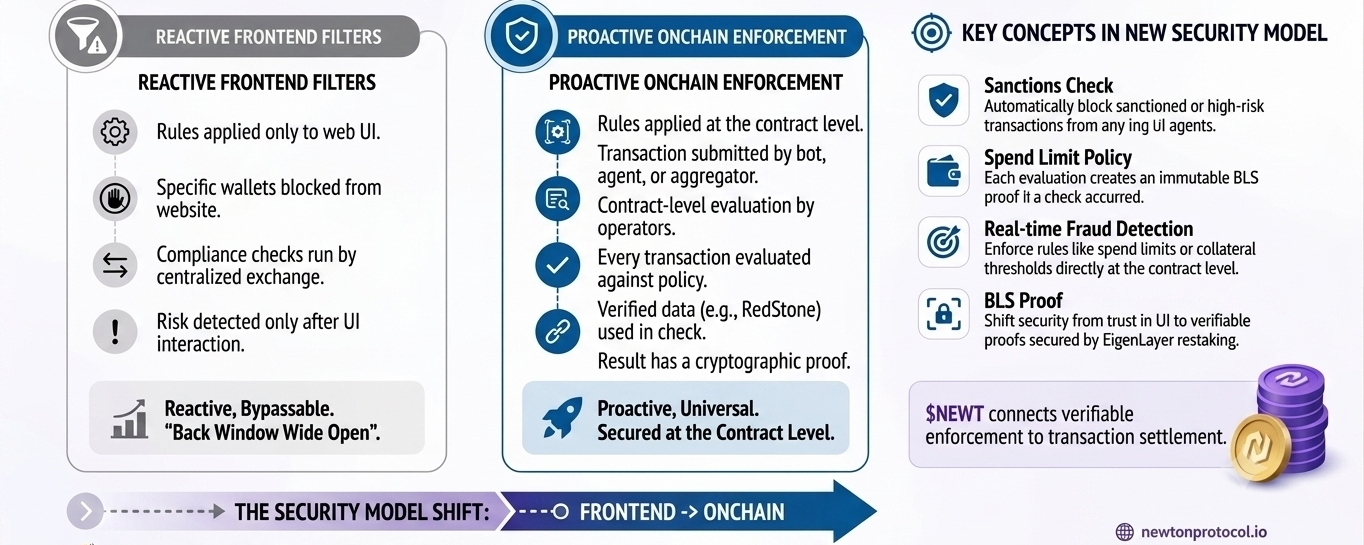
I want to talk about something that's been sitting in the back of my mind for a while, a security assumption that the whole crypto industry kind of built itself on without really questioning it.
The assumption is simple: control the frontend, control the risk.
Block the sanctioned wallet before they hit the UI. Run your compliance check at the exchange layer. Build your fraud detection into the website and trust that it'll hold. I get why everyone landed here. It was practical. It was fast. And honestly for a long time, when most users were showing up through official apps and interfaces, it mostly did the job.
But I think that era is quietly ending, and a lot of people haven't caught up to that yet.
The environment changed, the security model didn't:
Here's what's different now. A massive chunk of onchain activity never touches a frontend at all. Arbitrage bots calling contracts directly. DeFi aggregators routing through multiple protocols without a human ever seeing a confirmation screen. Automated trading systems executing thousands of transactions without anyone clicking anything.
And now we're adding AI agents into the mix. Autonomous programs managing wallets, executing strategies, handling governance votes, all without a human in the loop. These things don't log into a dApp. They don't see your carefully designed compliance UI. They hit the contract and that's it.
When that's the reality, frontend filters don't just become weaker. They become almost decorative. Whatever protection you built into your interface simply doesn't exist for anything bypassing it. The back door isn't just unlocked, it doesn't even have a lock.
I sat with that for a bit when I first really thought it through and it made me genuinely uncomfortable about how much of DeFi's security architecture is built on this assumption.
What actually changes with Newton's approach:
So when I started reading about Newton Protocol properly, not just skimming the headlines, the thing that struck me was that they're not trying to build a better frontend filter. They're scrapping the model entirely.
Newton sits at the contract level as an onchain authorization layer. Any transaction — from a user, a bot, an agent, whatever — gets evaluated against a policy before it settles. That policy is whatever the developer writes: a sanctions check, a spend limit, a fraud rule, a collateral threshold. The evaluation runs through a decentralized operator network secured by EigenLayer restaking, so you're not trusting some company's server, you're leaning on Ethereum's own security model. And every check produces a BLS attestation, a cryptographic proof that the evaluation actually happened and happened correctly.
That last part matters more than it might seem. With frontend compliance you're trusting someone's word that the check ran. With Newton's model the proof is onchain and verifiable by anyone. Nobody has to take anyone's word for anything.
Mainnet Beta is the part that really got my attention:
Everything I just described would be interesting theory if Newton was still years away from shipping. But Mainnet Beta is live. It launched with VaultKit, an SDK that lets developers actually write and deploy enforceable transaction policies. Not suggested guidelines. Not frontend warnings. Rules that fire before settlement regardless of where the transaction originates.
And the RedStone integration is something I think people are underestimating. Newton's policy checks can now pull live, verified price data from RedStone directly into the evaluation. That matters a lot because a rule like "block this transaction if collateral falls below X" is completely hollow if the price it's checking against is stale or manipulated. Real enforcement needs real data. That piece is now in place.
The AI agent question is what I keep coming back to:
Honestly the thing that keeps pulling me back to this is thinking about where crypto is heading over the next few years. More autonomous agents. More automated treasury management. More onchain activity that no human is supervising in real time.
In that world, frontend compliance isn't just imperfect. It's a completely wrong answer to the problem. You need enforcement that exists at the contract level, that fires on every transaction regardless of how it originated, that leaves a verifiable paper trail.
That's the gap Newton is filling and right now I don't see many other projects approaching it this way.
Where I'm landing on this:
I'll be straight with you, I'm still learning the finer details of Newton's attestation model and how the operator network functions under the hood. Some of this is genuinely technical and I'd rather admit that than pretend I have it all figured out.
But the big picture thesis feels solid to me. The onchain world has evolved past what frontend security was designed to handle. The question now is what fills that gap. Newton's answer is to move enforcement into the transaction itself, make it verifiable, and make it apply everywhere regardless of origin.
Mainnet Beta proves it's not just a concept anymore.
Following @NewtonProtocol closely as this develops.