
Look, I've been covering technology long enough to recognize a familiar pattern. Every few years, the industry finds two exciting ideas, bolts them together, and declares the combination to be the future. Twenty years ago it was cloud computing and social networks. Later it was blockchain and finance. Now the fashionable pairing is artificial intelligence and crypto.
Newton Protocol sits squarely inside that trend.
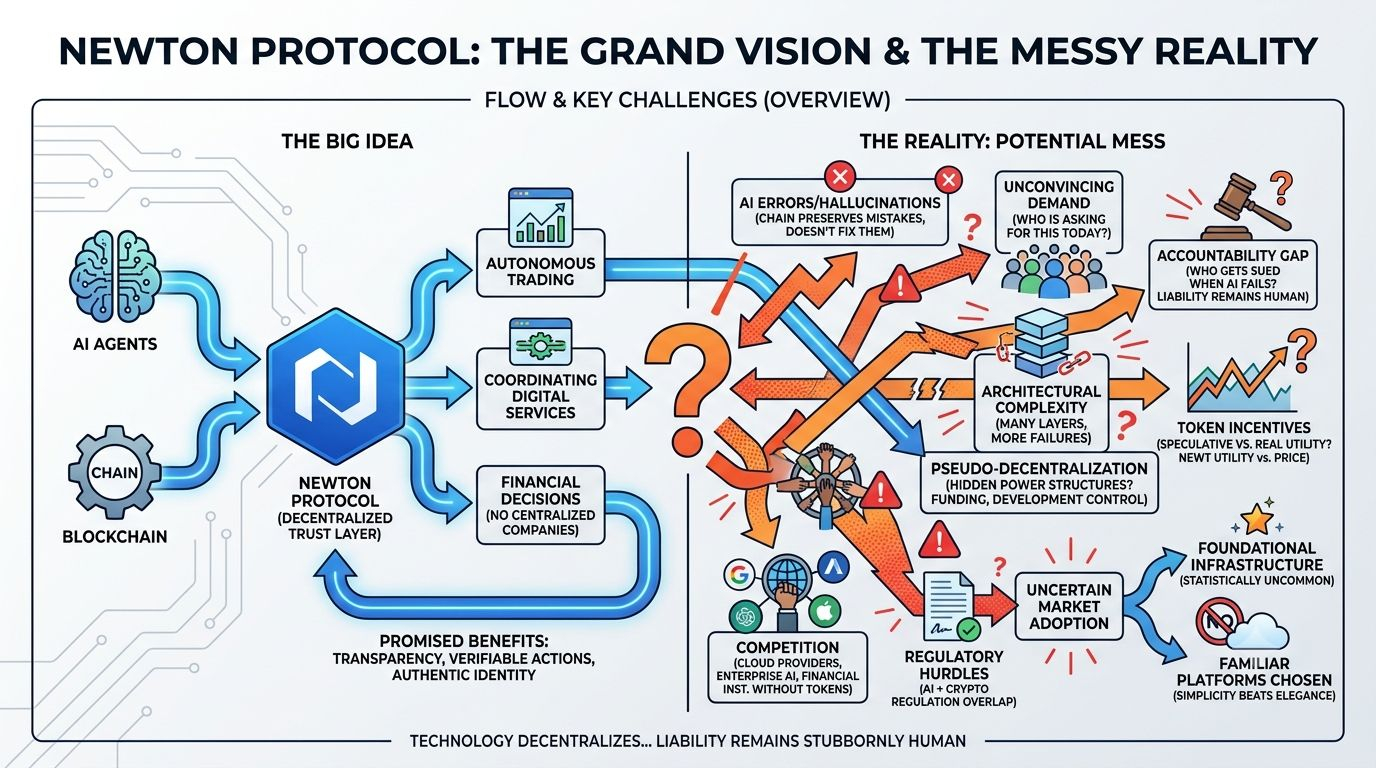
Its pitch is simple enough to understand. AI agents are becoming more capable. Blockchain provides transparent infrastructure. Put the two together and you supposedly get autonomous software that can trade assets, coordinate digital services, make financial decisions, and operate without relying on centralized companies.
It sounds tidy.
On paper, at least.
But I've seen this movie before.
Every generation of technology believes it has finally discovered the missing ingredient that earlier projects lacked. Every generation says, "This time it's different." Sometimes they're right. Most of the time, they're not.
The first question worth asking isn't whether Newton Protocol works technically. Engineers can build impressive systems. The harder question is whether the problem is large enough to justify another blockchain protocol.
The project argues that AI agents need decentralized infrastructure because they'll eventually perform economic activities independently. Instead of humans approving every transaction, software will negotiate contracts, execute trades, purchase computing resources, and coordinate businesses.
That's the dream.
The core problem they're trying to solve is trust.
If an AI agent is going to spend money or make financial decisions, other systems need confidence that the agent is authentic, authorized, and following agreed rules. Blockchain becomes the proposed trust layer. Every action gets recorded. Every transaction becomes verifiable. Every participant supposedly gains transparency.
Reasonable enough.
Until you start asking uncomfortable questions.
Who exactly is asking for this today?
That's where the story becomes less convincing.
Most companies aren't struggling because they lack blockchain infrastructure for AI. They're struggling because AI itself still makes mistakes. Large language models hallucinate. Autonomous systems misunderstand instructions. Machine learning models fail in strange ways when exposed to situations outside their training data.
None of those problems disappear because a blockchain records them permanently.
If an AI agent buys the wrong asset, signs the wrong contract, or executes a disastrous trade, blockchain doesn't fix the mistake.
It preserves it.
There's a big difference.
Let's be honest. Recording bad decisions with perfect transparency isn't the same thing as making good decisions.
Newton Protocol assumes that once identity and settlement become decentralized, trust naturally follows.
That's an optimistic assumption.
Trust doesn't come from cryptography alone. It comes from accountability.
And accountability remains stubbornly human.
Suppose an autonomous AI agent manipulates a market, loses millions of dollars, violates financial regulations, or simply behaves unpredictably.
Who gets sued?
The blockchain?
The validator?
The software developer?
The company deploying the AI?
Someone always ends up responsible.
Technology has never managed to decentralize legal liability, no matter how many white papers promise otherwise.
Then there's the architecture itself.
Newton Protocol relies on rollups to improve blockchain scalability. That's hardly controversial anymore. Rollups are becoming common because traditional blockchains simply cannot process enough activity cheaply.
So Newton isn't inventing an entirely new foundation.
It's building another specialized layer on top of existing blockchain infrastructure.
That raises another question.
How many layers do we actually need?
Think about the stack.
You've got an AI model making decisions.
That AI interacts with application software.
The application talks to smart contracts.
Those smart contracts operate on a rollup.
The rollup eventually settles transactions on another blockchain.
Each additional layer introduces new assumptions, new software, new security risks, new maintenance requirements, and new points of failure.
Complexity has a cost.
Technology companies often pretend otherwise.
Marketing brochures love words like efficiency, automation, and seamless integration.
Engineers know better.
Every extra layer eventually demands debugging.
Someone has to maintain it.
Someone has to audit it.
Someone has to explain it to regulators.
Someone has to fix it at three o'clock in the morning when something unexpected breaks.
That's rarely mentioned in promotional presentations.
The incentives deserve even closer attention.
Every blockchain project has a token.
Newton has NEWT.
Naturally, the token is described as essential for network operations, governance, incentives, and ecosystem participation.
You've heard this story before.
Maybe the token genuinely becomes indispensable.
Maybe it doesn't.
History isn't encouraging.
Crypto has produced hundreds of tokens described as critical pieces of future infrastructure.
Many eventually became little more than speculative assets disconnected from actual product usage.
The difficult question isn't whether NEWT has theoretical utility.
The difficult question is whether businesses would still want Newton Protocol if the token didn't appreciate in price.
That's a much harder sales pitch.
The marketing also talks about decentralization.
That word deserves skepticism every single time it appears.
Who controls protocol upgrades?
Who decides software standards?
Who writes the reference implementation?
Who funds development?
Who owns most of the tokens?
Who influences governance votes?
Many supposedly decentralized ecosystems eventually reveal surprisingly centralized power structures once you examine token ownership, development activity, and funding sources.
Decentralization often exists on a spectrum rather than as an absolute condition.
Reality tends to be messier than slogans.
Another issue receives remarkably little attention.
Competition.
Newton Protocol isn't competing against empty space.
It's competing against cloud providers with enormous engineering budgets.
It's competing against enterprise software companies already integrating AI into existing platforms.
It's competing against financial institutions building private infrastructure that businesses already trust.
Those competitors don't need tokens.
They already have customers.
That matters.
Technology doesn't win simply because it's technically elegant.
It wins because organizations decide adopting it creates fewer headaches than sticking with what they already have.
Newton must prove that decentralized infrastructure solves enough real problems to justify introducing blockchain complexity into enterprise AI workflows.
That's a very high bar.
Then comes regulation.
Financial regulators are already examining cryptocurrency.
AI regulators are already examining autonomous decision-making.
Newton Protocol sits directly where those two regulatory worlds intersect.
That's not necessarily a comfortable place to build a business.
Governments tend to become much more interested once autonomous software begins handling real money.
Compliance requirements don't disappear because software calls itself decentralized.
Neither do legal obligations.
I've also noticed something else after watching technology cycles for two decades.
The most successful infrastructure projects usually don't spend much time talking about changing the world.
They spend their time quietly solving one expensive problem extremely well.
Newton Protocol is attempting to solve several enormous problems simultaneously.
AI coordination.
Digital identity.
Blockchain scalability.
Autonomous finance.
Developer marketplaces.
Decentralized governance.
Machine-to-machine commerce.
Each one would be ambitious on its own.
Combined together, they create a project whose success depends on almost every assumption proving correct at roughly the same time.
That isn't impossible.
It's just statistically uncommon.
Maybe Newton Protocol becomes foundational infrastructure for autonomous AI economies.
Maybe businesses embrace decentralized machine identities.
Maybe developers build thriving ecosystems around autonomous software agents.
Or maybe companies continue choosing familiar cloud platforms because simplicity beats architectural elegance when real money and real customers are involved.
Technology history is crowded with brilliant systems that solved problems few people actually had. That's the uncomfortable question hanging over Newton Protocol, and no amount of sophisticated engineering can answer it until the market does.
