
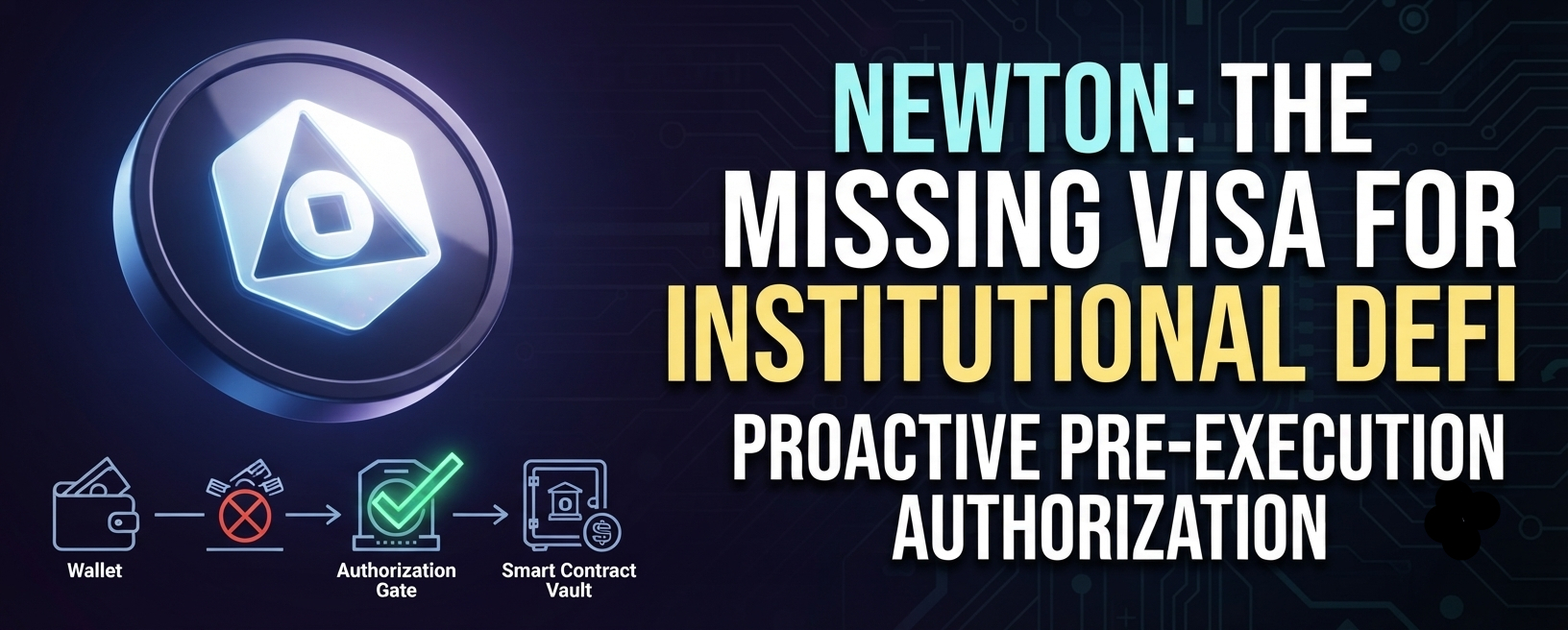

EveryOne is focused on tracking what already happened. The bigest mistake institutional investors make is equating surveillance with safety.
Think about it. Nearly every security tool in crypto is just a sophisticated flight recorder. They monitor wallets, log data, and generate alerts after funds are stolen, sanctions are breached, or rogue trades settle onchain. You get a notification about the damage that's already done. You are essentially paying for a beautifully written obituary for your capital.
This reactive mindset ignores a structural flaw in blockchain architecture. Public blockchains are pure settlement rails. If you possess a private key and gas money, a smart contract will execute blindly. It does not care about your internal risk mandates, your credit limits, or whether a counterparty is sanctioned. The decision to settle assets and the settlement itself happen instantly, with zero policy checks in between.
We are missing a critical separtion layer the exact mechanism that has kept traditional finance secure for decades.
Look at the Visa network. When you swipe a card, money does not instantly leave your bank. The terminal pings Visa's authorization network first. It checks your balance, flags fraud, and validates your limit. The payment proceeds only after receiving a pass. Crypto has historically lacked this filter. That is precisely the void Newton fills.
Newton introduces a proactive pre-execution authorization layer. It sits directly in front of the smart contract, evaluating the transaction against programmable business rules before a state transition occurs. Critically, Newton achieves this through a decentralized network of verifiers, not a single centralized gatekeeper. This preserves data sovereignty while issuing a cryptographic pass/fail attestation onchain. If the check fails, execution stops dead. This is not surveillance it is automated prevention. Using Newton, institutions finally force the blockchain to ask for permission based on logic, not just verify a cryptographic signature. This pre-execution check adds minimal latency—a negligible trade-off when measured against the catastrophic cost of a rogue transaction—and Newton optimizes attestation generation to keep gas overhead predictable and efficient.
This shift has immediate value in complex environments like curated DeFi vaults. Risk curators managing billions on platforms like Morpho or Euler currently rely on offchain spreadsheets and legal agreements to set boundaries. The smart contract remains blissfully unaware of those human rules. A tired operator or a compromised key can route capital into a toxic pool instantly.
With developer toolkits like Newton's VaultKit, these policies become ironclad code. A vault can enforce a hard concentration cap never allocating more than 15% to a single protocol. It can automatically block deposits if an asset's secondary liquidity drops below $50 million. It can gate interactions strictly to KYC-passed addresses. Newton transforms abstract financial policies into technical enforcement. Importantly, the framwork is architected to prevent mempool leakage, shielding institutional flow from front-running and MEV extraction bots that prey on pending transactions.
Over the next decade, institutional capital will not enter DeFi without programmable guardrails. The era of blindly trusting smart contract code with corporate treasury logic is ending. The winners will architect compliance directly into the transaction pipeline, moving from reactive reporting to preventative control.
and ultimately you cannot police value in motion you must validate it befor it moves. With Newton, the rule is the code, and the code is the gate.
