
I'll admit something... when I first came across Newton Protocol, I almost skipped it.
Not because it looked bad, but because I've reached the point where every other crypto project seems to have "AI" attached to it. After reading dozens of whitepapers and announcements over the past year, everything starts sounding the same. AI agents. Autonomous trading. Smarter automation. The future of finance. After a while, those phrases stop meaning much on their own.
But the more I read about Newton Protocol, the more I realized that AI wasn't actually the part that kept grabbing my attention.
The real question was much simpler.
Can people trust AI to control financial decisions?
That feels like the problem Newton is actually trying to solve.
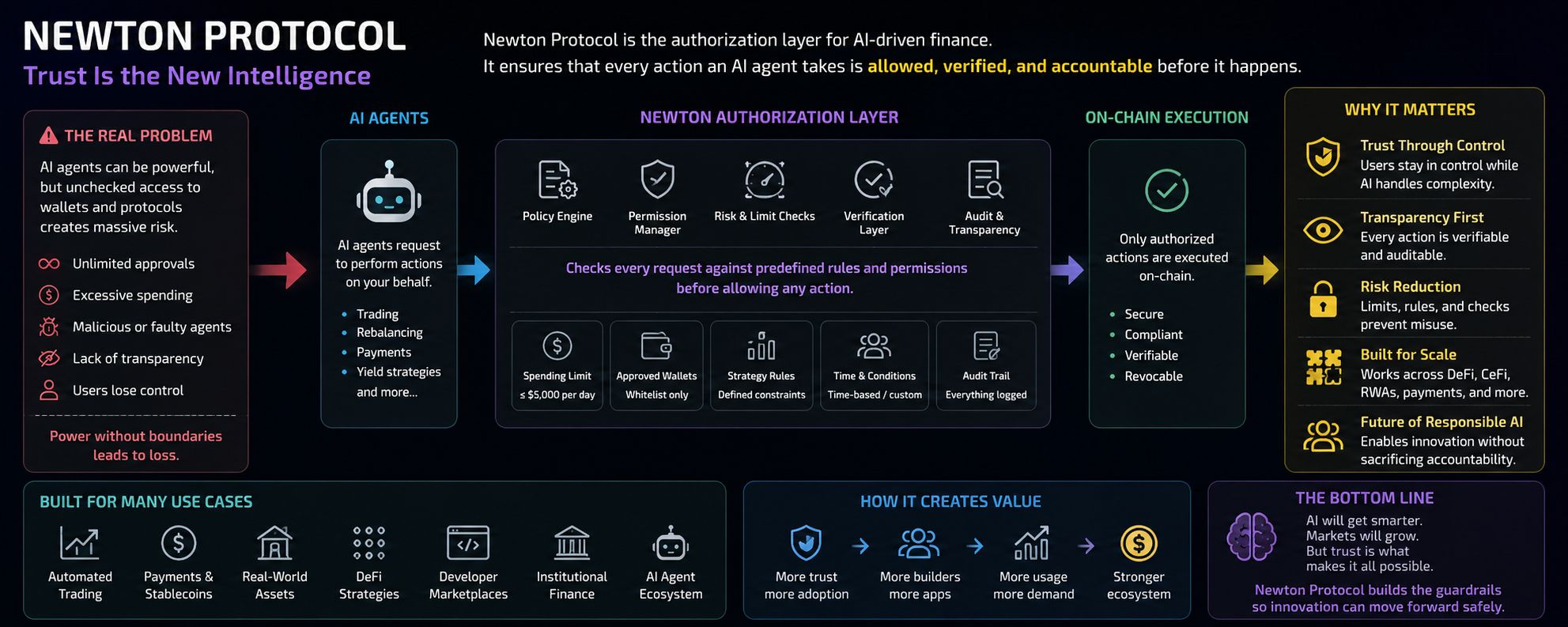
Instead of building another chatbot or another AI model, Newton is focused on the layer that decides what an AI agent is allowed to do before a transaction happens. That difference might sound technical, but I think it's important.
Most conversations around AI in crypto focus on what AI can do.
Newton seems more interested in defining what AI should be allowed to do.
The more I thought about that, the more it started making sense.
Imagine giving an AI permission to manage your wallet. Nobody wants an AI making unlimited decisions with unlimited access. People want boundaries. They want rules. They want transparency. They want the ability to verify why something happened instead of simply trusting a black box.
That seems to be where Newton is placing its bet.
The protocol is designed around pre-transaction authorization, where actions are checked against predefined permissions before execution. Whether those permissions involve spending limits, approved wallets, trading strategies, or organizational policies, the basic idea is that automation should stay inside clearly defined rules instead of operating without limits.
I actually think that's a healthier direction than simply making AI more powerful.
Power without restrictions rarely ends well.
Another thing I found interesting is that Newton isn't trying to limit itself to automated trading. The vision stretches into payments, stablecoins, tokenized real-world assets, decentralized finance, and marketplaces where developers can create AI-powered applications.
That's ambitious.
Maybe even a little too ambitious.
Crypto has a long history of projects trying to solve ten different industries at the same time. Sometimes it works, but more often it creates a roadmap so broad that execution becomes difficult.
That's probably one of my biggest questions.
Can one protocol realistically become the authorization layer for so many different use cases?
I genuinely don't know.
And I think it's okay to admit that.
One thing I appreciated while reading about Newton is that the project spends a lot of time discussing verification instead of simply talking about intelligence.
That feels refreshing.
For years, crypto has struggled with trust.
People don't lose money because computers can't perform calculations.
They lose money because permissions are abused, private keys are compromised, contracts contain vulnerabilities, or users approve transactions they don't fully understand.
If AI is going to become more involved in financial systems, then authorization may actually become more valuable than intelligence itself.
That's an idea I hadn't really considered before reading about Newton.
At the same time, I don't think technology alone creates adoption.
This is something crypto teaches us over and over again.
A technically impressive protocol doesn't automatically become widely used.
Developers have to build on it.
Wallets need to integrate it.
Businesses have to see value in it.
Users need to understand why it matters.
Institutional participants need confidence that the infrastructure will remain secure over time.
None of that happens automatically.
Sometimes I think crypto communities underestimate how difficult adoption really is.
Building something useful is only half the challenge.
Convincing people to change existing habits is often much harder.
That may end up being Newton's biggest challenge.
Not because the technology isn't capable.
But because infrastructure projects often become successful very quietly.
People rarely get excited about security layers.
Nobody talks passionately about authorization systems.
Yet those invisible systems often become the foundation that everything else depends on.
It's almost ironic.
The projects receiving the loudest attention are usually the applications people can see.
Meanwhile, the infrastructure underneath quietly determines whether those applications remain trustworthy.
That's why I keep coming back to Newton.
It isn't trying to become another flashy consumer product.
It's trying to solve a backend problem that most users may never even notice.
If it succeeds, people might interact with applications powered by Newton without ever realizing the protocol is working behind the scenes.
In some ways, that's exactly how good infrastructure works.
You only notice it when it fails.
Another thing that stood out to me is the project's emphasis on transparency and accountability.
Those ideas sound simple, but they're surprisingly rare.
Crypto has experienced enough exchange failures, protocol exploits, governance disputes, and questionable treasury decisions that transparency is no longer just a nice feature.
It's becoming a competitive advantage.
Whether Newton can consistently maintain that standard over the long term remains to be seen.
Making promises is easy.
Keeping them for years is much harder.
I also spent some time thinking about the token itself.
Like many infrastructure protocols, the token is designed to support multiple functions inside the ecosystem, including governance and network participation.
That makes sense from a protocol perspective.
But I also think crypto investors have become much more careful than they were a few years ago.
People no longer assume that every utility token automatically becomes valuable simply because it has multiple use cases.
Markets have become more demanding.
Projects now have to prove actual demand instead of relying on theoretical utility.
That's probably healthier for the industry.
One thing I genuinely like about Newton is that it feels like it's asking a practical question instead of chasing the latest trend.
As AI becomes capable of making increasingly complex decisions, how do humans remain in control?
That's not just a crypto question.
That's a technology question.
Maybe even a societal one.
Whether we're talking about finance, businesses, or personal wallets, authorization and accountability are going to matter.
The challenge is making those systems simple enough that ordinary users don't feel overwhelmed.
Because complexity has always been one of crypto's biggest weaknesses.
If users need to read technical documentation just to feel safe, most people simply won't participate.
So Newton doesn't just need strong technology.
It needs great user experience.
That's often where excellent engineering either succeeds or struggles.
After spending hours reading about the project, I don't walk away thinking Newton has all the answers.
Actually, I leave with more questions than certainty.
Will developers build meaningful applications on top of it?
Will institutions trust decentralized authorization systems?
Will users care about permission layers before they experience problems?
Can the protocol stay relevant as AI evolves faster than expected?
Those questions don't make me less interested.
If anything, they make the project more worth watching.
Because the future of AI in crypto probably won't be decided by whichever system makes the smartest decisions.
It will be decided by whichever system people trust enough to let those decisions happen in the first place.
And that, more than anything else, is why Newton Protocol stayed in my mind long after I finished reading about it.
