
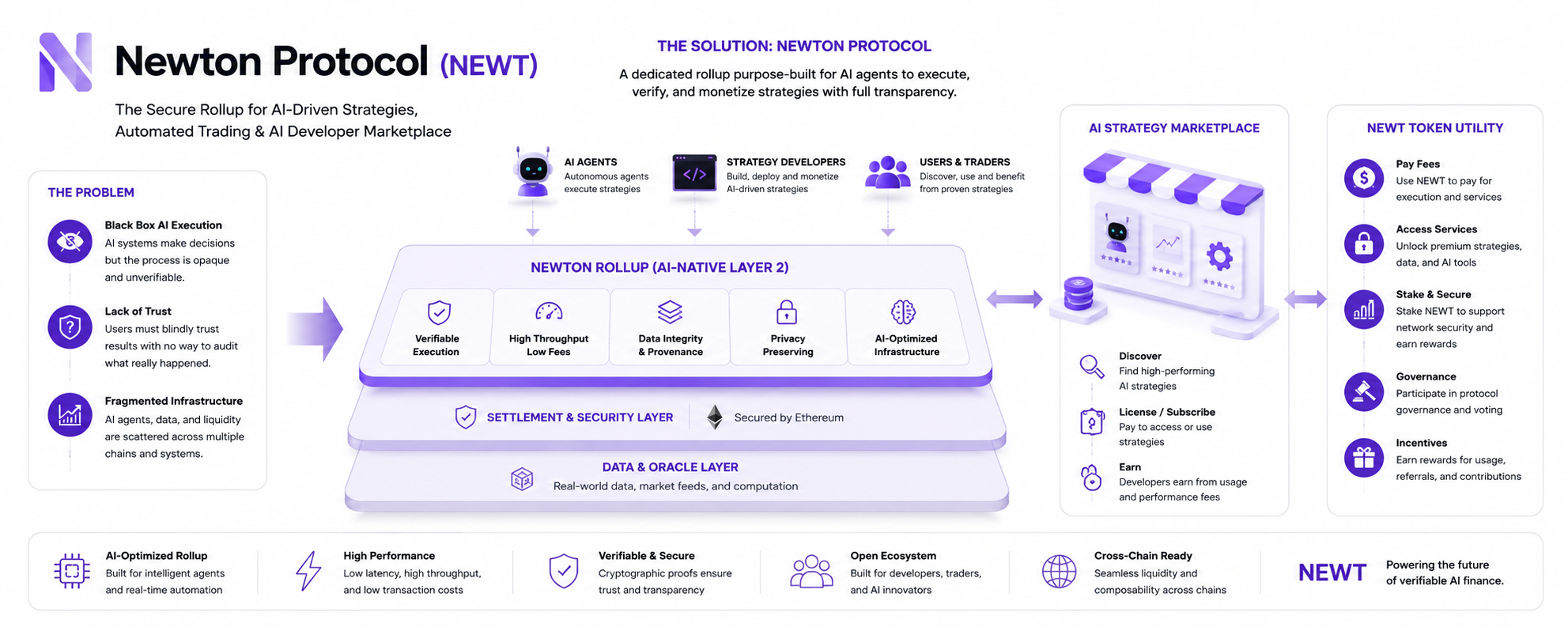
I keep thinking about one thing with Newton Protocol. It is not really about whether AI can make smart decisions. We already know AI can scan data, react fast, build strategies, and do things faster than most people can. The bigger question is what happens after the AI makes a decision.
Who checks it?
Who proves it actually did what it claimed?
That matters a lot more when money is involved.
Most automated systems only show the final result. A trade happened. A strategy worked. A portfolio changed. But the part in the middle is usually hidden. You do not really see the full path from signal to decision to execution. You are just expected to trust the system.
And in markets, blind trust never feels safe for long.
That is why Newton Protocol feels interesting to me. It is not just trying to make AI look powerful. It is trying to make AI actions more accountable.
The idea is simple but important. If AI agents are going to trade, automate strategies, and manage real financial activity, then their actions need a clear record. Not just promises. Not just results. A record people can verify.
That is where Newton’s rollup design makes sense. AI systems create a lot of activity: strategy updates, execution records, automated decisions, marketplace interactions, and constant adjustments. Putting every small action directly on a base chain would become expensive and slow. But keeping everything hidden off-chain creates another problem: users lose visibility.
Newton is trying to sit between those two extremes.
Fast enough for automation, but still transparent enough to build trust.
The developer marketplace is another part I find important. A lot of AI projects focus only on the model. Newton seems to care more about the strategy layer. That is a different angle. A good AI trading agent, portfolio tool, or automation workflow could become something other users can discover, use, and improve.
That can turn individual tools into a larger ecosystem.
But this only matters if people actually use it.
For Newton Protocol, the key signals are not just price or hype. I would watch developer activity, new tools being built, marketplace usage, real strategy deployments, governance participation, and whether network transactions start looking more like real usage instead of simple token movement.
Those details matter because they show whether the protocol is becoming useful or just being discussed.
The NEWT token also depends on that same reality. Fees, marketplace access, governance, and ecosystem incentives only become meaningful if there is repeated activity around the protocol. Token utility sounds good on paper, but real demand only appears when users keep coming back.
That is the part the market usually learns slowly.
Newton Protocol has a strong idea, but it also has real risks. Developer adoption is not automatic. AI infrastructure is competitive. Users will not move to a new system unless it feels easier, safer, or more useful than what they already have. And if the marketplace does not attract strong builders, the whole idea becomes harder to sustain.
Still, the core direction makes sense.
As AI becomes more involved in trading and automation, people will not only ask whether the AI is smart. They will ask whether its actions can be trusted.
That may become Newton Protocol’s real opportunity.
Not just smarter machines.
More accountable machines.
And in crypto, that difference matters.
