
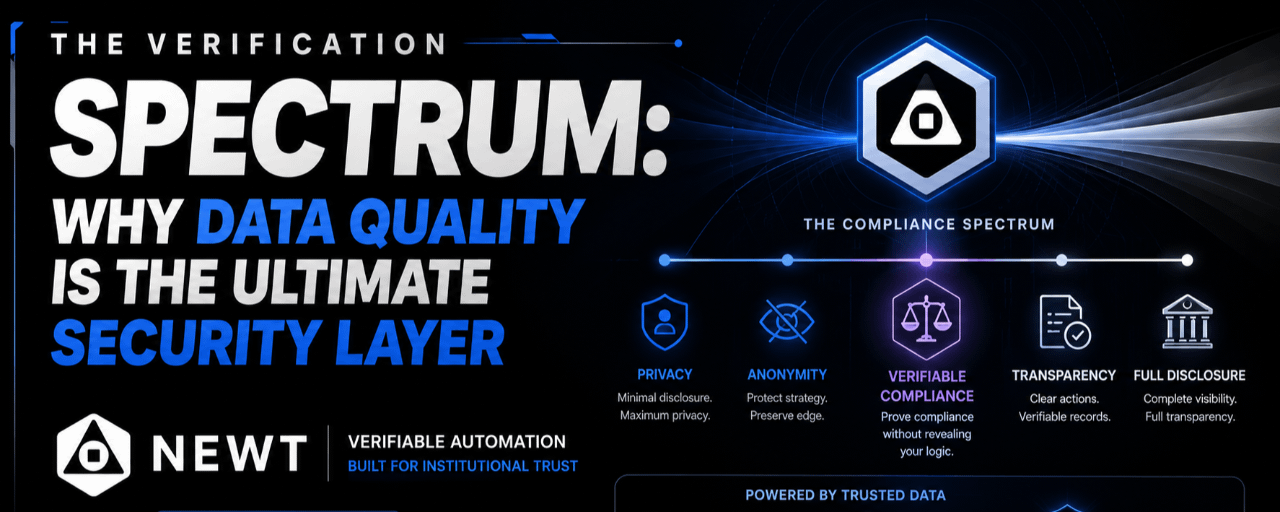
The more I watch the conversation around institutional compliance in DeFi, the more I feel people are searching for a binary solution that simply doesn't exist.
Some regulators believe everything must be entirely transparent, exposing all user logic and trading strategies. Most crypto natives believe everything must be entirely anonymous, relying solely on reactive audits. But real-world institutional systems rarely work in absolutes.
What I appreciate about @NewtonProtocol and their Mainnet Beta rollout is that they treat compliance as a programmable spectrum. By deploying their verifiable automation layer, they recognize that a low-stakes retail swap doesn't need the exact same level of risk assurance as a massive decentralized vault rebalancing millions of dollars.
For me, institutional security is less about the underlying blockchain and more about the quality of the data feeding the execution. A decentralized policy engine is entirely useless if the data it evaluates is flawed.
This is where Newton’s integration architecture stands out. By directly routing RedStone’s manipulation-resistant price feeds and Credora’s credit risk intelligence into their policy engine, they create an irrefutable ground truth. When a VaultKit mandate dictates that a transaction must be blocked due to a sudden drop in collateral health, that decision is backed by pristine, real-time data evaluated inside a Trusted Execution Environment (TEE).
We shouldn't view privacy and compliance as competitors. Zero-knowledge proofs (ZKPs) allow Newton to mathematically prove to a regulator that an institution adhered to strict spending limits, without ever leaking the actual trading logic to the public ledger. The goal isn't to expose everything. The goal is to prove enough to mitigate the risk you're taking.
In the long run, the most successful infrastructure networks won't be the ones that force a binary choice. They will be the ones that, like $NEWT , understand that true security requires proactive, data-driven enforcement.