
I have read enough post-incident reports to know that failures rarely begin with slow blocks. They begin with approvals that should never have existed, wallets holding unlimited permissions, and signatures accepted without enough questions. Risk committees and audit teams do not spend nights debating transactions per second. They debate exposure, authority, and whether a single mistake can become a systemic failure.
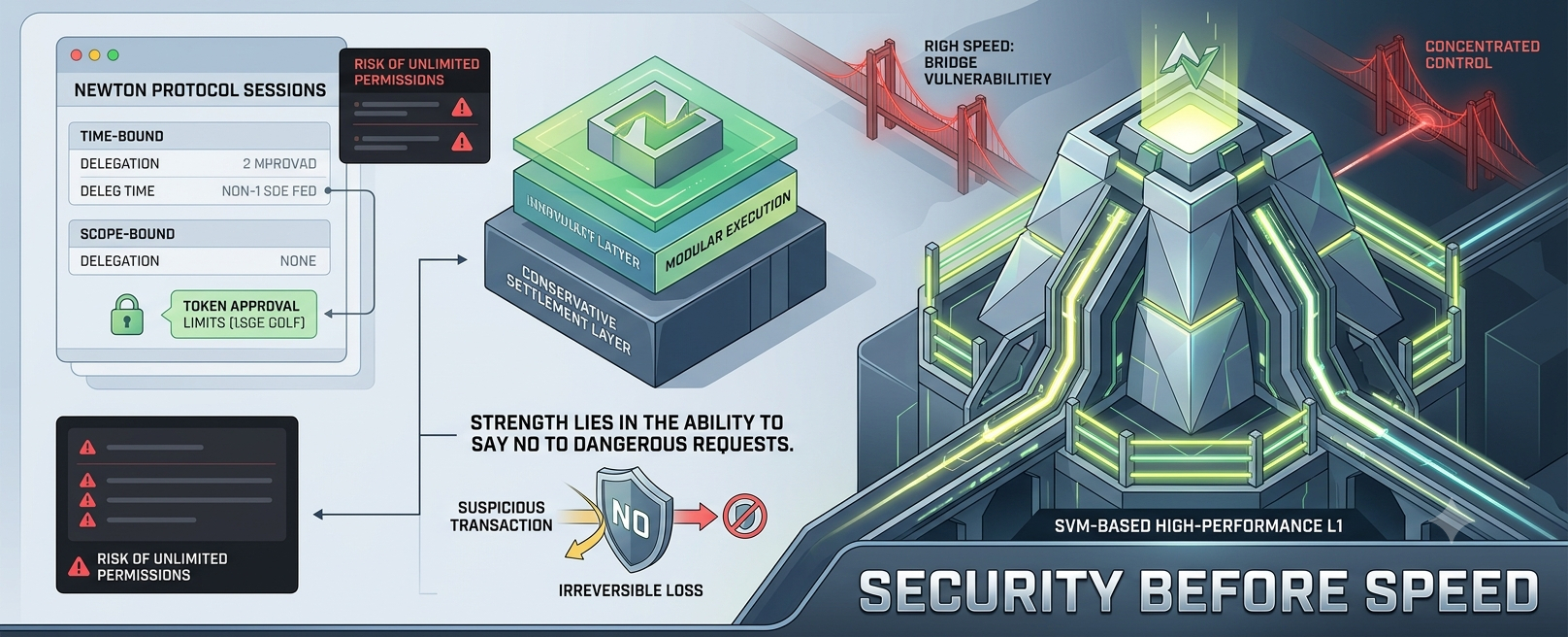
Newton Protocol approaches this problem from a different angle. As an SVM-based high-performance L1, it treats speed as useful but never sufficient. Performance matters, yet performance without guardrails only accelerates mistakes. That is why the architecture feels less like a race car and more like a machine designed to survive bad decisions.
The discussions around wallet approvals reveal the real challenge. Unlimited permissions are convenient until they become permanent liabilities. Newton Protocol Sessions replace that habit with enforced, time-bound, scope-bound delegation. “Scoped delegation + fewer signatures is the next wave of on-chain UX.” I see that idea as a security principle rather than a design trend, because reducing unnecessary authority often matters more than increasing raw throughput.
The execution model also reflects restraint. Modular execution above a conservative settlement layer separates speed from final trust, allowing innovation without weakening the foundation. EVM compatibility exists mainly to reduce tooling friction instead of redefining security assumptions. The native token serves once as security fuel, while staking represents responsibility carried by participants rather than a shortcut to rewards.
None of this removes every risk. Bridge vulnerabilities remain real, concentrated control must always be challenged, and every architecture deserves continuous audits. “Trust doesn’t degrade politely—it snaps.” That sentence belongs in every security review because confidence disappears much faster than it is earned.
I believe the strongest systems are not the ones that process every request as quickly as possible. They are the ones that refuse dangerous requests before they become irreversible losses. In the end, a fast ledger that can say “no” prevents the most predictable failures.
