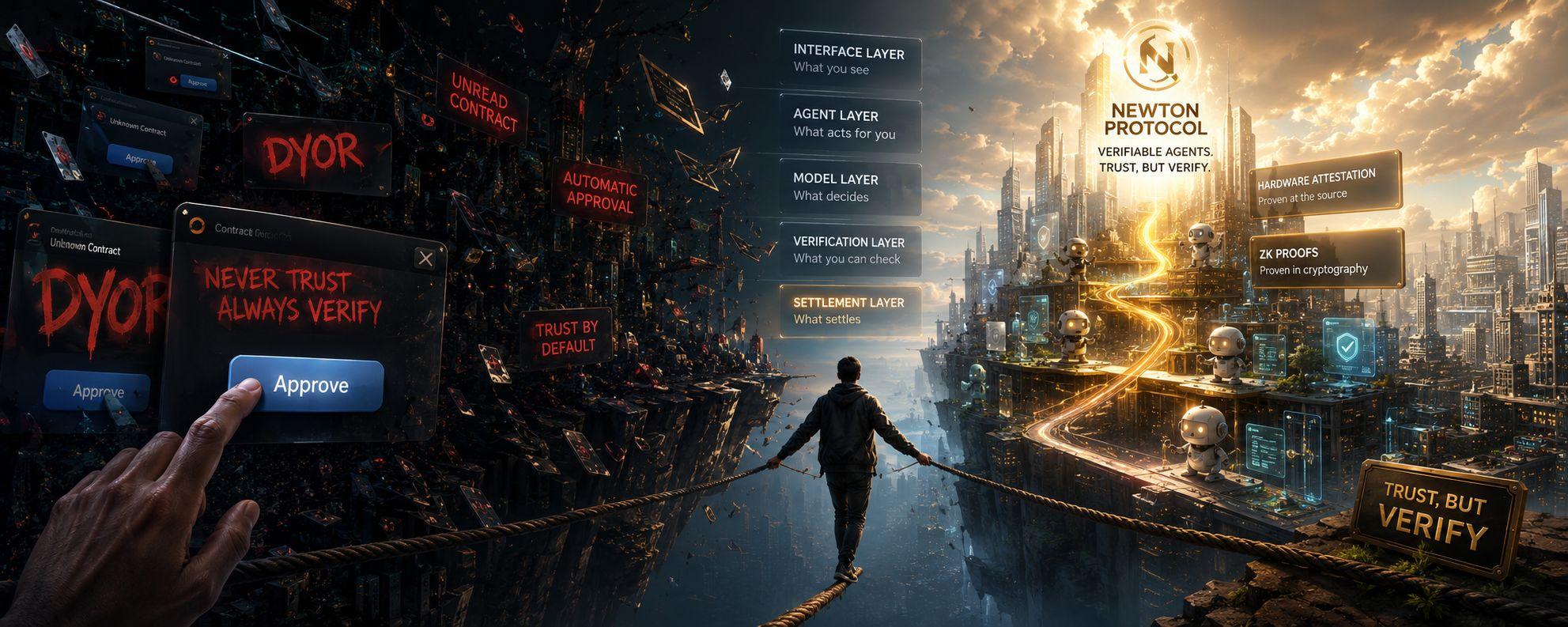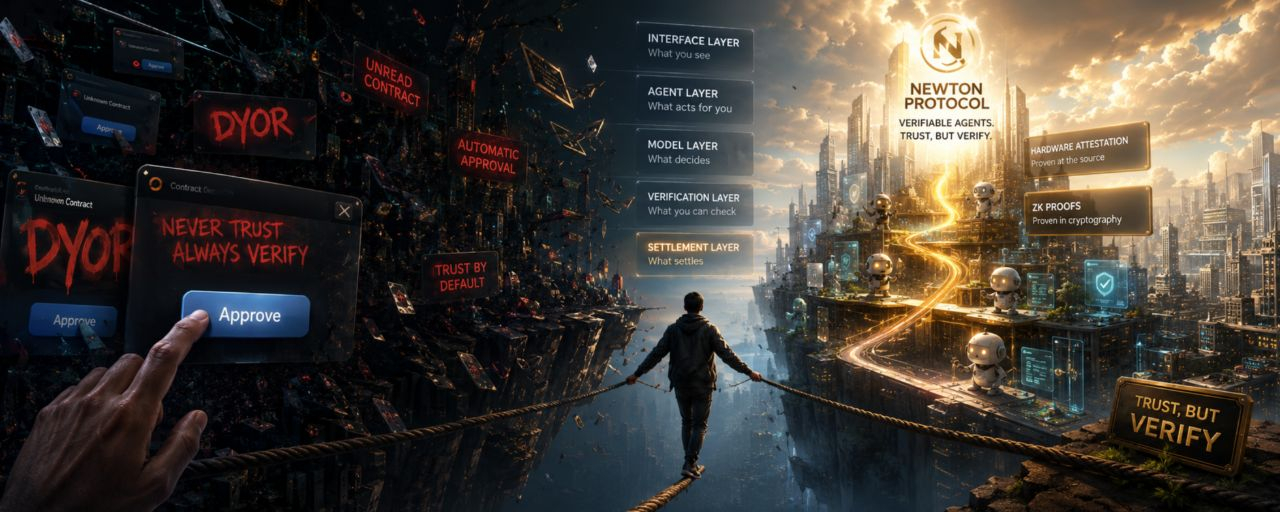
i saw a portfolio screenshot a few days ago, captioned with the usual dyor never trust always verify. two scrolls down the same feed the same account was already tapping approve on a contract popup without reading a line of it. that gap between what people say about trust and what they actually do with it is the part i cannot stop thinking about.
i keep coming back to newton protocol as an example that sits right inside that tension. it is built as a rollup for ai agents that trade and act with a degree of autonomy, plus a marketplace where developers publish the models doing that acting. the promise underneath most of this sounds familiar by now, remove the middleman, let the code verify itself, cut the number of humans a transaction has to pass through, and i wanted to see how far that promise actually goes.
the part that actually bothers me is which layer that trustless claim was ever about. it was always a claim about the base settlement layer, the part furthest from your hands, not about everything stacked on top of it. the interface you tap through, the strategy an agent runs on your behalf, the model deciding when to act, none of that was made trustless by the same guarantee. whoever builds convenience on top of that base layer gets to borrow its reputation, while whoever taps approve at the end carries the risk that the borrowing was not fully earned.
once i noticed that, the rest started rearranging itself. if trust quietly migrates toward the click instead of the base layer, then the habit people practice is not verification, it is a fast kind of faith dressed up as diligence. agents that act faster than a person can review make that habit worse, not better, because the manual check people used to do gets skipped by design rather than by accident. the structure that results is not verify everything, it is verify the one piece that is easy to verify and trust the rest by default.
zoom out and i do not think this is really a story about one protocol. it looks more like an industry that keeps announcing trust has been engineered away while quietly relocating it to whichever layer feels most invisible that year. users end up holding a risk they were told they no longer needed to evaluate, and the people building further up the stack end up holding a trust they never explicitly asked for but benefit from anyway.
this is roughly where newton protocol earns a closer look rather than a dismissal. it pairs hardware level attestation with cryptographic proofs, so what an agent actually did can be checked after the fact without needing to see the private reasoning that produced it. i do not think that solves the whole migration problem, but it is a specific, checkable answer to one piece of it, the piece where you previously just had to take their word for it.
somewhere in this chain there is a layer i have never actually checked myself, sitting quietly under the assumption that someone else already did. i suspect most people reading this carry at least one layer like that too, and whether it counts as a convenience worth keeping or a structural choice with consequences nobody priced in is not something i can answer for anyone else.
@NewtonProtocol $NEWT #Newt $NFP $TAIKO