
I've been following crypto long enough to know that most projects sound impressive during strong markets. Every cycle brings a new wave of promises about changing finance, improving scalability, or transforming how people interact with blockchain networks. After watching several of these cycles, I have become less interested in ambitious roadmaps and much more interested in how a protocol behaves once real users begin interacting with it. That is one reason why I started paying closer attention to @NewtonProtocol and its growing ecosystem around $NEWT. Rather than focusing only on theoretical performance, I wanted to understand whether the underlying structure could support practical use as artificial intelligence becomes increasingly involved in blockchain activity. #Newt
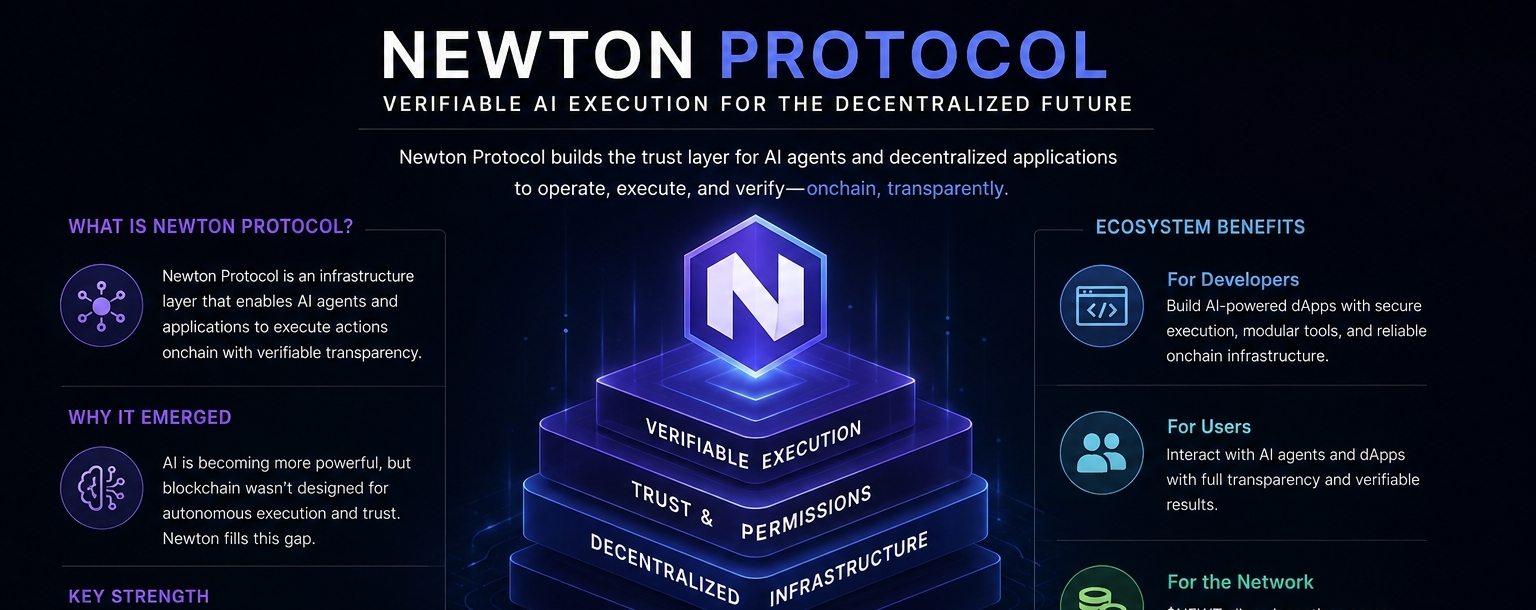
Newton Protocol appeared at a time when AI was becoming far more capable, while blockchain infrastructure was still largely designed for human-operated wallets and manually executed transactions. That difference created an interesting gap. AI agents can analyze markets, execute strategies, coordinate tasks, and process information continuously, but they also require secure environments where permissions, ownership, and verification are transparent. Instead of treating AI as another application running on top of existing chains, Newton Protocol approaches the problem from the perspective of infrastructure. The idea is not simply to make AI faster, but to make AI actions verifiable without forcing users to trust opaque systems.
The first period that caught my attention was not driven by price movement. It was the growing discussion around Newton Mainnet Beta and the practical questions people began asking. Could automated strategies actually operate safely? Would developers build applications that depended on verifiable execution rather than centralized services? Those questions mattered far more than temporary market excitement because infrastructure usually succeeds quietly. If developers continue building and users continue returning, that tells a much stronger story than a short-lived rally.
Like many newer protocols, Newton Protocol entered a market that has become far more demanding than previous cycles. Investors no longer reward every technical announcement with unlimited optimism. Liquidity is more selective, users are more experienced, and attention disappears quickly when products fail to deliver meaningful utility. In many ways, these conditions are healthy because they expose weaknesses much earlier. Projects built only around narratives often struggle once speculation fades, while projects with genuine technical direction have an opportunity to mature without depending entirely on market sentiment.
One aspect I find interesting is that Newton Protocol focuses on creating a trusted environment for autonomous execution instead of assuming trust already exists. AI systems can generate valuable insights, but users still need confidence that decisions are executed according to predefined rules. Verification becomes just as important as intelligence itself. That distinction may sound subtle, yet it changes how developers think about decentralized applications. Rather than asking only whether an AI model is powerful, the more important question becomes whether every important action can be independently verified.
Watching infrastructure projects has taught me that resilience rarely comes from perfect design. It usually comes from making reasonable trade-offs while remaining flexible enough to improve over time. Newton Protocol seems to understand this reality. The Mainnet Beta represents an opportunity to observe how the network behaves under genuine usage rather than controlled demonstrations. Real environments expose problems that test environments cannot reproduce. Performance, reliability, developer experience, and security all become visible only after people begin using a system in unpredictable ways.
The role of the $NEWT token is another area worth watching carefully. A token becomes meaningful when it reflects participation inside the network instead of existing solely as a speculative asset. Healthy blockchain ecosystems gradually develop economic relationships where validators, developers, applications, and users all interact through incentives that support continued activity. When token demand grows alongside actual usage, the network develops stronger foundations than those relying only on exchange trading volume. That relationship takes time to develop, and it cannot be manufactured through marketing campaigns alone.
Current on-chain activity should always be interpreted with caution, especially during the early stages of network growth. Short-term spikes often reflect curiosity, testing, or promotional campaigns rather than sustainable adoption. What I prefer watching are quieter indicators that receive less attention. Developer participation, repeated wallet activity, consistent transaction patterns, and gradual ecosystem expansion usually reveal more about long-term health than isolated moments of excitement. These signals rarely generate headlines, yet they often become obvious in hindsight once successful ecosystems mature.
Of course, skepticism remains justified. AI infrastructure is becoming increasingly competitive, and many projects are trying to solve similar problems from different technical angles. Success will depend on execution rather than vision alone. Developers need tools that reduce complexity rather than introduce additional friction. Users need experiences that feel reliable without requiring deep technical knowledge. Networks also need sufficient decentralization to maintain credibility while still delivering performance that modern applications expect. None of these challenges are easy, and every infrastructure project eventually encounters difficult trade-offs.
Another question worth asking is whether AI-driven activity will eventually generate enough independent economic value to sustain itself. Many blockchain ecosystems begin with financial incentives that encourage experimentation, but long-term durability usually depends on applications solving meaningful problems. If Newton Protocol succeeds in becoming a trusted foundation where autonomous agents can operate securely, then network activity could gradually become driven by utility instead of speculation. That transition is slow, but it represents one of the clearest indicators of genuine progress.
What keeps me interested today is not the expectation of immediate success but the structure of the problem Newton Protocol is attempting to solve. AI continues advancing rapidly, yet trust remains one of its weakest points. Blockchain offers transparency, but transparency alone does not automatically produce intelligent systems. Bringing those two worlds together requires careful engineering rather than bold promises. Infrastructure rarely attracts the same attention as consumer applications, yet history repeatedly shows that durable ecosystems are built upon dependable foundations instead of temporary narratives.
After spending years watching crypto evolve through optimism, disappointment, recovery, and innovation, I have learned that the most valuable projects are often the ones that continue improving when nobody is paying close attention. Markets eventually recognize real utility, but usually much later than people expect. Newton Protocol is still early, and many important questions remain unanswered. Even so, its focus on verifiable AI execution, practical infrastructure, and observable network development makes it a project worth following with patience instead of excitement. Sometimes the strongest signal in crypto is not the loudest announcement or the fastest price movement, but the quiet accumulation of systems that continue functioning while the market is distracted by something else.
