
A few months ago I found a note buried inside an old folder called "temporary assumptions"
The funny thing was that none of those assumptions had been temporary
Some were three months old
Some were older than the positions they were originally written for
I wasn't looking at strategies anymore
I was looking at permissions that had quietly survived long after I stopped questioning them
That realization felt small at first
Almost too small to matter
I closed the file and went back to my normal routine
Checking liquidity
Reading governance discussions
Looking at risk parameter changes
Reviewing a few AI-generated summaries before comparing them against the original sources
The usual stuff
Nothing in that routine looked broken
If anything, everything was becoming easier
The amount of information available to me had increased dramatically over the last two years
Research takes less time
Monitoring is better
Alerts are faster
I spend fewer hours collecting information than I used to
Yet I kept noticing the same strange pattern
The effort never disappeared
It simply moved somewhere else
A few weeks later I was reviewing a lending market after a governance proposal changed collateral parameters
The change itself wasn't particularly important
What caught my attention was something else
Most participants weren't debating execution
Nobody was worried about whether the contract could process the update
Nobody was worried about settlement
The disagreement was entirely about whether the existing authority to make the change still deserved trust
I remember staring at that discussion longer than necessary
Mostly because I had seen the same pattern before
Different protocol
Different community
Same argument
Someone always ends up asking a version of the same question
Why should this permission still exist
At first I thought that was just governance doing governance things
But after enough repetition I became less convinced
The more systems I looked at, the more it seemed that execution wasn't where most uncertainty lived
Execution was usually the easy part
The hard part was deciding whether the assumptions that authorized execution were still valid
That distinction felt subtle
Almost semantic
Until I started noticing how often markets change without triggering any obvious failure
Liquidity slowly moves
Counterparty risk slowly changes
Compliance requirements quietly update
Oracle conditions drift
Incentives evolve
None of those things automatically revoke authority
The permission structure remains intact even when the environment that justified it has already changed
Maybe that's why so many incidents feel obvious in hindsight
People often describe them as technical failures
Sometimes they are
But many times the system executed exactly what it had permission to execute
The mismatch appeared earlier
The environment changed faster than the authorization model
I think I spent years focusing on the wrong layer
Partly because execution is visible
Blocks settle
Transactions confirm
Gas fees fluctuate
Everything leaves a measurable footprint
Authorization is harder to see
Most of it exists as accumulated assumptions
A multisig approval
A risk committee decision
A governance vote from months ago
A policy someone agreed with under conditions that no longer exist
Those assumptions become infrastructure without anyone explicitly calling them infrastructure
That idea stayed in the back of my mind for a while
I didn't really have language for it
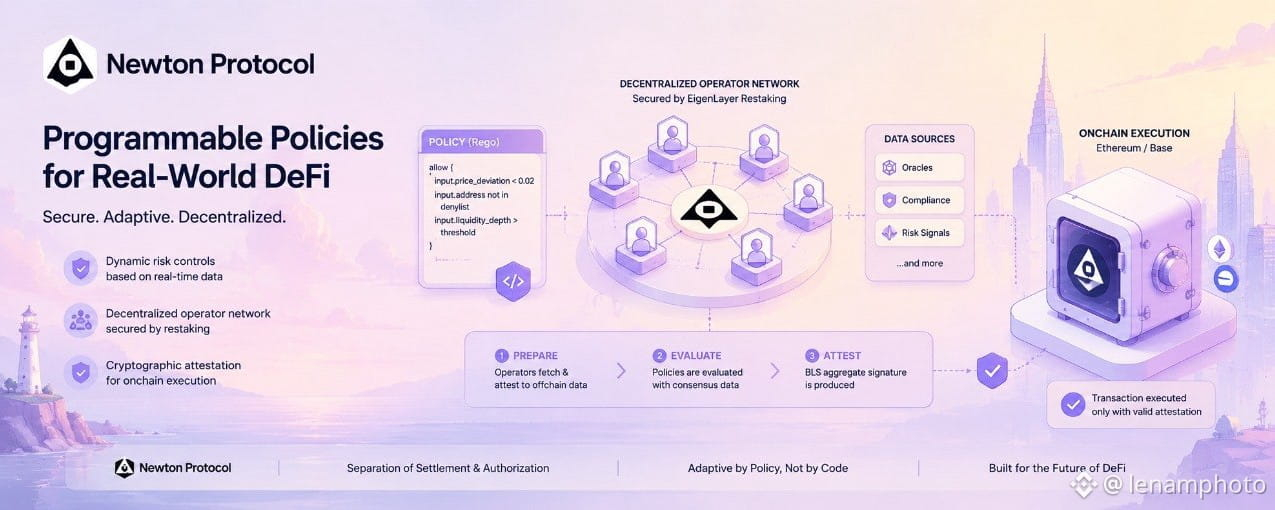
Then I came across Newton Protocol's VaultKit
I expected another vault framework
Crypto has plenty of those already
Instead I found myself paying attention to something much less obvious
The separation between settlement and authorization
The architecture wasn't trying to make execution more intelligent
It was trying to make permission more adaptive
Curators define policies externally using Rego
Operators independently gather context
Consensus forms around observable conditions
Policies evaluate against that context
Only then does execution receive the attestation required to move forward
I kept rereading the flow because it didn't feel like another security feature
It felt like infrastructure acknowledging that authority ages
That may sound obvious now that I'm writing it
It certainly didn't feel obvious when I first encountered the idea
I think I had unconsciously assumed that permissions were relatively static objects
You grant them
You review them occasionally
You move on
VaultKit made me wonder whether permissions behave more like living state
Something that gradually becomes less accurate as the surrounding environment changes
If that's true then the bottleneck isn't execution speed
It isn't throughput either
It may be the distance between changing reality and the authority structures that continue acting inside it
I'm still not completely sure where that thought leads
What I do know is that I evaluate systems differently now
When I look at a protocol I spend less time asking what it can do
I spend more time asking how long its assumptions can remain trustworthy before someone is forced to revisit them
Lately that question keeps showing up in places where I never expected to find it
Not just in crypto
Not just in automation
Maybe the most fragile component inside a system isn't the code that executes decisions
Maybe it's the permission that quietly survives after the reason for granting it has already faded
@NewtonProtocol #newt $NEWT $HYPE $ZBT