
I've been following crypto for quite a while now, and one thing keeps bothering me.
The industry loves talking about speed, decentralization, scalability, and the next big breakthrough. Every few months there's a new narrative that's supposed to change everything. Yet when I look outside the crypto bubble, most people still aren't interested.
I don't think that's because they dislike blockchain.
I think they're simply tired of dealing with it.
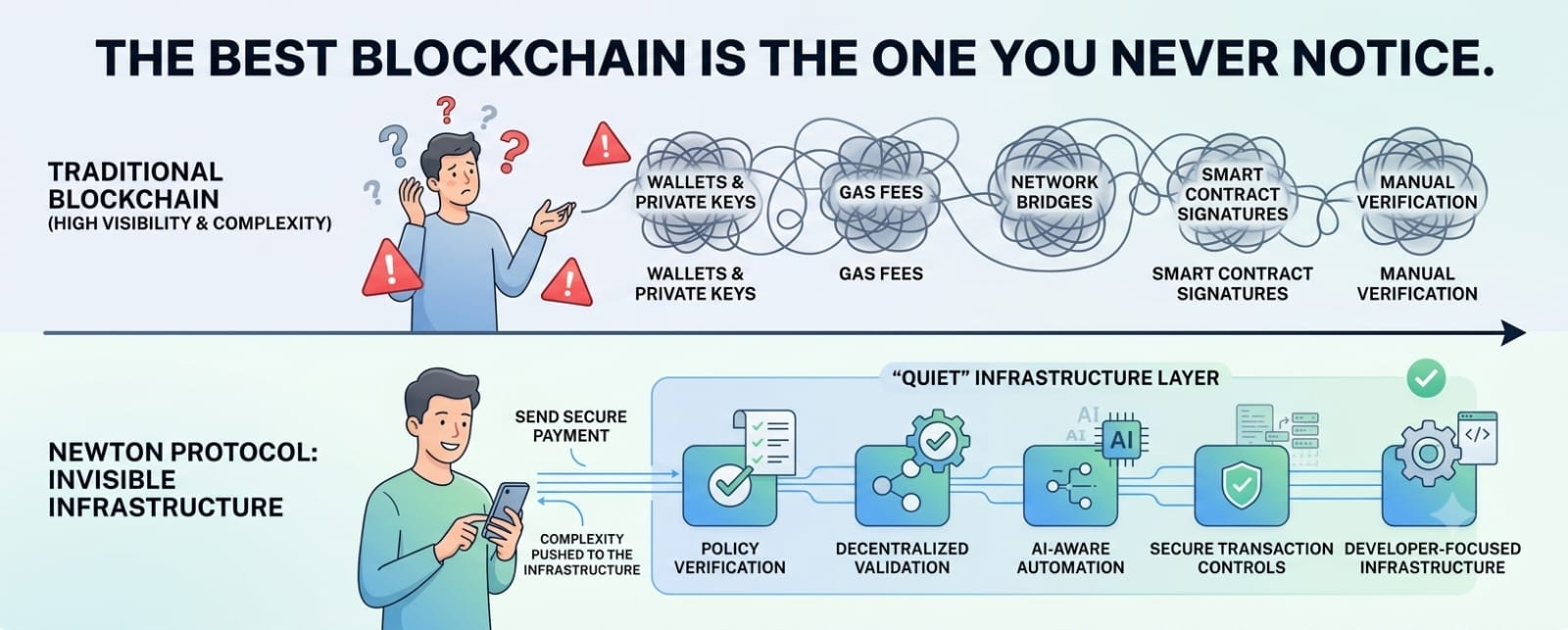
Using crypto today still feels like being handed the controls of an airplane before you've even learned how to drive. You're expected to understand wallets, private keys, gas fees, network bridges, approvals, signatures, and smart contracts. One small mistake can cost real money, and there's rarely anyone to call when something goes wrong.
That's not how mainstream technology succeeds.
People never cared how the internet worked. They cared that they could send an email. Nobody thinks about cloud infrastructure when uploading a photo. The technology fades into the background, and that's exactly why it becomes useful.
Crypto hasn't reached that point yet.
That's probably why Newton Protocol caught my attention.
It isn't trying to make blockchain louder. It's trying to make it less visible.
To me, that's a far more interesting direction than simply launching another AI-powered product or another automated trading platform. We've seen enough projects throw "AI" into their branding as if the word itself solves problems.
It doesn't.
If anything, AI introduces new questions. How do you know an automated system is making the right decision? Who decides what it's allowed to do? What happens if something goes wrong?
Those questions matter much more than flashy demos.
What I like about Newton is that it seems to accept this reality instead of pretending automation should operate without limits. The protocol is built around policies and verification, meaning automated actions can be checked against predefined rules before they're executed.
That may not sound exciting at first.
But honestly, I think it's exactly the kind of thinking crypto has been missing.
For years the industry has focused on removing intermediaries. While that brought obvious benefits, it also transferred an enormous amount of responsibility onto ordinary users. Suddenly everyone had to become their own security expert.
Most people never signed up for that.
They just wanted better financial tools.
Newton appears to take a different approach. Rather than expecting users to constantly understand what's happening underneath, it tries to push much of that complexity into the infrastructure itself. If the protocol can quietly verify whether a transaction follows certain rules before it happens, then users don't need to spend every interaction wondering if they're about to make an expensive mistake.
That's what good infrastructure should do.
You shouldn't have to think about it.
In fact, the best technology usually disappears from view completely.
Nobody celebrates the systems that quietly keep the internet running every second of the day because those systems simply work. Ironically, becoming invisible is often the biggest compliment technology can receive.
I think blockchain eventually needs to reach the same place.
Of course, none of this guarantees success.
Building infrastructure is difficult. Convincing developers to build around a new framework is difficult. Making policy-based automation flexible enough for different applications is difficult. Even great ideas can struggle if adoption never arrives.
There are still plenty of unanswered questions.
Can the system remain simple as it grows? Can developers create policies without adding unnecessary complexity? Will businesses trust decentralized verification for important financial decisions? Can AI stay useful without becoming unpredictable?
Those aren't small challenges.
But I'd rather see a project wrestling with real problems than another one chasing whatever trend happens to be popular this month.
What stands out to me is that Newton doesn't seem obsessed with making blockchain more complicated. Instead, it's trying to make the technology feel less demanding for the people actually using it.
That feels like the right priority.
Because the truth is, nobody wakes up excited to interact with a blockchain. People want secure payments. They want reliable automation. They want applications that save time instead of creating extra work.
If blockchain keeps asking users to understand every technical detail before they can do something simple, mainstream adoption will continue moving slower than everyone expects.
Newton Protocol seems to understand that.
Instead of asking people to adapt to blockchain, it's attempting to make blockchain adapt to people through policy verification, decentralized validation, AI-aware automation, secure transaction controls, developer-focused infrastructure, and systems designed to make complex processes happen quietly in the background.
Whether it succeeds is impossible to know today.
But I genuinely believe the industry needs more projects thinking this way.
Because in the end, the future of crypto probably won't belong to the platform with the loudest marketing.
It will belong to the one people use every day without even realizing they're using blockchain at all.