
I've seen crypto create too many new narratives just to cover up old problems. People say DeFi will replace banks, then AI Agents will autonomously run the economy. But there's one question I keep asking: Why can you send $10 billion to a smart contract without anyone approving it?
In traditional finance, every transaction goes through an authorization layer. Visa won't let you spend if your card is blocked. Your bank won't let you transfer money if you violate limits. Crypto rebuilt the entire financial system but forgot that authorization layer.
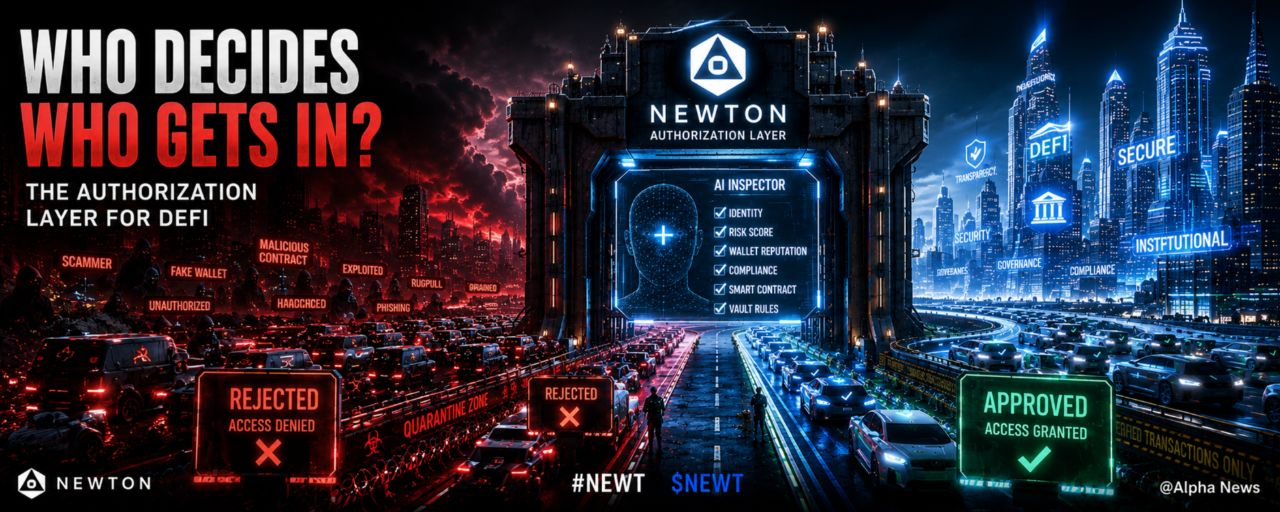
That's why Newton Protocol caught my attention. They're building what I call the "missing authorization layer" of the on-chain economy.
Newton's differentiator lies in the timing of intervention.
Most security tools on the market are "ambulances" – they show up after the crash, reporting that you've been hacked and lost money. Newton does the opposite: it checks every transaction before settlement and returns a verifiable Pass/Fail attestation on-chain.
Sound familiar? Exactly – it works like how Visa authorizes a credit card transaction – a decision happens before the money moves.
I don't like projects that just polish their narrative. What makes me take Newton seriously is the team behind it. Newton is built by Magic Labs – the company that has created 57 million embedded wallets, serves 200,000+ developers, and powers Polymarket's wallet infrastructure. They're backed by PayPal Ventures and Tiger Global.
Not only that, Newton runs as an EigenLayer AVS, meaning it borrows Ethereum's security model to verify off-chain computations. This solves a problem many automation projects are struggling with: how to trust a system that doesn't run entirely on-chain.
Newton starts with DeFi Vaults – where billions of dollars are managed but risk limits live in fragmented off-chain processes. They turn those rules into something enforceable on-chain.
And they're not doing it alone. Partners include Chainalysis + Hexagate for compliance and security, and RedStone + Credora for oracle data and risk management.
Of course, whitepapers always look good on paper. Narratives always sound convincing in early stages. But at the end of the day, it all comes back to real usage. I'm still watching whether Vaults will actually integrate Newton, and whether users are willing to pay fees for a pre-transaction protection layer.
Still, a project that dares to ask "What's missing in DeFi?" and answers with a real product – not just a slide deck – is always worth following.
@NewtonProtocol
