

I've rewritten it to feel more natural, personal, and focused on Newton, while removing all headlines and keeping the project name in the opening paragraph.
Newton has been on my mind lately because it approaches a problem that I think will become much bigger as more real-world finance moves onchain. A lot of people assume compliance means creating separate markets where only approved participants can interact. That sounds practical at first, but the more I think about it, the less convinced I am that fragmented liquidity is the right long-term answer. What caught my attention is that Newton seems to be asking a different question altogether: what if compliance could exist without forcing liquidity into isolated ecosystems?
The biggest strength of any market is the number of people who can participate in it. Liquidity isn't just about how much money is available; it's about how easily buyers and sellers can find each other without creating unnecessary friction. Every time liquidity is divided into smaller permissioned pools, the market loses some of that efficiency. Capital becomes harder to access, trading becomes less flexible, and everyone pays the price through weaker market depth.
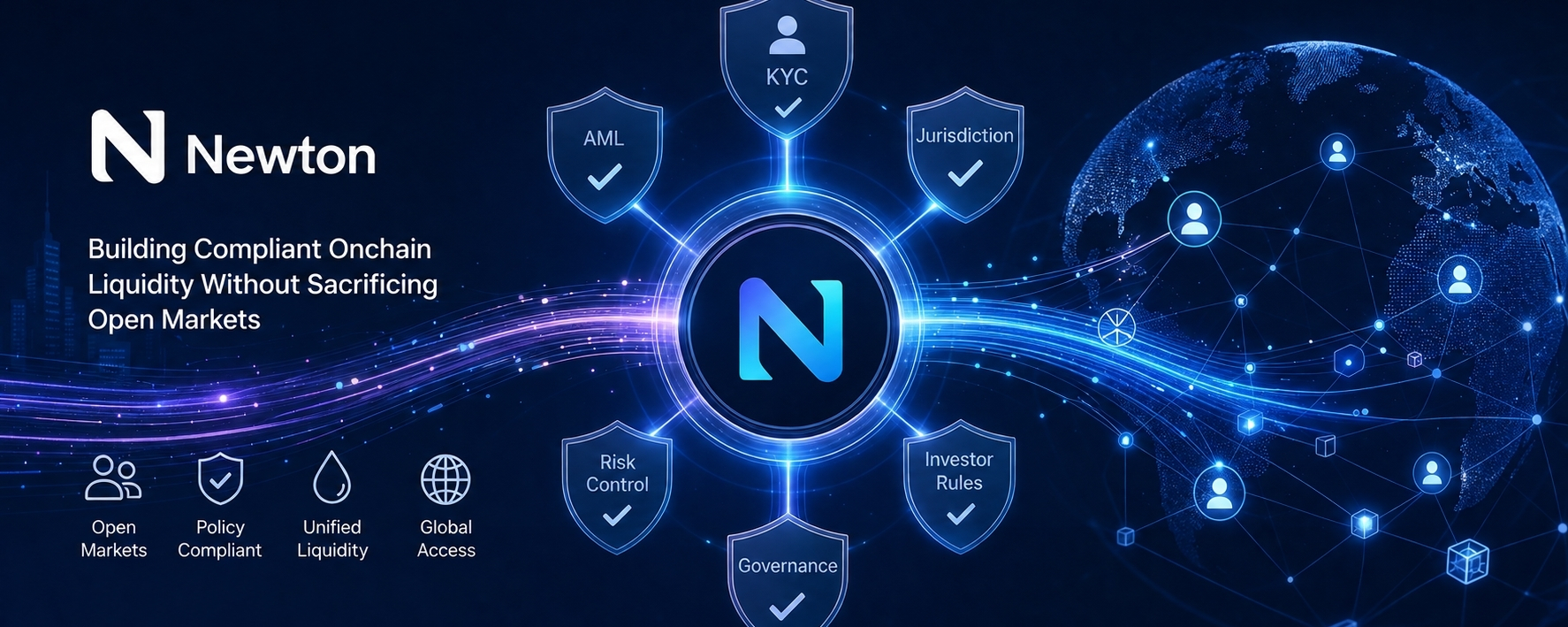
That's why Newton's approach feels interesting. Instead of treating compliance as something that belongs inside private marketplaces, it treats policy as something that can travel with individual transactions. Different participants can satisfy different regulatory requirements while still interacting with the same underlying liquidity. To me, that's a much more scalable way of thinking about compliant finance.
I also like that this approach doesn't pretend regulation disappears. Rules still exist, identities still need to be verified, and governance still plays an important role. Newton isn't trying to remove those responsibilities. Instead, it focuses on making compliance work alongside open financial infrastructure rather than against it.
As stablecoins and tokenized real-world assets continue to expand, liquidity will become even more valuable. Creating digital assets is becoming easier every year, but creating active markets around those assets is a completely different challenge. If every institution builds its own isolated environment, liquidity becomes fragmented before it ever has a chance to mature.
Newton seems to recognize that long-term growth depends on keeping markets connected while allowing compliance requirements to remain flexible. That balance could make it easier for institutions, developers, and users to interact without constantly rebuilding the same infrastructure for different regulatory frameworks.