
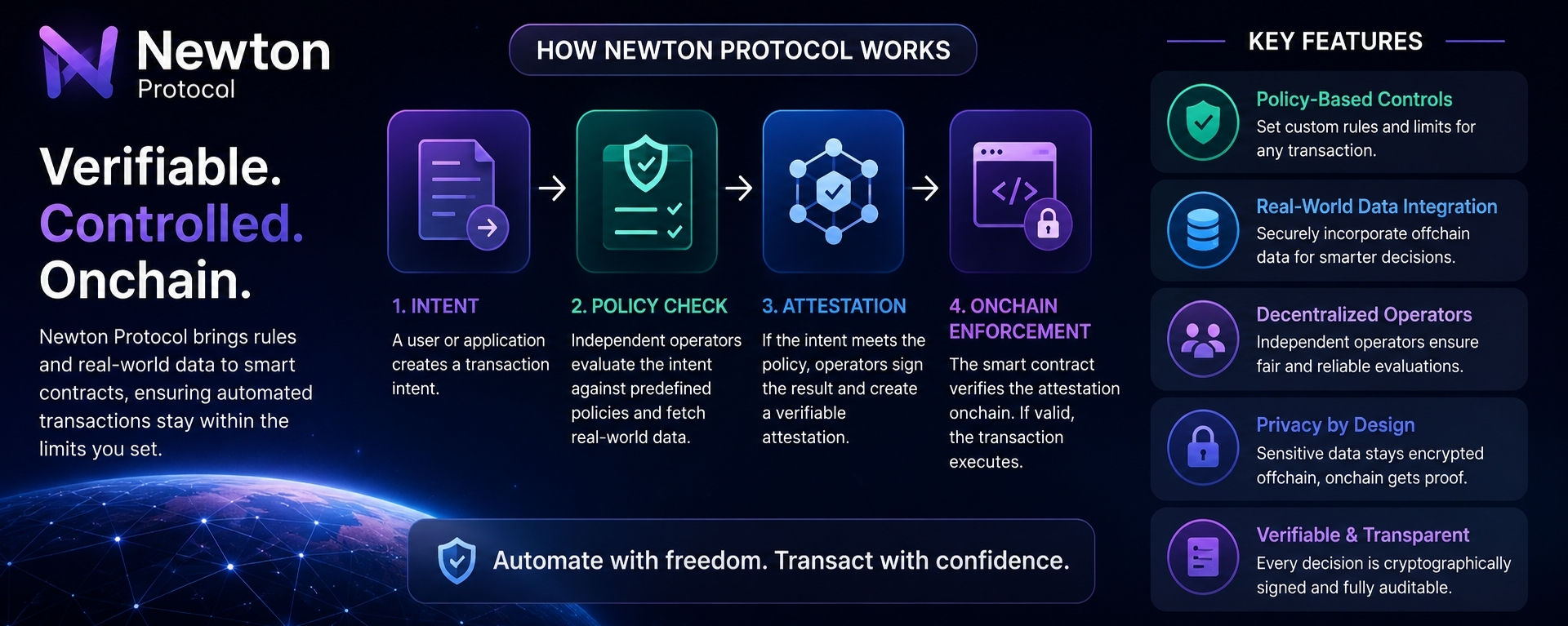

When I first came across Newton Protocol, I thought it was mainly about automated wallets and financial agents. That was the early impression I had.
After spending more time reading about the project, I saw it differently.
Newton is really about control.
It allows software to carry out financial actions, but only within rules set by a user, business, wallet, or application. Instead of giving an automated system complete access to funds, Newton creates limits around what it can do.
That idea sounds simple. In practice, it solves a serious problem.
Automated software can move money quickly. It can also make mistakes quickly. A wrong instruction, a faulty data source, or a compromised system could lead to funds being sent somewhere they were never meant to go.
Newton tries to stop that before it happens.
I see it as an approval layer placed between a requested transaction and its final execution. Before a protected action goes through, the system checks whether it follows the policy connected to it.
A policy can set a spending limit.
It can block unknown contracts.
It can allow only selected platforms.
It can also require outside checks, such as identity verification, wallet risk data, or market conditions.
This means an automated wallet does not need unlimited freedom. It can still work, but only inside clearly defined boundaries.
For example, a treasury system could be allowed to make regular payments while staying under a daily limit. A portfolio tool could rebalance funds but only through approved protocols. A vault manager could move capital between selected markets but be blocked from placing too much money into one position.
The software can propose the action.
Newton decides whether the action fits the rules.
That is the part I find most useful.
The transaction process involves several technical components, but the basic flow is easy to follow.
First, a user or application creates an intent. This describes what it wants to do, including the amount, destination, contract, and function involved.
Newton then finds the policy linked to that action.
Independent operators review the request. They compare the transaction with the policy and collect any outside information needed for the decision.
If the action follows the rules, the operators sign the result.
Their signatures are combined into one proof, known as an attestation. The receiving smart contract checks this proof before allowing the transaction to continue.
If the proof is valid, the action can happen.
If not, it is rejected.
I like that the final restriction is enforced by the contract itself. It is not only a warning shown on a website.
Warnings can be ignored.
Contract rules are much harder to avoid.
The policy system is the centre of Newton. A policy is simply a list of conditions used to decide whether a transaction should be approved.
Some policies may be basic. A personal wallet might only need a daily spending cap.
Others could be much more detailed.
A business might require identity checks for large transfers. A vault could limit exposure to one market. A payment application could block restricted regions or suspicious addresses.
Newton uses a policy language called Rego. I did not need to study every technical detail to understand why this matters.
The rules can be managed separately from the main smart contract.
That gives developers more flexibility. Risk limits can change. Approved addresses can be added or removed. Regional requirements can be updated without rebuilding the entire application.
Still, flexibility creates another question.
Who controls the policy?
If someone can update the rules, users need to know who that person or group is. They should also be able to see how changes are approved and when they take effect.
A policy can protect users.
It can also create centralised control if one party has too much authority.
Newton will need to keep this part transparent.
Another important area is outside data.
Blockchains can see balances, transactions, and contract activity. They cannot naturally know a person’s identity, location, age, risk status, or legal eligibility.
They also cannot directly see market conditions, sanctions lists, treasury yields, or offchain financial records.
Newton uses data providers and policy oracles to bring this information into the approval process.
This opens many possible uses.
A platform could require identity verification before a large transaction. A company could stop payments to addresses linked with suspicious activity. A vault could reject an action when market risk moves above an accepted level.
The idea is useful.
The weakness is also clear.
Newton can prove that a policy used certain data, but it cannot always prove that the original data was correct.
If the source is outdated or wrong, the final decision may also be wrong. The cryptographic proof only confirms that the process was followed with the available input.
It does not turn bad information into good information.
That means Newton depends heavily on the quality of its data providers. It also matters whether operators use different sources or all rely on the same one.
Agreement does not always mean accuracy.
The operators also need a way to handle small differences in data.
For example, several operators may request an asset price at slightly different moments. Their answers may not match exactly.
Newton can compare the results and use a shared value, such as the median. Operators then evaluate the policy using the same agreed information.
This is a practical solution.
It accepts that real-world data is not always perfectly consistent.
Even then, the system can still fail if most operators depend on the same weak provider or shared infrastructure. That is why operator diversity matters just as much as operator numbers.
Privacy is another major challenge.
Newton wants to support identity and compliance checks, but public blockchains are not suitable places for storing private information.
A user should not have to publish identity documents or financial details just to prove that a condition has been met.
Newton’s design tries to keep sensitive data encrypted and offchain.
The information can be protected before reaching the operator network. Access to it can be divided between multiple operators, so one participant should not control everything alone.
The blockchain only needs the final proof.
It does not need the full personal record behind it.
This could allow someone to prove eligibility without exposing their complete identity. A business could confirm that a customer passed verification without placing private documents onchain.
I think this is necessary for serious adoption.
At the same time, some privacy features have still been described as under development. Newton has a clear direction, but not every part of that direction is fully complete.
One of its clearest current uses is connected with onchain vaults.
Vaults collect user funds and follow a strategy. A manager may place those funds into lending markets, liquidity pools, or other positions.
Users usually have to trust the manager to follow the stated plan.
That trust can be weak.
A manager may promise to avoid risky platforms or limit exposure, but those promises may remain only written guidelines.
Newton’s VaultKit is designed to turn some of those promises into enforceable rules.
A vault could allow only approved markets. It could limit how much money goes into one protocol. It could block transactions when risk conditions become too high.
This seems like a sensible use of Newton.
Vault managers need enough freedom to react to markets, but users also need protection from decisions that go outside the agreed strategy.
Newton can create a middle ground.
The difficult part is writing policies that work during real market stress. A rule that is too loose may fail to protect users. A rule that is too strict may prevent a manager from acting when quick action is needed.
Good policy design will matter a lot.
Newton was also strongly connected with autonomous agents in its earlier direction.
That idea is still relevant.
An agent may suggest or start a transaction, while Newton checks whether the action stays within the owner’s limits.
An agent could search for better yields but use only approved platforms. It could handle payments while remaining under a daily cap. It could rebalance a portfolio but avoid unknown tokens and unaudited contracts.
This feels safer than giving software full wallet access.
The agent remains useful.
It just does not become all-powerful.
Another thing I liked is that Newton does not always need to understand how the agent reached its decision. It can focus on the final action.
Where is the money going?
How much is being moved?
Which contract is involved?
Does the action follow the policy?
The internal process may be complex. The transaction itself can still be checked against clear rules.
Newton also creates records showing how an action was approved.
These records can help users, developers, auditors, and institutions. A vault depositor could confirm that a manager stayed within limits. A company could show that a payment passed its internal controls. A developer could investigate why a transaction failed.
That adds accountability.
But a valid record does not mean the policy was good.
A poorly designed rule can still produce a valid proof.
This is why policy transparency matters. People need to know who wrote the rules, who can change them, and what data they depend on.
Newton relies on operators to evaluate policies and sign results. The goal is to avoid depending on one company or server.
The system uses cryptographic signatures and economic incentives.
That sounds strong in theory.
The real test will be how decentralised the operator network becomes in practice.
It is not enough to count operators. I would also look at how much influence each one has, whether they use separate infrastructure, and whether they depend on the same cloud services or data providers.
A network can look decentralised while sharing the same hidden weaknesses.
NEWT is the native token of the protocol.
Its total supply is fixed at one billion tokens. The published allocation includes community categories, ecosystem development, treasury funds, contributors, early supporters, and Magic Labs.
The token is expected to support staking, fees, governance, and parts of the wider Newton network.
Staking may help secure the protocol by giving participants something to lose if they behave dishonestly.
Still, I noticed that some early token utility was explained when Newton was presented more heavily as an agent network.
The current focus is more about transaction authorization, policies, vaults, and compliance controls.
Because of this shift, I think Newton needs to keep explaining how NEWT fits into the project as it exists now.
A token should connect clearly with real usage.
The supply schedule also matters. A large part of the token supply will enter circulation over time. Even when the schedule is public, future unlocks can affect the market.
I would not judge Newton by token price alone.
I would look at active operators, real policy checks, integrated applications, protected capital, developer activity, and fees created by genuine use.
The strongest part of Newton is its focus on prevention.
Many systems explain what happened after a bad transaction.
Newton tries to stop the transaction first.
I also like the flexibility of its policy model. Different users and organisations can create different limits instead of following one fixed system.
The project could be useful for payments, vaults, treasuries, stablecoins, automated wallets, and identity-based transactions.
Its biggest challenge is adoption.
Newton adds another step to the transaction process. Developers must integrate contracts, create policies, connect data providers, and depend on operator responses.
That extra work must be worth it.
Speed may also become a problem. A direct transaction can be faster than one that requires external data, operator agreement, signature collection, and proof verification.
For a large institutional transfer, the delay may be acceptable.
For fast trading, it may not be.
Reliability is another concern.
If operators cannot agree, a data source fails, or a policy behaves unexpectedly, the transaction may stop. That may protect users, but repeated failures could also make the system difficult to use.
Policy design could become a security field of its own.
A policy may be technically correct and still cause financial harm. It could use the wrong limit, depend on weak data, or react badly during unusual market conditions.
I would not be surprised to see policy audits become important if Newton grows.
After researching the project, I came away with a simple view.
Newton is not mainly about automation.
It is about controlled automation.
People may want software to manage funds, make payments, and interact with financial platforms. That does not mean they want to give up all control.
Newton gives them a way to set boundaries.
A transaction is proposed. A policy checks it. Operators review the needed information. A proof is created. The smart contract verifies it.
Only then can the action continue.
The idea makes sense to me.
The problem is real.
As financial activity becomes more automated, users will need better ways to limit what software can do. They will also need evidence that those limits were respected.
Newton still has work ahead. It must prove that the network can remain private, reliable, decentralised, and useful under real conditions.
It also needs real applications and real users.
Even with those open questions, I think Newton is working on an important part of blockchain infrastructure.
It is not trying to give financial software unlimited independence.
It is trying to make that independence safer, clearer, and easier to verify.
