
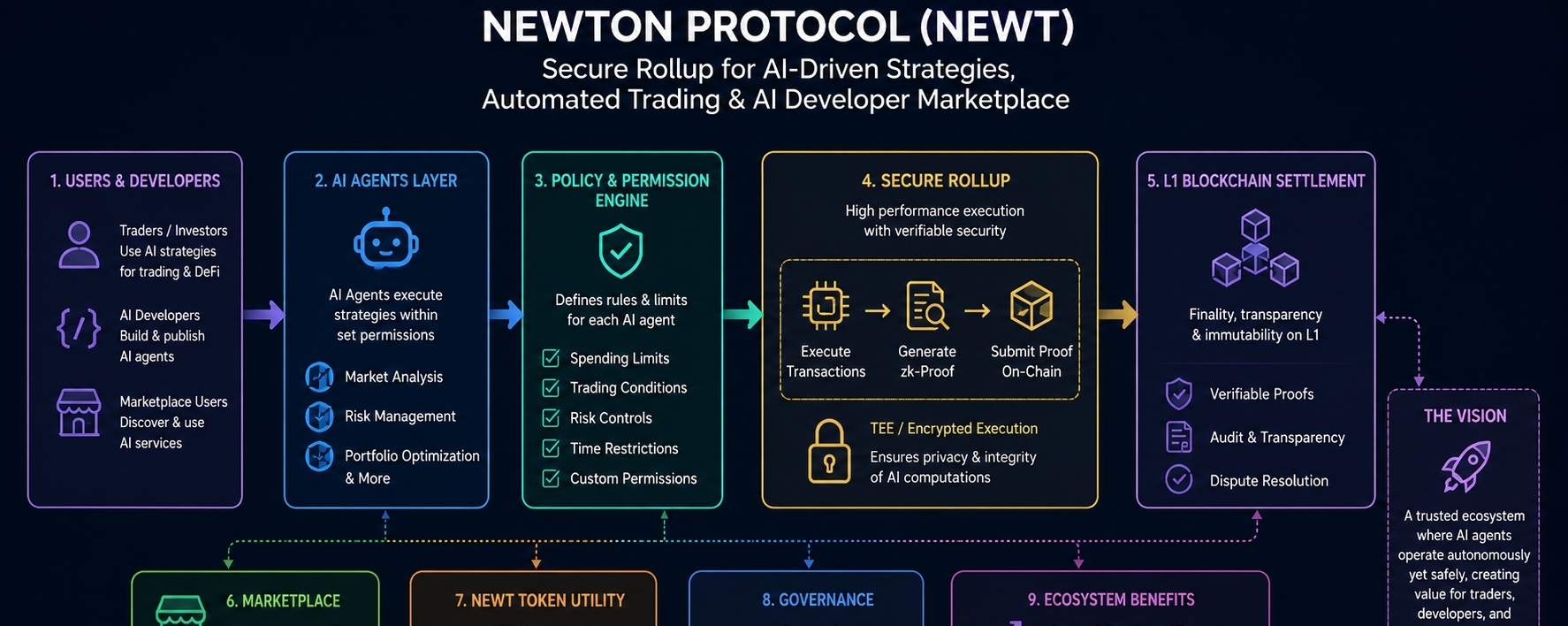
The world of blockchain has changed dramatically over the last few years. At first, the main focus was simply creating digital money that people could send without relying on banks or other centralized institutions. As time passed, developers introduced smart contracts, decentralized finance, NFTs, decentralized applications, and many other innovations that pushed blockchain far beyond its original purpose. At the same time, artificial intelligence experienced an incredible rise. AI is no longer something people only read about in research papers. It now writes content, analyzes data, generates software, assists businesses, automates daily tasks, and helps individuals make faster decisions than ever before. While both industries have grown at an impressive speed, combining them safely has remained one of the biggest challenges. This is where Newton Protocol enters the conversation with a vision that feels both practical and ambitious. Instead of asking people to choose between automation and security, the project attempts to build an infrastructure where intelligent software can operate on blockchain networks while remaining transparent, verifiable, and accountable.
One of the biggest concerns surrounding AI is trust. An AI agent can make thousands of decisions within minutes, but how does anyone know those decisions follow the rules they were originally given? In traditional systems, users often have no visibility into what happens behind the scenes. They are expected to trust the company operating the software. Blockchain changed that expectation by introducing transparency, yet AI introduces a new layer of complexity because intelligent systems constantly adapt, learn, and make independent choices. Newton Protocol recognizes that intelligence alone is not enough. A future where AI manages digital assets, executes automated strategies, or interacts with decentralized finance requires strong safeguards. Every action needs clear authorization, secure execution, and reliable verification. Without those foundations, automation can quickly become a source of uncertainty instead of efficiency.
The project is designed around the belief that AI should become a trusted participant within blockchain ecosystems rather than an unpredictable actor. Instead of giving autonomous software unlimited authority, Newton Protocol focuses on programmable permissions. Every AI agent operates according to policies that define exactly what it is allowed to do. These permissions can include spending limits, trading conditions, risk controls, execution boundaries, timing restrictions, and many other customizable rules. This approach creates a balance between automation and human oversight. Users remain in control while intelligent systems perform repetitive or data-intensive work on their behalf.
Automated trading represents one of the most obvious applications for this technology. Cryptocurrency markets operate twenty-four hours a day without interruption. Human traders cannot realistically monitor every opportunity across multiple chains and decentralized exchanges. AI systems, however, can analyze market movements continuously and respond much faster than manual traders. Yet speed alone does not guarantee safety. If an AI strategy behaves unexpectedly or receives incorrect instructions, significant losses could happen within seconds. Newton Protocol aims to reduce these risks by ensuring every automated action follows predefined authorization policies before execution. Rather than allowing unlimited freedom, the protocol creates a structured environment where automation remains accountable.
The project's secure rollup architecture plays an important role in achieving this vision. Rollups are designed to process transactions efficiently while relying on the security of an underlying blockchain. By handling execution separately and submitting verified results back to the main network, rollups improve scalability without sacrificing core security principles. Newton Protocol adapts this concept for AI-driven activity, creating an environment where intelligent agents can execute complex operations while maintaining verifiable records of what happened. Instead of asking users to blindly trust an automated system, the protocol seeks to provide evidence that every action complied with established policies.
Another interesting aspect of Newton Protocol is its focus on verifiable execution. One of the biggest questions surrounding AI is whether people can independently confirm that a model actually behaved according to expectations. In many traditional AI services, users simply receive an output without knowing how it was produced. Newton Protocol explores ways to make execution more transparent by combining blockchain records with cryptographic verification techniques. While the technical details behind these systems can become highly complex, the overall objective remains simple. Trust should come from evidence rather than assumptions. Users deserve confidence that automated systems are operating exactly as intended.
Beyond automated trading, the protocol envisions a much broader ecosystem where AI developers can build, publish, and distribute intelligent applications. Many talented developers create specialized AI models capable of solving unique problems, but reaching users often requires centralized platforms that control access, pricing, and distribution. Newton Protocol attempts to introduce a decentralized marketplace where developers can offer AI-powered services while users gain access through blockchain infrastructure. This creates opportunities for innovation without requiring every interaction to pass through a single company acting as an intermediary.
For developers, this marketplace could become more than a simple distribution channel. It represents an opportunity to create reusable AI services that other applications can integrate into their own workflows. One developer might specialize in market analysis, another in portfolio optimization, another in risk management, while someone else builds fraud detection tools. Instead of recreating similar systems repeatedly, developers could contribute specialized capabilities that become available throughout the ecosystem. Such collaboration has the potential to accelerate innovation while rewarding expertise directly.
Security remains one of the strongest themes throughout Newton Protocol's design philosophy. Every year the blockchain industry experiences attacks involving compromised wallets, malicious smart contracts, phishing attempts, stolen private keys, and software vulnerabilities. Introducing AI into this environment creates additional risks because automated systems can execute transactions at extraordinary speed. If an attacker gains unauthorized control over an AI agent, the consequences could become severe. Newton Protocol attempts to reduce these dangers by combining cryptographic security, policy enforcement, and transparent execution. While no technology can completely eliminate risk, building multiple protective layers can significantly improve resilience.
The NEWT token serves as an important part of the ecosystem by supporting participation, incentives, governance, and various protocol functions. Rather than existing solely for speculation, utility tokens generally become stronger when they encourage meaningful activity inside a network. As developers create applications, users interact with services, validators secure infrastructure, and governance participants contribute to protocol evolution, the token becomes connected to real ecosystem activity instead of existing independently from it. Long-term value often depends less on temporary excitement and more on whether people continue finding reasons to use the underlying network.
Community participation also matters because decentralized ecosystems rarely succeed through technology alone. Developers build infrastructure, validators secure networks, researchers discover improvements, creators educate newcomers, and everyday users provide valuable feedback based on practical experience. Healthy communities encourage discussion, experimentation, and continuous learning instead of treating every question as criticism. Projects that remain open to constructive feedback often adapt more effectively as technology evolves and user expectations change.
Of course, Newton Protocol also faces meaningful challenges. AI remains one of the fastest-changing fields in technology, with new models, frameworks, and capabilities appearing almost every month. Blockchain itself continues evolving through new scalability solutions, interoperability improvements, and security innovations. Building infrastructure that remains relevant within such a rapidly changing environment requires constant development. The protocol must balance innovation with stability, ensuring new features do not compromise reliability or user trust. Competition is another reality. Numerous projects are exploring the intersection of blockchain and artificial intelligence, meaning success will depend not only on ambitious ideas but also on consistent execution and real adoption.
One encouraging aspect of Newton Protocol is that it focuses on infrastructure instead of short-term hype. Throughout blockchain history, many projects attracted attention through marketing campaigns before demonstrating meaningful utility. Sustainable ecosystems usually emerge differently. They grow because developers continue building, users discover practical value, communities remain engaged, and technology solves genuine problems. Infrastructure projects rarely generate the same excitement as consumer applications, yet they often become the invisible foundation supporting entire ecosystems over time.
Looking ahead, the relationship between AI and blockchain will likely become much deeper than it is today. Intelligent software may eventually manage digital identities, coordinate decentralized organizations, optimize financial strategies, monitor security risks, automate business operations, and assist users across countless blockchain applications. As these responsibilities increase, trust will become just as important as intelligence. People will naturally ask not only whether an AI system is smart enough to perform a task but also whether its decisions can be verified, controlled, and audited. Newton Protocol positions itself around this important question by attempting to create an environment where automation remains transparent rather than mysterious.
No one can predict exactly how quickly this vision will become reality. Technology rarely develops in perfectly straight lines, and even promising ideas often require years of refinement before reaching widespread adoption. Still, the problems Newton Protocol is trying to address are genuine. As AI becomes increasingly involved in financial systems and decentralized applications, reliable authorization, secure execution, and verifiable decision-making will likely become essential rather than optional. Whether Newton Protocol ultimately becomes one of the leading solutions will depend on continued development, real-world adoption, community support, and its ability to deliver on ambitious technical goals. Even so, its broader message is already meaningful. The future of blockchain may not simply belong to the smartest AI systems, but to the ones people can trust with confidence.