
A friend of mine got a trade alert last week and just stood there, staring at his phone. He'd been in a meeting. Whatever the alert was telling him had already happened by the time he looked down, and he wasn't panicked exactly, just doing that quiet arithmetic people do when they realize something significant occurred while they were busy looking at something else entirely.
Newton is building toward a rollup meant to host AI-driven trading strategies, run automated execution, and give developers an actual marketplace to build and sell those strategies on. Every action that happens through it is supposed to leave behind something like a receipt, a verifiable record proving that whatever executed did so under the conditions it claimed to. That's the pitch, in short: infrastructure for automation that doesn't just ask you to trust it after the fact.
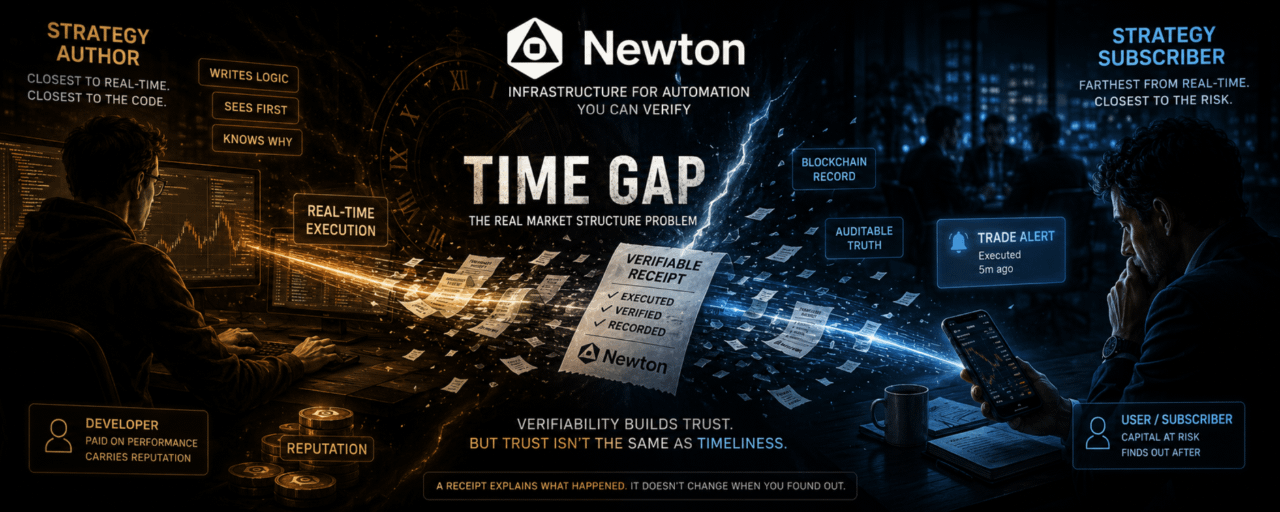
Here's the part that's easy to skip past, though. A marketplace for AI strategies creates two very different relationships with time. The developer who builds a strategy knows, in the most literal sense, when and why it will act, because they wrote the logic that decides it. The person who subscribes to run that strategy with their own capital doesn't get that. They get a notification after the fact, the same as everyone else, no matter how sophisticated the system underneath happens to be. That gap between authorship and use isn't really an oversight in the design. It's just what the design is.
It's worth sitting with what that arrangement actually rewards, too. A developer selling a strategy on a marketplace gets paid on performance and adoption, not on how quickly a subscriber finds out what their own capital just did. The capital at risk belongs to the person running it. What the developer carries is closer to reputation than money. That's not necessarily a flaw, but it does mean the party furthest from the risk is the one closest to real time, and the party closest to the risk is the one left waiting on a push notification, same as my friend.
Which is really a market structure problem wearing a UX costume. Whoever sits nearer the execution layer, the strategy's own code, the operators processing the request, experiences something close to real time. Everyone else experiences a reconstruction of it, delivered a little late. Being early to information has always been worth more than eventually being right about it, and no amount of thoughtful product design changes who gets to be early. It just changes how comfortable people feel about not being early anymore.
So a verifiable receipt, I think, solves a specific problem, not the one my friend was standing there feeling. It makes the after the fact account trustworthy. It doesn't make it earlier. Those are two different problems wearing the same outfit, and it's dangerously easy to fix one while quietly assuming you've fixed the other too.
Ironically, there's a version of this that gets worse, not better, once the receipts are good enough to trust completely. If the record is reliable, the pressure to close the actual timing gap tends to fade, because a trustworthy explanation after the fact starts to feel like an acceptable substitute for having been present at all. No one really sets out to build that outcome. It just tends to happen once verification stops being the hard part of the problem and starts getting treated as the whole problem.
None of which means the verifiability doesn't matter, because it genuinely does. Most automated systems people actually live with, the thermostat that ran for six hours while you were out, the trading bot quietly logging its own decisions, rely on records that can be edited, lost, or never checked against anything external at all. A receipt you can audit close to when something happened, on infrastructure that isn't quietly rewriting its own history later, is a real improvement over a black box you're simply told to trust. That's the harder problem to actually solve. It's just not the one that had my friend still staring at his phone.
So maybe the more honest question isn't whether a rollup can close the gap between an action and your awareness of it, because it probably can't, not fully, not yet. It's whether you'd even recognize what actually closing that gap would look like if someone built it, or whether you've just gotten comfortable finding out afterward and calling that being part of the loop.